ITI to Qatar: Fast-Track Gulf Careers for Skilled Workers

If you have been following the recent viral discussions under the #ITIPathshala and #SkilledWorkerIndia hashtags, you are likely intimately familiar with the growing frustration among vocational graduates. Thousands of highly skilled plumbers, industrial electricians, welders, and heavy mechanics from India and Pakistan are watching their prime earning years slip away while waiting on seemingly endless visa backlogs for the United States, Canada, and the United Kingdom. The traditional "Western Dream" for blue-collar professionals has become a bureaucratic nightmare of exorbitant agency fees, multi-year processing delays, and heartbreaking rejections.
But while social media focuses on the broken immigration systems of the West, a massive, highly lucrative, and significantly faster migration corridor is operating right next door. The Gulf Cooperation Council (GCC) countries, specifically Qatar, are aggressively hiring certified Industrial Training Institute (ITI) graduates. For skilled trade workers who want to start earning tax-free income immediately, build international expertise, and secure their family's financial future without waiting half a decade, Qatar has emerged as the premier global destination.
In this comprehensive guide, we will break down exactly why Qatar is the ultimate launchpad for skilled trade careers, how the recruitment and trade test pipeline actually works, and how you can leverage your ITI or vocational diploma to land high-paying roles in the Middle East's booming industrial and energy sectors.
The #ITIPathshala Debate: Escaping the Western Visa Trap
The core of the recent #ITIPathshala debate on Reddit and X (formerly Twitter) revolves around the staggering opportunity cost of chasing Western visas. Today, an Indian or Pakistani tradesperson attempting to secure an EB-3 or H-2B visa for the United States can expect a waiting period stretching anywhere from three to seven years. Worse, unregulated "consultants" often demand upfront fees ranging from $10,000 to $20,000 (roughly 8 to 16 Lakhs INR) just to initiate the paperwork—a sum that forces many families into crippling, high-interest debt.
Contrast this harsh reality with the Middle Eastern migration framework. The Gulf job market for blue-collar and skilled trade workers is heavily regulated, incredibly fast, and driven by direct employer demand. When a Qatari construction firm or facility management conglomerate wins a government contract, they need workers on the ground in weeks, not years. The recruitment timeline from the day you pass your technical trade test in Mumbai, Delhi, or Islamabad to the day you board a flight to Doha is typically less than 45 days.
More importantly, the financial risk is practically eliminated when dealing with reputable GCC employers. Under strict regional labor laws, large Qatari and UAE corporations operate on a "free recruitment" model. The employer covers the cost of the work visa, the flight ticket, and the medical screening. Instead of going into debt to buy a visa, an ITI graduate can step off the plane in Doha and immediately begin remitting a pure, zero-tax salary back home.

Why Qatar is the Ultimate Launchpad for Skilled Trade Workers
Many job seekers mistakenly believe that since the 2022 FIFA World Cup has concluded, the Qatari job market has dried up. This is a fundamental misunderstanding of the region's economic cycle. While the era of hyper-speed stadium construction has ended, Qatar has aggressively pivoted into two massive, long-term employment sectors that heavily rely on ITI-certified workers: mega-infrastructure maintenance and global energy expansion.
The Post-World Cup Facility Management Boom
Qatar built billions of dollars worth of cutting-edge infrastructure over the last decade, including the Doha Metro, expansive new hospital networks, luxury hospitality districts like Msheireb Downtown, and smart cities like Lusail. All of these advanced structures require permanent, 24/7 maintenance. Facilities Management (FM) companies are currently the largest employers of skilled tradespeople in the country.
If you hold an ITI diploma in HVAC (Heating, Ventilation, and Air Conditioning), you are entering a market where air conditioning is a critical survival utility, not a luxury. HVAC technicians, Building Management System (BMS) operators, and electrical technicians are in perpetual demand to keep these mega-structures operational.
The North Field LNG Expansion
Beyond civil infrastructure, Qatar is executing the North Field Expansion (NFE) project, the largest liquified natural gas (LNG) development in global history. This multi-billion-dollar initiative is designed to increase Qatar’s LNG production capacity by over 60% by 2027. The energy sector does not hire general laborers for these projects; they require highly specialized, certified technicians.
The NFE project and its associated downstream facilities have created a massive recruitment drive for specific ITI and vocational trades, including:
- TIG and MIG Welders (specifically 6G Pipe Welders)
- Industrial Electricians and Instrumentation Technicians
- Diesel Mechanics and Heavy Earth-Moving Machinery (HEMM) Operators
- Scaffolding Inspectors and Industrial Riggers
- Millwright Fitters and CNC Machinists
Earnings, Allowances, and the GCC Financial Reality

“I kept getting rejections from London. Base Career rewrote my CV for Dubai, and I landed Emirates in 3 weeks.”
Sarah M. · Marketing Manager · UK 🇬🇧 → Dubai 🇦🇪
No credit card required
When evaluating a move to the Gulf, evaluating the base salary in isolation is a rookie mistake. The true financial power of a GCC contract lies in the cumulative value of the allowances, overtime pay, and the zero-tax environment. For an ITI graduate heading to Qatar, the compensation package is designed to ensure that almost 100% of your base pay can be saved or sent home to your family.
An entry-level ITI electrician or mechanic in Qatar typically secures a base salary between 1,200 and 1,800 Qatari Riyals (QAR) per month. However, under Qatari labor law and standard corporate practice, the employer is obligated to provide high-quality shared accommodation, free daily transportation to the work site, and either fully catered meals or a fixed monthly food allowance (usually 300 to 500 QAR). Furthermore, the industrial sector operates on strict deadlines, meaning overtime is abundant. A skilled worker willing to put in consistent overtime can easily increase their monthly take-home pay by 40% to 60%.
Qatar vs. UAE: Comparing the Compensation
Many candidates weigh Qatar against the UAE when deciding where to begin their Gulf careers. While Dubai and Abu Dhabi offer incredible opportunities, the cost of living dynamics differ. In Qatar, the heavy reliance on massive corporate labor accommodations means your living expenses are essentially zeroed out by the employer. In contrast, if you are looking at the Emirates, you can explore our UAE blue-collar salary guide for skilled trades to see how complex allowance structures and site benefits impact your final earnings.
Additionally, the visa entry strategy varies. Qatar primarily relies on block visas issued directly to corporations in your home country. You are recruited, tested, and processed before you ever leave India or Pakistan. The UAE, conversely, sees many candidates entering on tourist visas to hunt for immediate openings. If you are considering that route eventually, you must thoroughly understand the rules surrounding visit visa or cancellation candidates entering the UAE to avoid expensive overstay fines and predatory recruitment traps.
The true financial power of a Gulf skilled trade contract isn't just the base salary—it's the zero-tax environment paired with employer-provided housing, food, and transport that allows ITI graduates to remit nearly 100% of their earnings back home.
Upskilling: How Technical Licenses Multiply Your Income
Entering Qatar with an ITI diploma is just the first rung on a highly lucrative career ladder. The Gulf market heavily rewards professionals who continuously upgrade their certifications to meet international industrial standards. Once you are established in the region, your goal should be to transition from a frontline technician to a supervisory or specialized role.
For example, an ITI-certified industrial electrician who invests in regional electrical inspectorate approvals or advanced programmable logic controller (PLC) training can transition into an Electrical Foreman or Automation Technician role, easily doubling their initial salary. Similarly, professionals who acquire a NEBOSH International General Certificate (IGC) or an OSHA 30-hour certification can pivot entirely out of manual labor and into highly respected Health, Safety, and Environment (HSE) Officer positions.
This phenomenon of certifications driving massive salary leaps is universal across the GCC. Just as healthcare workers and aviation engineers pursue the most profitable technical licenses in the UAE to jump pay brackets, blue-collar tradespeople must view their ITI diploma as a foundation, not the finish line. Earning manufacturer-specific certifications from brands like Caterpillar, Cummins, or Schneider Electric while working in Qatar makes you an irreplaceable asset to your company.
The Qatar Recruitment Pipeline: Trade Tests and GAMCA Medicals
The process of securing a skilled trade job in Qatar is highly structured. Unlike white-collar roles where interviews are heavily reliant on soft skills and corporate presentation, the blue-collar recruitment pipeline is purely meritocratic and skill-based. It is anchored by the "Client Interview" and the "Trade Test."
How to Master the Gulf Trade Test
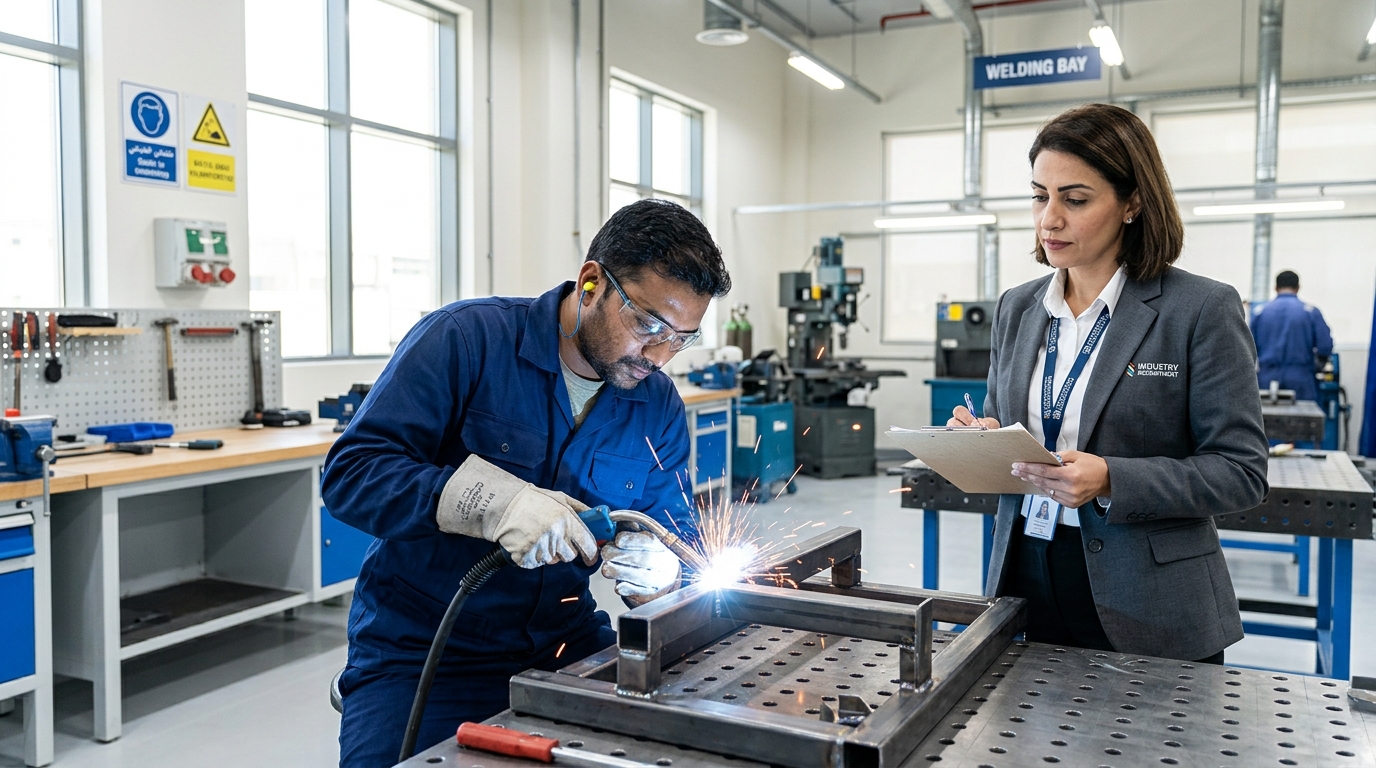
When a Qatari company needs 50 electricians and 30 mechanics, they send a technical delegation to major recruitment hubs like Mumbai, Kochi, Sikar, Islamabad, or Lahore. Candidates are gathered at specialized trade testing centers where they must prove their skills in real-time under the supervision of the Qatari engineers.
These tests are rigorous and practical. An electrician will not just answer multiple-choice questions; they will be handed a schematic and asked to wire a 3-phase motor starter panel (such as a Direct-On-Line or Star-Delta starter) within 45 minutes while strictly adhering to safety protocols. A diesel mechanic will be asked to physically diagnose a fault on a live engine block, calibrate a fuel injector, or properly utilize precision measuring tools like micrometers and dial gauges.
If you pass the trade test and are selected, the next mandatory step is the GAMCA (Gulf Approved Medical Centers Association) medical examination. This is a highly stringent physical and pathological screening process that checks for infectious diseases, severe chronic conditions, and general physical fitness. Only after clearing the GAMCA medical can your employer initiate the actual visa stamping process.
Navigating Cross-Border Mobility in the Middle East
One of the greatest advantages of securing your first Gulf job in Qatar is the regional mobility it unlocks. Having two to three years of documented, high-quality GCC experience drastically changes how recruiters view your resume. You are no longer an untested fresh graduate; you are a proven professional familiar with Middle Eastern industrial standards, extreme weather working conditions, and multinational team dynamics.
Many workers eventually look to leverage their Qatari experience into higher-paying supervisory roles in Saudi Arabia's NEOM project or the UAE's advanced manufacturing sector. However, transitioning across borders requires strategic networking and understanding regional biases. If your long-term goal is to transition into the Emirates, you must proactively learn the nuances of applying to Dubai from Oman and Qatar, as many UAE recruiters heavily favor candidates who are locally available for immediate interviews.
Avoiding Recruitment Scams and Contract Fraud
Finally, as you embark on this journey, vigilance is your best defense against exploitation. The desperation created by Western visa backlogs has spawned a cottage industry of fraudulent agents preying on ITI graduates. A genuine Qatari recruitment drive will never ask you for massive "security deposits" or "visa processing fees" upfront. Legitimate hiring is conducted through government-approved channels—such as the eMigrate portal in India or the Bureau of Emigration and Overseas Employment in Pakistan.
Always verify the agency's license number, ensure that the trade test center is a recognized facility, and never hand over your original passport to an unregistered sub-agent. By staying informed, utilizing official channels, and continuously honing the skills you acquired during your ITI training, you can bypass the grueling Western visa queues and build a highly successful, financially secure career in the Gulf.
Frequently Asked Questions
Is an ITI certificate legally valid for a work visa in Qatar?+
What is the average salary for an ITI electrician or mechanic in Qatar?+
How long does it take to get a Qatar work visa from India or Pakistan?+
Do I need to pay a high agency fee for a genuine Qatar job?+
Conclusion: Your Fast Track to Financial Freedom
The viral #ITIPathshala movement has shined a necessary spotlight on the immense value of skilled vocational labor. While waiting years for an elusive Western visa might seem like the ultimate goal, the practical, immediate, and highly lucrative alternative lies in the Gulf. Qatar’s booming energy and infrastructure sectors offer ITI graduates the chance to deploy their skills, earn zero-tax income, and secure their families' futures today—not half a decade from now.
By mastering your trade, acing the practical tests, and continuously upgrading your certifications, you can transform a basic vocational diploma into a prestigious international career. Ready to bypass the queues and take control of your professional journey? Start exploring verified employer demands, optimize your technical resume, and connect with genuine Middle Eastern opportunities by registering at basecareer.co today.
Land 4x more interviews in 27 days. Join Base Career Today.
Track applications, tailor resumes, and follow up faster in one UAE job search system.
Start freeNo credit card required

James T.
Canada 🇨🇦 → Riyadh 🇸🇦
“50 applications, zero replies with my Canadian CV. Base Career got me 4 Riyadh interviews and a Series B offer.”
Written by Base Career Research Team
Produced by the Base Career Research Team with AI, using Base Career job-market data, and published automatically. How our articles are made
Related Posts

Is it Easy to Get a Job in Dubai From Overseas? The Honest Truth
Dreaming of a tax-free salary in Dubai but living abroad? We analyze the challenges of international applications and share a strategic roadmap for success.

Building 'Wasta' from Scratch: Networking Strategies for Dubai Expats
Frustrated by 1,000+ applicants on LinkedIn? Learn how to build 'Wasta'—your professional network—from zero to access the UAE's hidden job market.