Dubai Jobs from Oman or Qatar: Apply Before Moving

You can apply for Dubai jobs while you are still employed in Oman or Qatar. The strongest approach is not to pretend that you are already in the UAE; it is to remove uncertainty. State where you are, when you can interview, what your contractual notice requires and whether you need employer-sponsored UAE work permission. That gives a recruiter a usable hiring timeline without asking you to resign before an offer exists.
This guide combines a fresh aggregate of active UAE postings tracked by Base Career with current official guidance from the UAE, Qatar and Oman. The posting figures describe records in Base Career’s pool, not unique vacancies, hires or the entire labour market. Legal and immigration steps can depend on your contract and circumstances, so use the linked government services for a final check.
What current UAE posting locations show
Base Career tracked 74,493 active UAE posting records scraped in the latest 30-day window. The city field was not usable in 45,610 records. Among the largest named locations, Dubai appeared in 16,410 records and Abu Dhabi in 9,603. The rest of the leading named locations were much smaller: Sharjah 999, Ras Al Khaimah 502, Ajman 215 and Al Ain City 197.
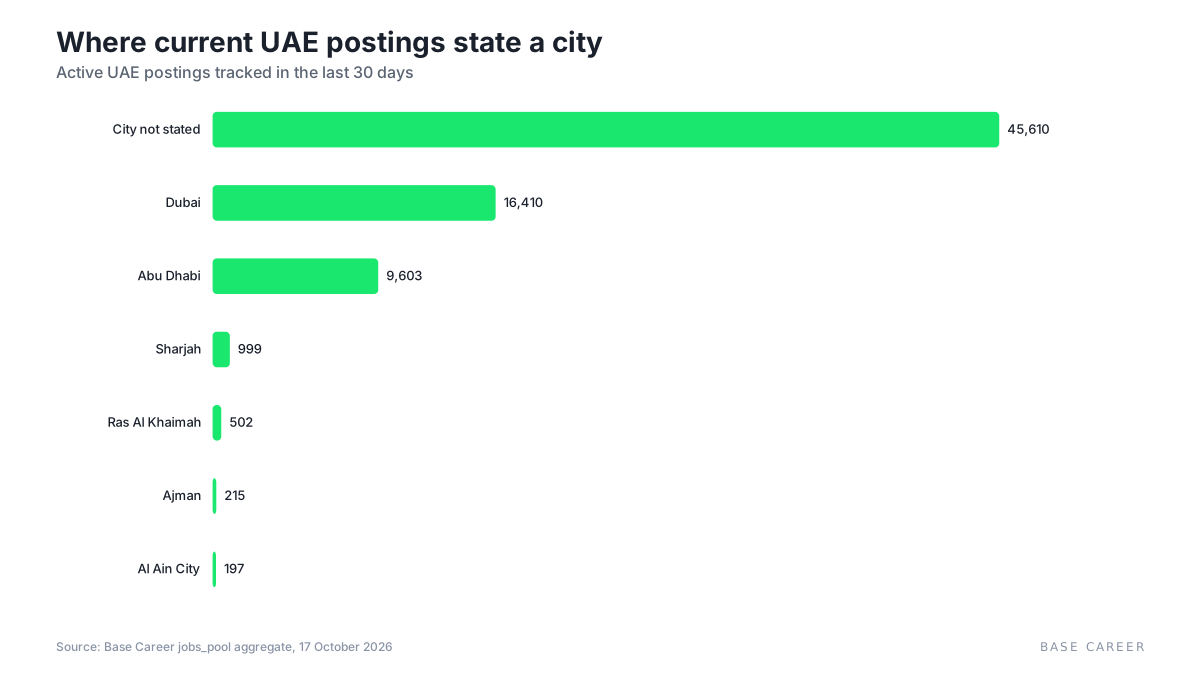
The practical lesson is not that every cross-border candidate should target Dubai alone. It is that a broad UAE alert can contain a large amount of incomplete location data. Open the vacancy, confirm the actual worksite and search separately for Dubai when the city matters. A blank city field is not evidence that an employer will accept remote work, relocation from another Gulf country or an undefined start date.
Your GCC experience can reduce context risk, but your application still needs to answer the operational questions: where are you now, when can you interview, when can you start and who must arrange UAE work permission?
Separate role fit from relocation fit
Recruiters assess professional fit and hiring logistics at the same time. Your CV may match the role while the application leaves basic operational questions unanswered. Make both layers easy to review. The professional layer should show relevant outcomes, systems, sectors and scope. The logistics layer should show current country, target city, interview availability, notice position and sponsorship need.
- Current location: write Muscat, Oman or Doha, Qatar accurately. A city and country are enough; a full home address is unnecessary.
- Target location: state Dubai or UAE relocation explicitly instead of relying on an “open to work” badge.
- Interview access: offer video interviews now and in-person meetings only on dates you can genuinely attend.
- Notice: use the contractual notice or an honest range, then say if an earlier release is being discussed but is not confirmed.
- Work permission: say that UAE employer sponsorship is required unless you already hold a residence status that changes the process. Do not describe yourself as self-sponsored without a valid basis.
Use an honest location line on your CV
Do not borrow a Dubai address, buy a local number merely to look resident or change your profile location in a way that creates a false impression. Those tactics may win an initial screen but create a credibility problem as soon as the recruiter asks for an in-person meeting, visa status or start date. An accurate line is more useful because it lets an employer decide whether the timing fits.
Doha, Qatar — targeting Dubai roles; video interviews available; in-person meetings by prior arrangement; contractual notice confirmed at offer stage; UAE employer-sponsored work permit required.
Adapt that structure to your facts. If you are in Muscat, write Muscat. If you already have permission to visit the UAE, do not present it as permission to work. If your notice can be shortened only with employer agreement, call it negotiable rather than promising an immediate start.
Read “locally available” as a question, not a verdict
The phrase can describe different employer needs. A team may need an urgent start, a face-to-face assessment, someone who already understands the UAE market, or simply a candidate whose relocation plan is credible. You cannot know which interpretation applies from the phrase alone, so respond with concrete availability rather than an argument about regional proximity.
- When the role is urgent: give the earliest start date you can honour. Do not convert an unapproved early release into a promise.
- When an in-person meeting matters: propose a confirmed travel window after the employer has scheduled a meaningful stage.
- When UAE experience is requested: map your Oman or Qatar work to the actual requirement—clients, regulations, languages, procurement, delivery environments or regional stakeholder work—without calling it UAE experience.
- When the advert says UAE residents only: respect the filter. Apply only if the employer provides a route for overseas or regional candidates, or if your lawful status genuinely meets the wording.
Build separate search lanes
A cross-border search works better when vacancies are divided by hiring friction. Keep a lane for employers that clearly recruit from outside the UAE, a lane for roles where regional experience is valuable and interview travel is practical, and a lane for genuinely local-only openings that you monitor rather than forcing. This prevents urgent resident-only roles from consuming the same effort as realistic relocation opportunities.

“I kept getting rejections from London. Base Career rewrote my CV for Dubai, and I landed Emirates in 3 weeks.”
Sarah M. · Marketing Manager · UK 🇬🇧 → Dubai 🇦🇪
No credit card required
- Overseas-capable lane: look for explicit relocation, sponsorship, international hiring or a work-permit route for an overseas recruit.
- Regional-transfer lane: prioritise roles where GCC clients, market knowledge, project delivery or language capability are relevant to the work.
- Local-only lane: treat “must be in the UAE” or “immediate local joiner” as a hard constraint unless the employer confirms otherwise.
Start with current UAE jobs on Base Career, then verify the worksite, employer and original application route. The aggregate behind this guide shows why city filters alone are imperfect, so read the full vacancy rather than assuming the location label is complete.
For channel selection, use the Base Career guide to Dubai job sites. The useful principle is to discover roles where they are visible, but submit through a verified employer or recruitment channel when possible. Keep a record of the original URL, contact and follow-up so a fast-moving search does not become a duplicate or scam-prone search.
Plan notice before you discuss a start date
Your current employment does not disappear when a UAE opportunity appears. Review your contract before applying heavily, and distinguish the contractual notice from a possible waiver. Qatar’s official Ministry of Labour change-employer guide shows that a notice period can be reviewed, amended within the legal limit or waived through the formal process when the relevant parties agree. The Qatar government service page points residents to that Ministry process.
Oman also provides an official resignation-request service, while the current Omani Labour Law and your own contract govern the employment relationship. Do not infer your lawful exit date from a recruiter’s preferred start date. Confirm the contract, required process, final obligations and any employer-approved release before you commit.
- Keep a copy of the current contract and any approved amendments.
- Ask your employer or the relevant ministry channel how an early release would be documented; do not rely on a verbal assumption.
- Tell the UAE recruiter what is confirmed and what is still subject to approval.
- Resign only after you have verified the written UAE offer, work-permit path and conditions that matter to you.
Keep interview access separate from permission to work
The UAE offers a jobseeker visit visa for eligible applicants with validity options of 60, 90 or 120 days, according to the official UAE Government portal. That may support an in-country search for someone who meets the criteria, but it is not a work permit and it is not a requirement for every candidate applying from Oman or Qatar.
The official UAE guidance is clear that a person must not work in the country without a valid work permit. It also states that work on a visit or tourist visa is prohibited, including unpaid work. Attend legitimate interviews, but decline any “trial”, training shift or productive work until the correct permission exists. The UAE Government’s work-permit guide and preparing-to-work guidance are the sources to check.
For an overseas recruit, MoHRE provides an employer service for issuing a new work permit from outside the country. The employer or its authorised representative submits that application. The current service page also requires a passport with at least six months of validity and lists qualification or professional-licence evidence for roles where those documents apply. Confirm the latest requirements against the official MoHRE service before sending sensitive documents.
Verify the offer before you resign or relocate
A fast start is not a reason to lower verification standards. MoHRE’s worker guidance says the employment offer should be received before the work relationship is established, the employment contract should match the signed offer, and the approved offer form carries a serial number that can be checked through official channels. It also says recruitment and hiring costs are borne by the employer. Read the MoHRE Know Your Rights page rather than trusting a screenshot or private message.
- Confirm the employer’s legal name, official domain and the person authorised to issue the offer.
- Compare title, duties, worksite, salary, allowances, probation, notice and start conditions across the offer and contract.
- Use official MoHRE or government channels to verify documents and process claims.
- Do not pay a recruiter or intermediary for a promised job, permit or guaranteed interview.
- Share passport and qualification documents only through a verified process and only when genuinely required.
Make the application easy to screen
Your CV should lead with evidence of fit, not a long relocation explanation. Put the logistics line near the contact details, then use the profile and experience sections for role-specific evidence. Replace vague regional claims with outcomes: accounts handled, systems used, delivery scope, sectors served, languages used in professional work and the scale of responsibility. Keep employer-confidential information out.
- Use the exact role family and core skills from the vacancy where they truthfully match your experience.
- Translate Oman- or Qatar-specific job titles into widely understood functional language without changing seniority.
- Show GCC exposure through relevant projects and stakeholders, not through a generic “Middle East expert” label.
- Add an availability sentence to the cover letter and recruiter message; keep it consistent with the CV.
- Offer interview times in Gulf time and provide a reliable phone or video channel.
Base Career can help you find relevant UAE roles, tailor application documents and keep the search organised. It cannot make a false location, unconfirmed notice date or unsupported visa statement safe. Review every generated document and make sure each claim reflects your real background and current status.
Use a repeatable cross-border workflow
- At the start of the week: refresh narrow role and city searches, remove duplicates and identify employers with a credible overseas or regional hiring path.
- Before each application: verify the employer, worksite and source; tailor the CV to the actual requirements; add the accurate location and availability line.
- After applying: record the source, vacancy, document version and follow-up date. Contact a relevant recruiter or hiring manager only with a short, specific message.
- When invited: confirm whether the stage is video or in person, who will attend, and whether travel is worth the cost before booking.
- At offer stage: verify the written terms and official process before resigning, paying for travel or committing to a start date.
Common mistakes that create avoidable risk
- Claiming a Dubai address or UAE residence that you do not have.
- Using “immediate joiner” when your release has not been approved.
- Treating a tourist or jobseeker visa as permission to work.
- Assuming all GCC employment and visa processes are interchangeable.
- Travelling for an unverified interview or resigning on the strength of a message rather than a validated offer.
- Sending the same generic CV to local-only and overseas-capable roles without changing the logistics line or evidence of fit.
What this evidence cannot tell you
The aggregate posting data can show the volume of tracked records and the quality of location fields. It cannot tell us which employers will sponsor a specific person, which applicant received an interview, whether a vacancy is still open at the moment you read it, or how a recruiter will interpret your circumstances. GSC also withheld the query-to-page detail for this article at the available privacy threshold, so the refresh responds to the page-level opportunity—strong impressions with no recorded clicks—rather than pretending to know a hidden query.
Use the data to design a clearer search, not to predict an outcome. Your role fit, evidence, employer process, current contract and lawful work-permit route remain the deciding factors.
Frequently asked questions
Frequently Asked Questions
Can I apply for Dubai jobs while working in Oman or Qatar?+
Should I change my CV location to Dubai?+
Do I need to resign before applying?+
Do I need a UAE jobseeker visa to apply?+
How should I answer “when can you join?”+
Can I do a trial shift while visiting Dubai?+
Sources and methodology
Base Career aggregate: active jobs_pool records where country = 'UAE' and date_scraped fell in the trailing 30 days; grouped by the normalised city with the raw city as fallback. Query executed 17 October 2026. Only counts were retrieved—no individual jobs, descriptions, users or personal data.
- UAE Government: Work permits — accessed 17 October 2026.
- UAE Government: Preparing to work — accessed 17 October 2026.
- UAE Government: Jobseeker visit visa — accessed 17 October 2026.
- MoHRE: Issuance of a new work permit from overseas — accessed 17 October 2026.
- MoHRE: Dear Worker—Know Your Rights — accessed 17 October 2026.
- Qatar Ministry of Labour: Change-employer guide — accessed 17 October 2026.
- Qatar Government: Change of employer service — accessed 17 October 2026.
- Oman Government: Register resignation requests — accessed 17 October 2026.
- Oman Royal Decree 53/2023 issuing the Labour Law — accessed 17 October 2026.
Ready to organise the search? Browse current UAE opportunities, verify each employer and use Base Career to prepare a role-specific application you can defend in an interview.
Land 4x more interviews in 27 days. Join Base Career Today.
Track applications, tailor resumes, and follow up faster in one UAE job search system.
Start freeNo credit card required

James T.
Canada 🇨🇦 → Riyadh 🇸🇦
“50 applications, zero replies with my Canadian CV. Base Career got me 4 Riyadh interviews and a Series B offer.”
Written by Base Career Research Team
Produced by the Base Career Research Team with AI, using Base Career job-market data, and published automatically. How our articles are made
Related Posts

Is it Easy to Get a Job in Dubai From Overseas? The Honest Truth
Dreaming of a tax-free salary in Dubai but living abroad? We analyze the challenges of international applications and share a strategic roadmap for success.

Building 'Wasta' from Scratch: Networking Strategies for Dubai Expats
Frustrated by 1,000+ applicants on LinkedIn? Learn how to build 'Wasta'—your professional network—from zero to access the UAE's hidden job market.