Why You're Not Getting Callbacks in Dubai (And How AI Fixes It)
.png)
Ankush Wadhwa

You have updated your LinkedIn profile, polished your CV until it shines, and set up daily job alerts for every major company in the Emirates. For the past four to eight weeks, you have been treating your job hunt like a full-time job. You wake up, grab a coffee, and apply to dozens of roles across Dubai, Abu Dhabi, and the wider UAE. Yet, despite your extensive qualifications, your years of experience, and your sheer volume of effort, you are facing the single most common and demoralizing frustration for expats in the region: absolute silence.
If you find yourself constantly asking, "why am I not getting interviews Dubai?", you need to know that you are not alone. Thousands of highly skilled professionals relocate to the UAE every single month, drawn by the promise of tax-free salaries, career acceleration, and a world-class lifestyle. This constant influx creates one of the most hyper-competitive talent markets on the globe. When your job applications are ignored in the UAE, it is incredibly easy to internalize the rejection. You might start to assume that you simply aren't good enough, that your lack of local experience is an insurmountable barrier, or that the market is entirely closed off to newcomers.
But the truth is much more mechanical. The problem usually isn't your underlying experience; it is how that experience is packaged, targeted, and timed. In 2026, the UAE job market operates on speed, precision, and algorithmic filtering. If you are not getting callbacks in Dubai, it is almost certainly a structural issue with your application strategy rather than a reflection of your professional worth. The old methods of mass-applying no longer work, and understanding how long it takes to get hired in Dubai requires a deep dive into modern recruitment mechanics.
In this comprehensive guide, we will break down the exact reasons your applications are going unanswered, what local recruiters actually look for when they open your file, and how AI resume tailoring through platforms like basecareer.co can completely flip your response rate from silence to scheduled interviews.
The Reality of the Dubai Job Market in 2026
To understand why you are not getting callbacks Dubai style, you first have to understand the math behind the hiring desk. Dubai is unique. Unlike regional cities in Europe or North America where companies struggle to find localized talent, Dubai is a global magnet. A single LinkedIn job posting for a mid-level marketing manager, financial analyst, or operations director can attract upwards of 1,500 applicants within the first 48 hours.
Because of this staggering volume, human resources teams and corporate recruiters physically cannot manually read every CV. It is a mathematical impossibility. Instead, they rely heavily on automated systems to reduce the applicant pool to a manageable size. If you are applying to 50 jobs a day and hearing nothing, you are likely part of the 80% of candidates who are filtered out before a human being ever lays eyes on their name. Navigating this landscape requires more than just a good work ethic; it requires a deep understanding of the complete guide to getting a job in Dubai and the systemic barriers in place.
Silence is the default response in the UAE job market simply because companies do not have the bandwidth to send rejection emails to thousands of people a week. This lack of feedback leaves job seekers in the dark, guessing what went wrong and usually making the mistake of just applying to more jobs rather than fixing their core application materials.
The Psychological Toll of the Silent Inbox
Before we dive into the technical diagnostics of your resume, we must acknowledge the mental toll of the silent inbox. Job hunting is inherently stressful. But conducting a job search in a foreign country where your visa status, housing arrangements, and financial savings might be ticking clocks adds an immense, suffocating layer of pressure. When you hit the four to eight-week mark of seeing "job applications ignored UAE 2026" play out in real time, burnout sets in.
You might start to doubt your career choices, lower your salary expectations drastically, or consider applying for survival jobs that are far beneath your skill level just to secure a visa. It is vital to separate your self-worth from the mechanics of the modern job search. The system is flawed and heavily automated. Your lack of interviews is a data and formatting problem, not a personal failure. Recognizing this is the first step toward regaining control, protecting your mental health, and shifting to a strategy that actually yields results.

5 Brutal Reasons You’re Not Getting Callbacks in Dubai
If you want to fix the problem, you have to diagnose it accurately. Here are the five most common reasons your applications are disappearing into the void in the UAE market.
1. The 'Spray and Pray' Approach is Actively Damaging
The "spray and pray" method involves creating one generic, catch-all resume and sending it to 500 different companies, hoping that sheer volume will result in a callback. This strategy is actively damaging your chances in Dubai. When a recruiter opens a generic resume, it is immediately obvious. The summary statement is vague (e.g., "A dedicated professional seeking opportunities for growth"), and the skills listed are too broad to be meaningful.
Employers in the UAE are hiring for highly specific pain points. They don't want a "jack of all trades"; they want the exact puzzle piece that fits their missing department role. If your resume does not immediately scream that you are the perfect candidate for that specific job description, you will be bypassed for someone whose resume does. Quality of applications will always beat quantity.
2. Your CV Fails the 6-Second Recruiter Test
Human recruiters do not read resumes; they scan them. Eye-tracking studies have consistently shown that recruiters spend an average of just six seconds on a resume before making a preliminary "keep" or "discard" decision. When dealing with the sheer volume of a Dubai hiring pipeline, that six-second scan is all the time you get to make your case.
If your resume is cluttered, uses complex graphic design templates, or buries your core skills in dense paragraphs, the recruiter experiences cognitive overload. If they have to hunt to figure out what your current job title is, whether you are currently based in Dubai, or what your visa status is, they will simply close the document and move to the next candidate. Visual hierarchy is just as important as the text itself.
3. ATS Filters Are Quietly Rejecting You
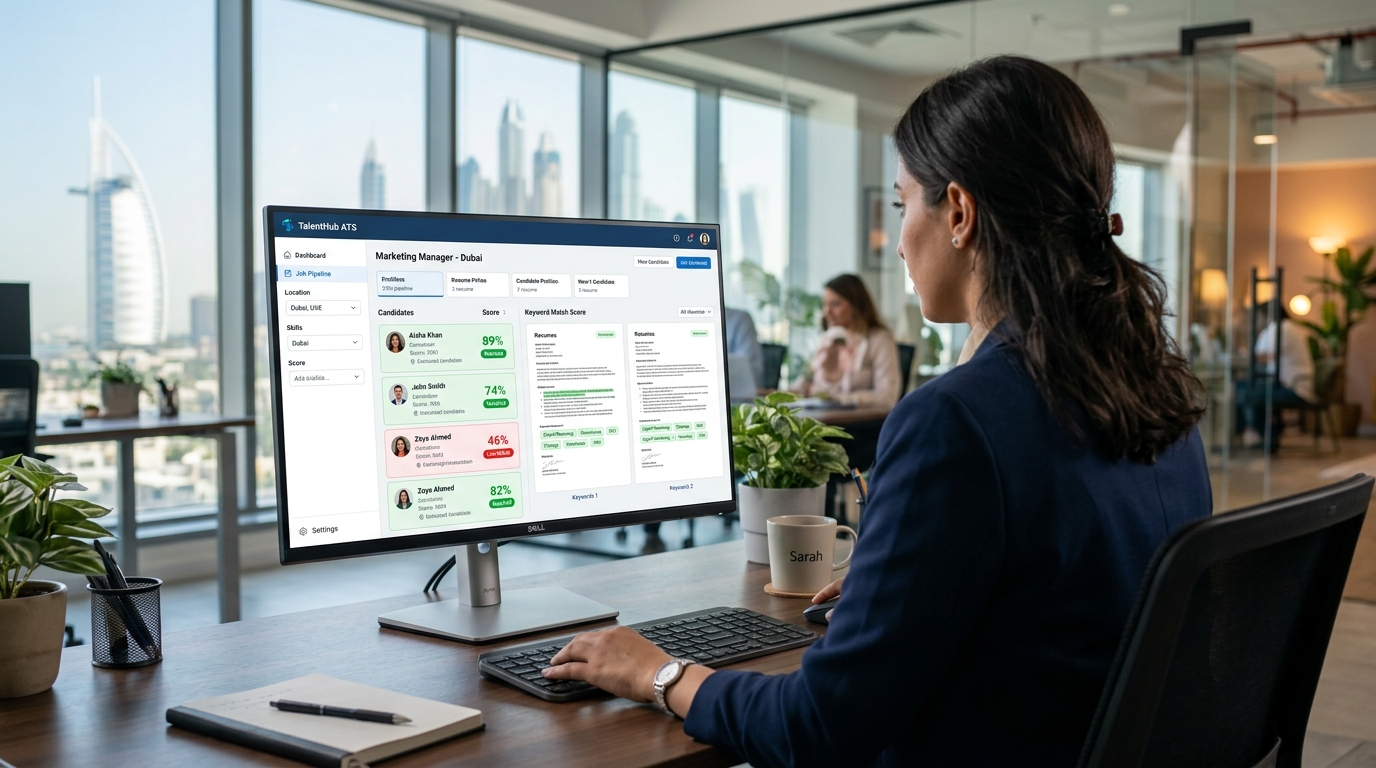
Over 75% of medium to large enterprises in the UAE use Applicant Tracking Systems (ATS) to manage their hiring. These software programs parse your resume, strip away the formatting, and read the raw text to determine if you match the job description. If you do not have the exact keywords, software proficiencies, and industry jargon listed in the job posting, the ATS assigns you a low relevance score.

“I kept getting rejections from London. Base Career rewrote my CV for Dubai, and I landed Emirates in 3 weeks.”
Sarah M. · Marketing Manager · UK 🇬🇧 → Dubai 🇦🇪
No credit card required
You might have ten years of incredible project management experience, but if the job description asks for "Agile Methodology" and "Stakeholder Alignment," and your resume says "Managed Team Workflows" and "Client Relations," the ATS will fail you. Learning how to beat ATS filters for UAE job applications is non-negotiable if you want your resume seen by human eyes.
4. Irrelevant Experience is Leading Your Resume
Many candidates treat their resume like an exhaustive autobiography rather than a targeted marketing document. If you are applying for a Senior Marketing Executive role, the recruiter does not care about the three years you spent in retail sales a decade ago. Leading with irrelevant experience dilutes your core message.
Furthermore, expats often list companies from their home countries that Dubai recruiters have never heard of. While you might know that "Smith & Sons" is a prestigious Fortune 500 equivalent in your home country, the recruiter in Dubai does not. If you do not provide a one-line context (e.g., "The UK's largest commercial logistics provider with £2B in revenue"), the recruiter cannot gauge the scale of your experience.
5. Applying Too Late in the Posting Cycle
Timing is everything in the UAE. When a job is posted on LinkedIn or a company portal, the vast majority of applications flood in within the first 48 hours. By day three or four, the recruiter already has a shortlist of 20 highly qualified candidates to interview. Even if the job posting remains "active" for thirty days, they are likely no longer actively reviewing new CVs.
If you are routinely applying to jobs that have been posted for two weeks, your application is simply sitting in a digital graveyard. You must set up targeted alerts and aim to be within the first 100 applicants to ensure you have a mathematical chance of being reviewed.
Common Resume Mistakes Specific to the Middle East
Beyond general errors, expats often stumble over cultural and regional nuances when formatting their CVs for the Dubai market. For instance, the inclusion of personal details. In North America and the UK, including a photo, your age, or your marital status is strictly prohibited due to anti-discrimination laws. However, in the UAE, especially when applying to local or family-owned conglomerates, these details are sometimes expected.
Conversely, if you are applying to a Western multinational corporation (MNC) based in the Dubai International Financial Centre (DIFC), including a photo might make you look unprofessional. You have to tailor not just the content, but the format based on the origin of the company you are targeting.
Another common mistake is failing to translate terminology. Using terms like "vacation" instead of "annual leave," or "compensation" instead of "salary and allowances," can subtly signal that you are unfamiliar with the local business landscape. Localization matters immensely when you are competing against candidates who already have UAE experience.
What UAE Recruiters Actually Look For in the First 6 Seconds
If you want to survive the six-second scan, your resume must follow a strict visual hierarchy. Recruiters read in a "Z-pattern," scanning the top horizontally, dragging their eyes diagonally down, and then scanning across the bottom. Here is exactly what they are looking for in order of importance:
- Target Job Title: Does your headline instantly match the role they are hiring for?
- Current Location & Availability: Are you already in Dubai? If you are on a visit visa or need sponsorship, is it clearly stated to manage their expectations?
- Recent Experience: The top three bullet points of your most recent role. Are they metric-driven and outcome-focused?
- Tenure and Stability: Have you job-hopped every six months, or do you show a reliable track record of loyalty?
- Education and Certifications: Only prioritized if the role specifically demands an engineering degree, CPA, or specific credential.
If your resume does not immediately deliver these five data points in a clean, easily readable format, your callback rate will remain at zero.
How Targeted AI Resume Tailoring Changes the Equation
We have established that you need a highly tailored, keyword-optimized, perfectly timed resume for every single application. The obvious problem? Doing that manually takes an hour per application. If you apply to ten jobs a day, that is a ten-hour shift of pure writing and formatting. It is unsustainable, which is exactly why candidates eventually give up and revert to the "spray and pray" method.
Base Career addresses that bottleneck by helping candidates produce tailored resumes and role-specific cover letters much faster, which makes it easier to stay early in the posting cycle without sacrificing relevance.This is where targeted Artificial Intelligence changes the entire equation. However, we are not talking about blindly pasting your CV into a basic chatbot. Recruiters can spot lazy AI generation from a mile away, and using AI authentically in Dubai requires a much more sophisticated approach.
Specialized AI career platforms like basecareer.co automate this heavy lifting while preserving your professional voice. The platform analyzes the specific job description you want to apply for, cross-references it with your master profile, and instantly generates a highly tailored version of your resume. It identifies the exact keywords the ATS will look for, restructuring your bullet points to highlight the most relevant achievements for that specific employer. This allows you to apply with sniper-like precision in a fraction of the time, bridging the gap between quality and quantity.

The Data: Tailored Applications vs. Generic CVs
The proof of this strategy lies entirely in the numbers. When we look at the data across the UAE job market, candidates utilizing a single, generic CV experience an abysmal 1% to 2% callback rate. This means for every 100 applications sent, they are lucky to get one or two phone screens, usually from third-party recruitment agencies rather than direct employers.
Conversely, candidates who utilize automated tailoring tools to ensure a 90%+ keyword match on every application see their callback rates surge to between 10% and 15%. Not only does this drastically reduce the timeline of the overall job search, but it entirely removes the mental fatigue of manual editing. Shifting from 1-click apply to automated workflows is the defining difference between candidates who struggle for six months and those who land multiple offers in eight weeks.
Step-by-Step: How to Audit Your Own Application Strategy
If you are stuck in the void right now, take a step back and audit your strategy before you send out another application today. Follow these three simple steps:
- Review Your Last 10 Applications: Did you send the exact same document to all ten companies? If yes, that is your primary failure point.
- Check Your Timestamps: Look at the jobs you applied for. Were they posted more than 72 hours before you hit submit? If so, you are arriving too late to the party.
- Analyze Your Metrics: Calculate your current callback rate. If you have sent 200 applications and received zero interviews, your resume is failing the ATS test. Do not blame the market; fix the document.
By acknowledging these systemic hurdles, you empower yourself to bypass them. The jobs are there, the budgets are there, and companies are aggressively hiring. You just need to speak their language, both to the algorithm and the human sitting behind the desk.
Frequently Asked Questions
Why am I not getting interviews in Dubai despite having strong experience?+
How long does it usually take to hear back from a job application in the UAE?+
Does applying to jobs on weekends affect my chances in Dubai?+
How does AI help fix a resume that isn't getting callbacks?+
Can Base Career improve my callback rate for Dubai jobs?+
Stop Guessing and Start Getting Callbacks with Base Career
The definition of insanity is doing the same thing over and over again and expecting a different result. If your current application strategy is yielding silence, sending out another hundred generic resumes tomorrow will not change your reality. The Dubai job market rewards precision, speed, and optimization. You have the experience; now you just need the right tools to communicate it effectively.
Base Career is built for this exact problem: it helps take the repetitive tailoring work off your plate so every application can be more targeted, more locally aligned, and easier for recruiters and ATS systems to shortlist.Stop letting your talent get lost in the void of the UAE job market. It is time to work smarter, leverage modern automation, and ensure every single application you send is perfectly aligned with what employers are actively seeking. Take control of your career journey today and start your free basecareer.co account to automatically tailor every application, bypass the ATS filters, and finally start landing the interviews you deserve.
If your CV is solid but your applications still feel invisible, go back to the full process. Our step-by-step guide to applying for jobs in Dubai covers platform selection, CV localization, and follow-up timing, while our article on how many jobs to apply to per day in Dubai explains how to avoid the low-conversion trap of panic applying.
If callback problems have turned into a full interview drought, the more complete breakdown is in Why You Are Not Getting Interviews for Dubai Jobs in 2026. That guide ties together CV quality, market positioning, local availability, and channel strategy in one place.
Land 4x more interviews in 27 days. Join Base Career Today.
Tailor your resume for every role with a workflow built for faster applications.
Start freeNo credit card required

James T.
Canada 🇨🇦 → Riyadh 🇸🇦
“50 applications, zero replies with my Canadian CV. Base Career got me 4 Riyadh interviews and a Series B offer.”
Written by Ankush Wadhwa
Helping you accelerate your career with AI-powered tools.
Related Posts

Top 5 Resume Tips for Landing a Job in Dubai in 2026
Mastering the Dubai job market in 2026 requires a blend of AI optimization and cultural intelligence. Learn the top 5 resume strategies to stand out today.

AI is Reshaping Middle East Hiring: How to Beat the Bots in 2026
Hiring in the UAE is changing. Learn how AI tools screen candidates and how you can use automation to land your dream job in Dubai.