Dubai Jobs After the Iran War Shock: UAE Hiring Data After February 28, 2026

Dubai job seekers have been trapped between two bad narratives since the Iran war shock and wider regional escalation around February 28, 2026. One side says the market is dead. The other says nothing meaningful has changed. Our internal Base Career data suggests a more useful conclusion: the market did not disappear, but it did get narrower, more concentrated, and less forgiving.
Because the UAE sits at the center of Gulf hiring flows, any military escalation involving Iran creates immediate second-order effects even when the damage is not visible in a single headline. Companies slow approvals, some hiring teams become more cautious on non-critical roles, candidates hesitate on relocation decisions, and the market starts to cluster around the channels and sectors seen as safest. That is the ripple effect this study tries to measure.
This analysis combines two layers of evidence. First, we use our published Dubai Jobs Report 2026 as the February inventory baseline. Second, we compare that baseline to fresh UAE job intake and deduplicated market breadth observed inside Base Career's jobs_pool after February 28 across LinkedIn, Indeed, Bayt, and NaukriGulf.
The result is not a simplistic story of collapse. Early March still showed backlog and fresh activity moving through the system. But by late March, the visible market had cooled below the pre-shock baseline, while the mix shifted more heavily toward a smaller set of channels and a smaller set of opportunities.
What We Measured
For the February benchmark, we used the source mix already published in our Dubai jobs report: 18,975 visible roles across four major sources. That report showed LinkedIn at 7,324 roles, Indeed at 5,551, Bayt at 2,400, and NaukriGulf at 3,700.
For the March comparison, we did not reuse the same cumulative inventory logic, because the live pool is additive. Instead, we measured two cleaner indicators from our own portal data:
1. Average daily fresh UAE jobs observed
2. Average daily unique company-title pairs, which helps estimate market breadth rather than just raw posting volume
One caveat matters: Bayt was part of the February baseline, but Bayt collection was paused during the March observation window. For that reason, Bayt is excluded from the March source concentration comparison, while still remaining part of the February reference set.
Fresh Intake Did Not Crash on March 1. It Cooled Later.
The cleanest mistake to avoid is assuming there was an immediate cliff on March 1. There was not. Early March still had strong activity flowing through the system, likely reflecting backlog, ongoing reposting, and roles already in motion before hiring teams fully adjusted.
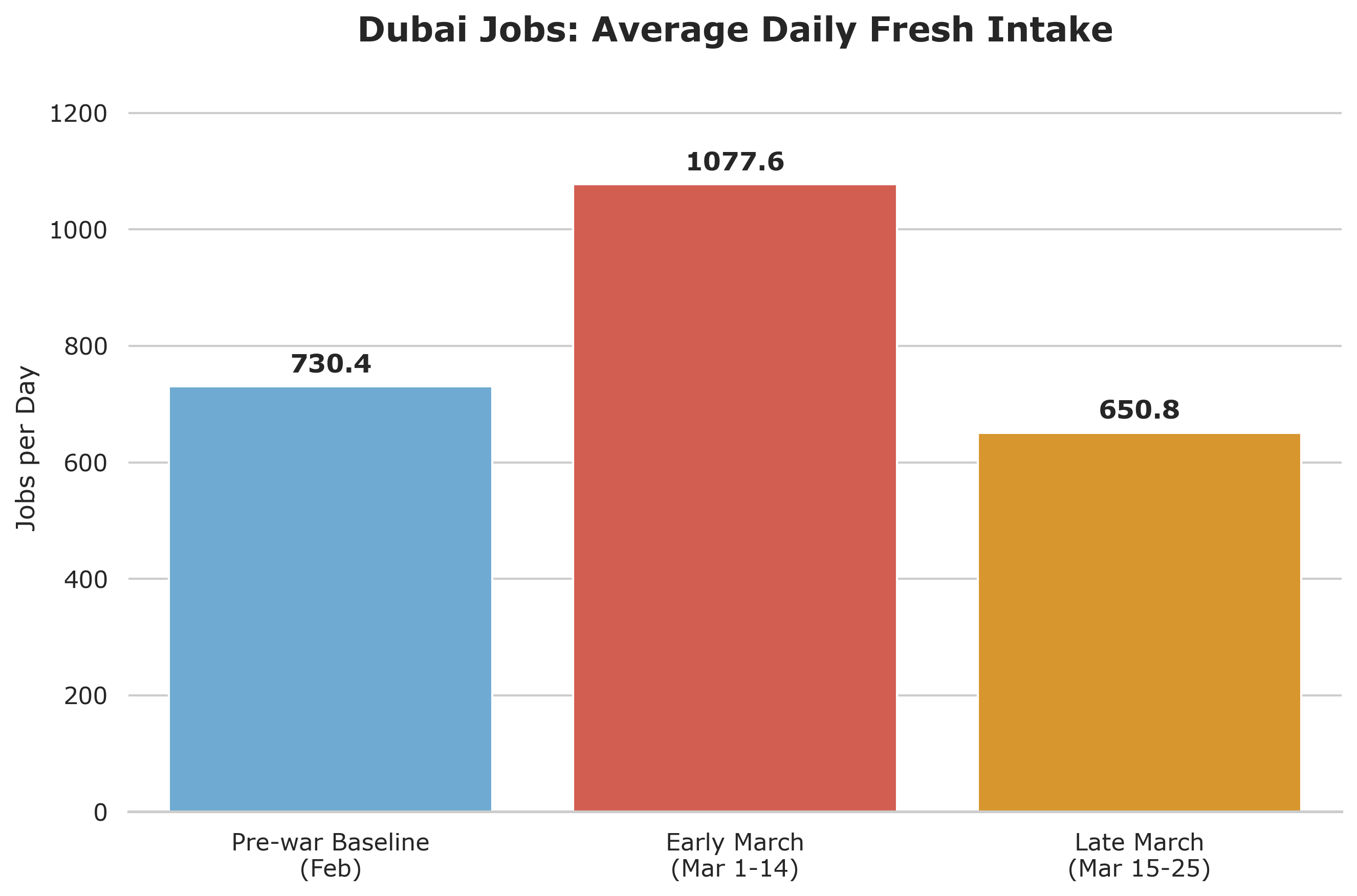
But the late-March picture is different. Once we compare the average daily fresh intake across the three periods, the cooling becomes clear:
Pre-war baseline (February): 730.4 jobs/day
Early March (March 1-14): 1,077.6 jobs/day
Late March (March 15-25): 650.8 jobs/day
That means late March fell 39.6% below early March and 10.9% below the pre-war baseline. The market did not vanish. It simply became less expansive once the early-March burst passed.
Why the Market Feels Harder: Breadth Contracted
Raw volume alone does not explain candidate experience. A market can still look active while quietly becoming less diverse underneath. That is why we also tracked unique company-title pairs per day, which acts as a better proxy for breadth.
Here is what we saw:
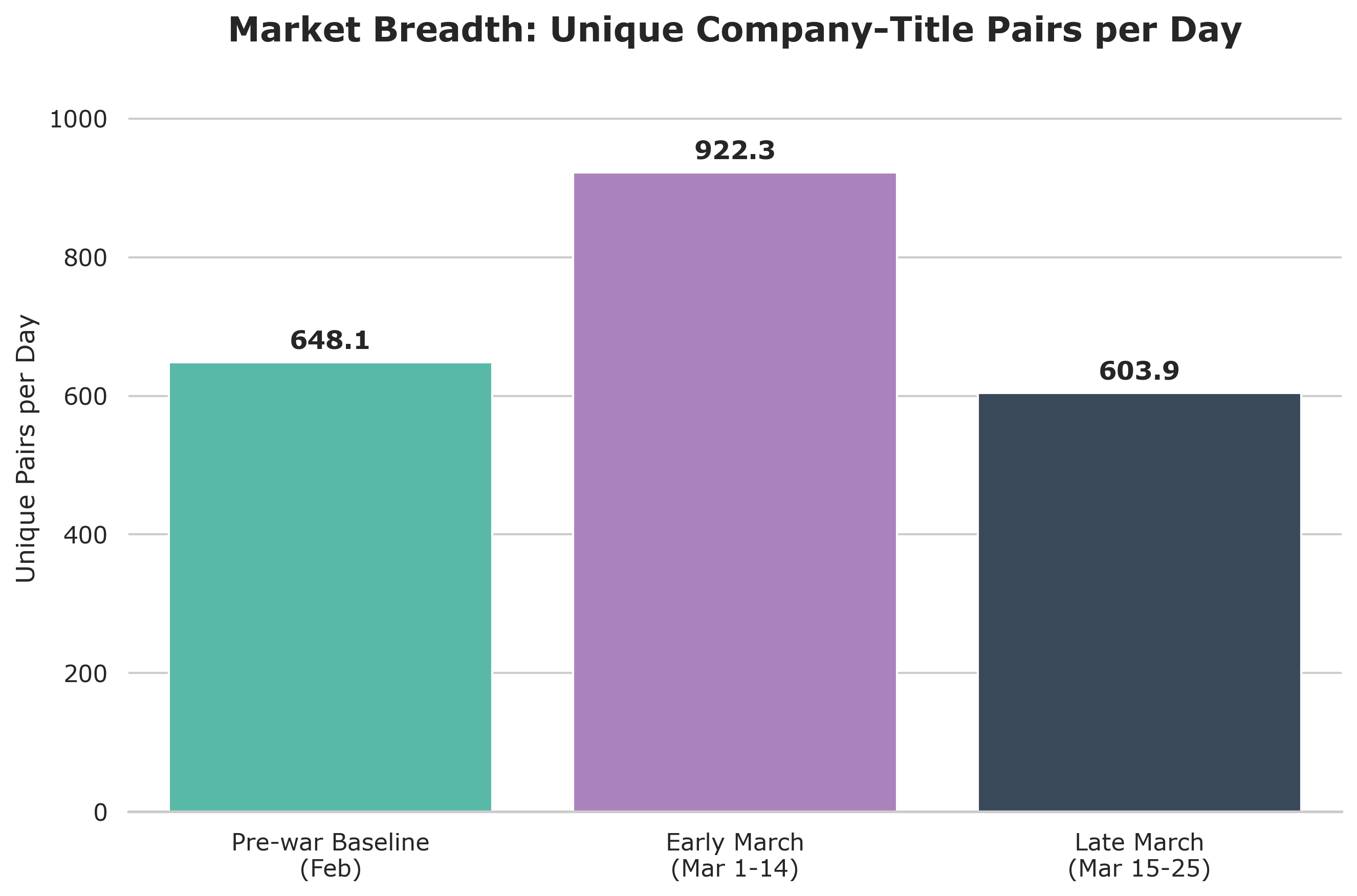
Pre-war baseline: 648.1 unique company-title pairs/day
Early March: 922.3/day
Late March: 603.9/day
Late March was therefore 34.5% below early March and 6.8% below the pre-war baseline. That is a meaningful contraction. It suggests that by the second half of March, job seekers were no longer just seeing fewer fresh opportunities. They were seeing fewer distinct combinations of employers and roles. In practice, that makes the market feel slower, noisier, and more repetitive.

“I kept getting rejections from London. Base Career rewrote my CV for Dubai, and I landed Emirates in 3 weeks.”
Sarah M. · Marketing Manager · UK 🇬🇧 → Dubai 🇦🇪
No credit card required
Source Concentration Shift: Dubai Became More Dependent on LinkedIn
The February Dubai report already showed that Dubai is not a one-platform market. The published mix was fairly balanced: LinkedIn held 38.6% of visible roles, Indeed held 29.3%, Bayt held 12.6%, and NaukriGulf held 19.5%.
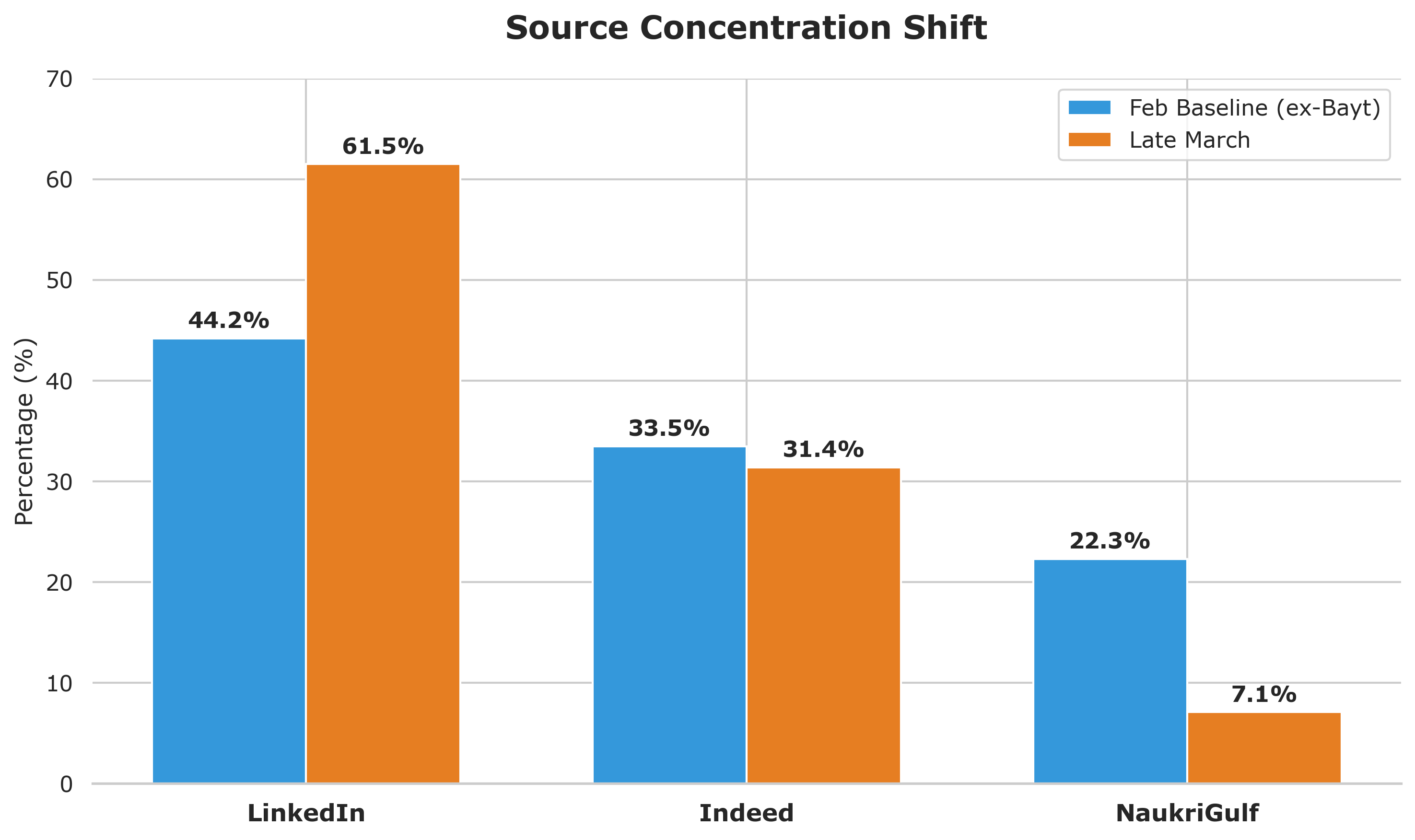
To make March comparable after Bayt collection paused, we removed Bayt from the source contrast and recalculated the February mix on a three-source basis. That gives us an ex-Bayt February baseline of 44.2% LinkedIn, 33.5% Indeed, and 22.3% NaukriGulf.
By late March, the observed mix inside our portal had shifted to 61.5% LinkedIn, 31.4% Indeed, and 7.1% NaukriGulf. That is not just a mild rebalancing. It is a concentration shift. The visible market became more dependent on LinkedIn and, to a lesser extent, Indeed, while regional visibility through NaukriGulf shrank sharply in our observed window.
That also affects candidate behavior. In a more concentrated market, discovery becomes easier on the surface but competition gets more crowded inside the same visible channels.
Sector Intake: IT and Finance Still Lead, but the Mix Is Tighter
Our February report used a broad sector mix that placed finance at 35%, IT at 30%, healthcare at 20%, and government/public roles at 15%. That baseline remains useful because it tells us which areas were carrying the visible opportunity set before the March cooling began.
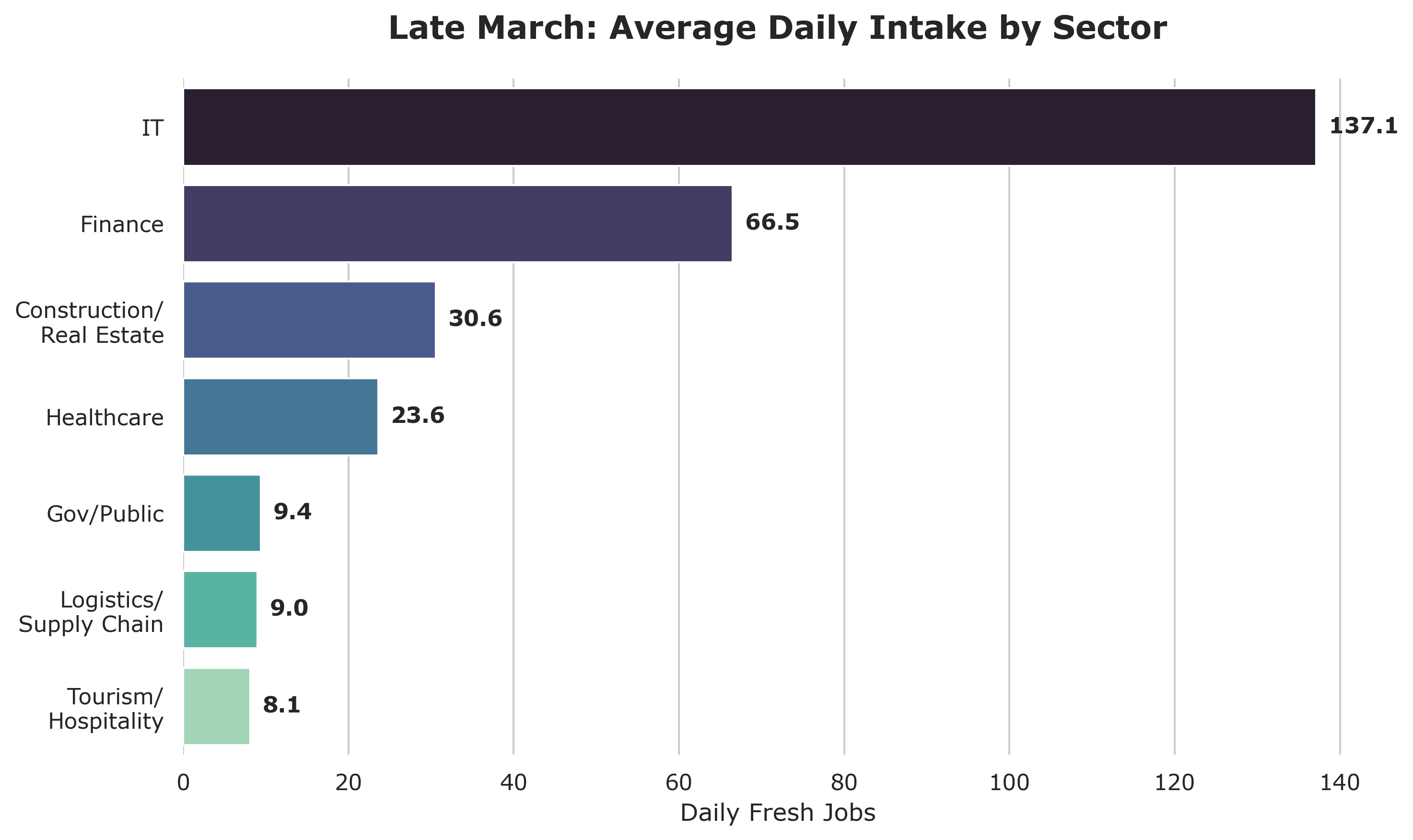
Late March intake data helps refine that picture. The strongest average daily categories we observed were:
IT: 137.1/day
Finance: 66.5/day
Construction/Real Estate: 30.6/day
Healthcare: 23.6/day
Government/Public: 9.4/day
Logistics/Supply Chain: 9.0/day
Tourism/Aviation/Hospitality: 8.1/day
The hierarchy matters. IT stayed the largest hiring lane, but it cooled materially from its early-March pace. Finance remained highly relevant, but it also slowed. Logistics and operationally critical roles held up relatively better than many broad consumer-facing categories. Tourism and aviation remained soft, which is consistent with the caution already visible across the wider GCC wartime hiring conversation in our GCC wartime hiring trends analysis.
What Serious Job Seekers Should Do Next
If this analysis can be reduced to one sentence, it is this: in a narrower market, workflow starts to matter almost as much as qualification.
The candidates who will do best in this environment are not necessarily the ones who apply to the most jobs. They are the ones who identify the right channels, focus on the more resilient role families, and keep application quality high while moving fast when a strong opening appears.
- Stop relying on one platform only. LinkedIn still matters most, but a concentrated market gets crowded quickly.
- Prioritize fewer, better applications. In a narrower market, high-volume generic applications are even less effective.
- Tighten your positioning around resilient demand. In our March data, IT, finance, logistics, and operationally critical roles held up better than broad consumer-facing categories.
- Use local availability as an advantage if you are already in the UAE. In uncertain hiring cycles, being on the ground matters more.
- Build a tighter workflow. Strong candidates now need sharper role targeting, cleaner tracking, and faster iteration when a real opportunity appears.
If you want to turn this analysis into action, pair this study with our step-by-step Dubai application guide, our comparison of the best job sites in Dubai, and our guide on how to automate your Dubai job search without spamming. Those pieces are operational. This one is diagnostic.
Bottom Line
Dubai's job market after February 28 did not collapse into silence. It became more concentrated, less balanced, and more selective. Early March still carried momentum, but late March showed a visible cooling in both fresh intake and distinct employer-role breadth.
That matters because job seekers are not competing in the same market they were competing in a month earlier. They are competing in a market where fewer channels matter more, fewer role clusters dominate the visible opportunity set, and execution quality has become even more important. The people who adjust their workflow fastest will likely outperform the people who keep applying as if nothing changed.
If you want help acting on this shift instead of just reading about it, sign up for Base Career. We help candidates move faster with tailored resumes, role-specific cover letters, and a cleaner workflow so you can apply with more relevance in a tighter Dubai market.
Frequently Asked Questions
Did the Dubai jobs market collapse immediately after February 28, 2026?+
Why is Bayt not included in the March source comparison?+
Which sectors still look resilient in the Dubai market?+
What should candidates do differently in a narrower market?+
Land 4x more interviews in 27 days. Join Base Career Today.
Track applications, tailor resumes, and follow up faster in one UAE job search system.
Start freeNo credit card required

James T.
Canada 🇨🇦 → Riyadh 🇸🇦
“50 applications, zero replies with my Canadian CV. Base Career got me 4 Riyadh interviews and a Series B offer.”
Written by Base Career Research Team
Produced by the Base Career Research Team with AI, using Base Career job-market data, and published automatically. How our articles are made
Related Posts

Is it Easy to Get a Job in Dubai From Overseas? The Honest Truth
Dreaming of a tax-free salary in Dubai but living abroad? We analyze the challenges of international applications and share a strategic roadmap for success.

Building 'Wasta' from Scratch: Networking Strategies for Dubai Expats
Frustrated by 1,000+ applicants on LinkedIn? Learn how to build 'Wasta'—your professional network—from zero to access the UAE's hidden job market.