Jobs in Dubai: What the Latest Posting Mix Means for Your Search

A useful search for jobs in Dubai starts with a clear role lane, not a promise that the city is hiring everyone. Base Career tracked 22,328 active Dubai postings scraped in the latest 30-day window on 11 September 2026. That is a large discovery pool, but it is not a census of every vacancy and it cannot tell any individual candidate how likely an interview or offer will be.
Use the market data to choose where to look. Use verified vacancies, role evidence and official employment guidance to decide where to apply.
What this Dubai posting snapshot measures
The analysis used aggregate fields from Base Career’s shared job pool. It filtered active records to country code UAE, limited the location field to normalised Dubai labels, and included records scraped during the rolling 30-day window. The wider UAE filter returned 97,220 active postings; the Dubai subset contained 22,328. Closely related titles can remain separate, and duplicated or imperfect source labels may still exist.
Role families were created with a reproducible keyword hierarchy. Each title was placed in the first matching family, so the chart is a directional discovery tool rather than an official occupational classification. A large residual group of 10,888 postings did not fit the selected families cleanly. That residual is important: the chart should not be read as a complete market-share breakdown.
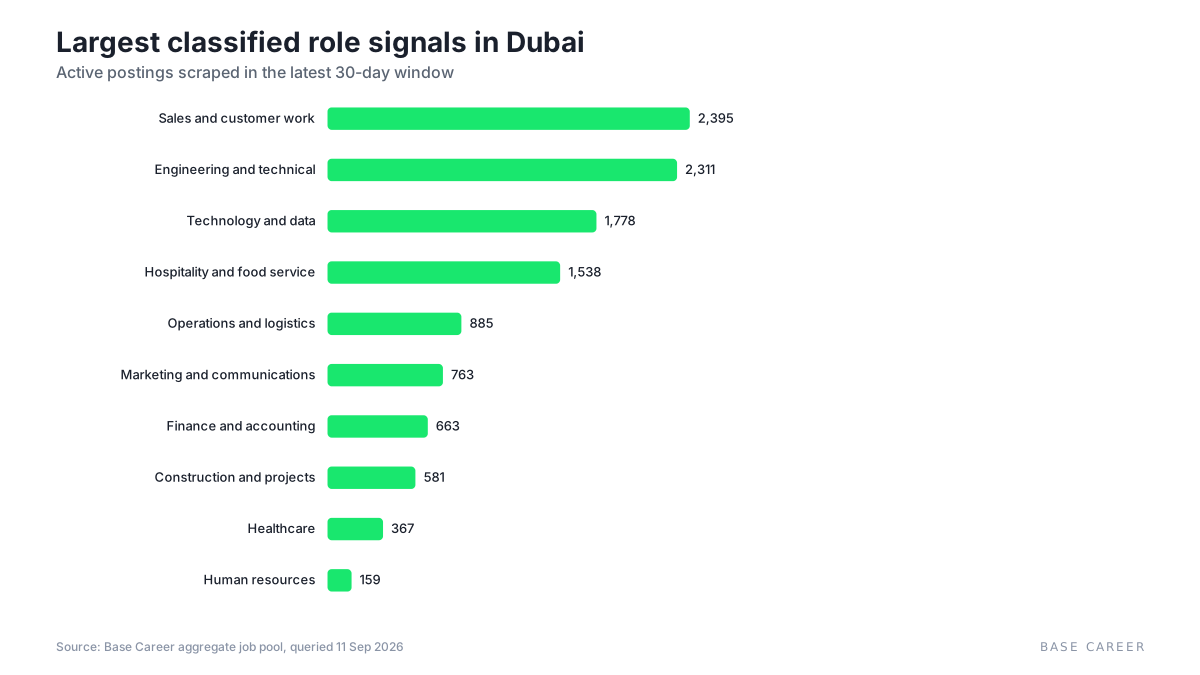
Sales and engineering lead the classified signals
Sales and customer work contributed 2,395 postings, narrowly ahead of engineering and technical work at 2,311. Technology and data followed with 1,778, while hospitality and food service contributed 1,538. These are broad families: a sales group may include business-development, account-management, customer-service and retail language, while engineering includes several disciplines and technical maintenance roles.
The next classified signals were operations and logistics with 885 postings, marketing and communications with 763, finance and accounting with 663, construction and projects with 581, healthcare with 367, and human resources with 159. Volume alone does not establish seniority, pay, sponsorship, licensing eligibility or applicant competition. It tells you where there is enough title activity to investigate further.
Exact titles show why broad searches become noisy
The largest exact-title counts were much smaller than the family totals. Architect appeared in 60 postings, Real Estate Agent in 59, Property Consultant in 58, Business Development Manager in 57, and Hotel Cleanliness Expert in 55. Sales Executive appeared in 53, Inside Sales in 52, Engineer I in 51, Sales Manager in 50, and Receptionist in 47.
This fragmentation is practical evidence for building a title map. Start with the job you can already prove, then collect accurate neighbouring titles from live vacancies. A commercial candidate might separate new-business, account-growth and property-sales lanes. An engineer should separate discipline, asset type, project stage and maintenance context. A technology candidate should distinguish software, data, infrastructure, security and support rather than treating “IT jobs” as one market.
- Write one primary target title that matches your strongest recent evidence.
- Add genuinely adjacent title variants used by current Dubai employers.
- Exclude roles whose essential licence, language, location or seniority requirement you cannot meet.
- Create separate alerts for each lane instead of combining every keyword into one feed.
The salary field is too thin for a Dubai benchmark
Only 898 of the 22,328 Dubai postings carried a usable salary field in this run, equal to 4.0% of the subset. That coverage is too incomplete to support a responsible city-wide salary average. It may also be uneven across employers, sectors, levels and source platforms.
Treat a displayed salary as information about that specific verified vacancy. Compare the same occupation, level, contract type and benefits, and ask for the complete written package before accepting. Do not infer a market range from blank fields, and do not assume that two similar titles carry equivalent responsibilities.
Build a safer Dubai job-search route

“I kept getting rejections from London. Base Career rewrote my CV for Dubai, and I landed Emirates in 3 weeks.”
Sarah M. · Marketing Manager · UK 🇬🇧 → Dubai 🇦🇪
No credit card required
Begin with narrow, live category pages
Use a live inventory to learn current employer vocabulary. For example, browse software engineer jobs in Dubai or accountant jobs in Dubai, then open each vacancy and verify its original destination. Category pages are discovery tools; the employer or authorised recruitment channel remains the place to confirm the vacancy, requirements and application route.
Use more than one legitimate channel
The UAE Government’s job-search guidance lists job portals, online job fairs, classifieds, licensed recruitment agencies, employer websites and professional networking sites as available routes. It also links to Dubai Careers for government vacancies. The point is not to apply everywhere; it is to use several credible discovery channels while keeping one consistent record of what you submitted.
For public-sector and participating employer opportunities, the official Dubai Careers portal provides searchable categories including administration, finance, engineering, information technology, healthcare and travel. Read the audience and eligibility details on each posting rather than assuming every listing is open to every applicant.
For a broader comparison of discovery channels, read Base Career’s earlier guide to the best job sites in Dubai. This refreshed report has a different purpose: it uses the latest Dubai posting mix to help you choose role lanes and verify the route from vacancy to offer.
Turn requirements into an evidence matrix
Before tailoring a CV, create a simple role-evidence matrix. In one column, record the essential responsibility or skill repeated across credible vacancies. In the other, write one concise example showing the setting, your responsibility, the action you took and the outcome. Remove any customer, patient, client or employer-confidential information.
This exposes weak applications early. If a requirement appears across several verified vacancies and you have no relevant evidence, decide whether it is a learnable gap, a terminology problem or a genuine mismatch. Do not hide the gap with keyword stuffing. Redirect the search lane when the essential work is outside your experience.
Keep the CV readable and defensible
Put the target role and strongest relevant evidence near the top. Use conventional section headings, consistent dates and occupational language that matches the work you actually did. Tailoring means selecting and clarifying truthful evidence; it does not mean copying a vacancy description, inventing tools or inflating responsibility.
Where a vacancy asks for Dubai or UAE experience, identify the underlying reason. It may be local regulation, a professional network, customer knowledge, site familiarity or immediate availability. Address the relevant transferable evidence honestly. If local experience is legally or operationally essential, treat that as an eligibility filter rather than a wording challenge.
Verify the vacancy before sharing sensitive documents
Check that the employer name, vacancy title, location and reference are consistent across the source page and the organisation’s own domain. Be cautious when a contact immediately moves the process to a private message, requests identity documents before a credible process exists, or uses an email domain unrelated to the employer.
The UAE Government’s job-search page states that job seekers should not pay recruitment agencies and advises candidates to check the email address used for offers. It also warns against demands for money to process a visa or medical test. If the route looks uncertain, stop and verify it through the employer or the Ministry of Human Resources and Emiratisation’s worker guidance.
Work permits, contracts and jobseeker status
A vacancy, interview or informal message is not permission to work. The official UAE employment-process guidance describes the private-sector sequence around a formal job offer, employment contract, work permit and work visa. Read the current rules for your situation and occupation, and do not rely on an employer summary when an official source is available.
Review the written offer carefully. Confirm the employer identity, job title, responsibilities, salary, benefits, work location and any conditions. The MoHRE worker guidance says workers should review the offer and its annex, obtain a copy of the contract, retain their identity documents, and avoid paying recruitment costs. These are verification steps, not a promise that a permit will be issued.
If you are considering entering the UAE specifically to search, consult the current official jobseeker visit visa page. It sets out eligibility, permitted validity options and application links. A search status should not be treated as work authorisation; confirm the appropriate employment process before starting work.
A practical weekly operating plan
- Refresh narrow alerts around your primary title and adjacent variants.
- Review new listings, remove obvious mismatches and verify the destination domain.
- Tailor the CV only for vacancies where your evidence fits the essential work.
- Record the source, date, CV version, contact and next action for every submission.
- Review response patterns and adjust title language or evidence before increasing volume.
Measure quality as well as activity. A useful review asks which title lane produced credible conversations, which requirements repeatedly blocked you, and whether employers understood your evidence. If a lane produces no relevant vacancies, update the title map. If suitable applications produce no response, inspect the top third of the CV, role fit and location or work-status clarity before sending more of the same.
What this report does not claim
The tracked pool is not every Dubai vacancy. It can include reposts, closely related title variants and incomplete fields. The family rules simplify a complex market, and the salary field is too sparse for a benchmark. The counts do not measure applicant volume, interview probability, sponsorship, licensing approval, employer quality or job-offer safety.
Use the report as a starting map. Your final decisions should rely on the original vacancy, official government guidance, the written offer and the evidence you can defend. For a wider national view, compare this city-specific analysis with Base Career’s UAE jobs guide.
Sources and methodology
- Base Career aggregate jobs_pool query for active UAE and Dubai postings scraped in the rolling 30-day window, executed 11 September 2026.
- UAE Government, Searching for a job, accessed 11 September 2026: https://u.ae/en/information-and-services/jobs/Find-a-job/searching-for-a-job
- UAE Government, Job offers and the employment process, accessed 11 September 2026: https://u.ae/en/information-and-services/jobs/Sector-of-employment/employment-in-the-private-sector/expatriates-employment-in-private-sector
- UAE Government, Jobseeker visit visa, accessed 11 September 2026: https://u.ae/en/information-and-services/visa-and-emirates-id/Types-of-visas/Visit-visa/jobseeker-visit-visa
- Ministry of Human Resources and Emiratisation, Dear Worker – Know Your Rights, accessed 11 September 2026: https://mohre.gov.ae/en/guidance-and-awareness-portal-new/employee-companies/dear-worker-know-your-rights
- Dubai Careers, official portal, accessed 11 September 2026: https://dubaicareers.ae/en/pages/default.aspx
Frequently Asked Questions
Which role family had the largest classified Dubai signal?+
Does the chart show every Dubai job?+
Can the salary field be used as a Dubai average?+
Where should I verify Dubai government vacancies?+
Does a jobseeker visit visa allow me to start working?+
Land 4x more interviews in 27 days. Join Base Career Today.
Track applications, tailor resumes, and follow up faster in one UAE job search system.
Start freeNo credit card required

James T.
Canada 🇨🇦 → Riyadh 🇸🇦
“50 applications, zero replies with my Canadian CV. Base Career got me 4 Riyadh interviews and a Series B offer.”
Written by Base Career Research Team
Produced by the Base Career Research Team with AI, using Base Career job-market data, and published automatically. How our articles are made
Related Posts

Landing Your First Dubai Job: A Roadmap for Freshers and Graduates
Breaking into the UAE job market with zero experience is tough but not impossible. Here is your strategic roadmap to landing that first role in Dubai.

Is it Easy to Get a Job in Dubai From Overseas? The Honest Truth
Dreaming of a tax-free salary in Dubai but living abroad? We analyze the challenges of international applications and share a strategic roadmap for success.