Saudi SVP Exam Guide: Professional Verification in 2026

Saudi professional verification is not one universal exam with one question paper. The official system now covers both practical skills checks and qualification verification, depending on the occupation and the worker’s route into the labour market. That distinction matters: preparing for a trade assessment when your case actually needs an academic-qualification review wastes time, while relying on an unverified “question dump” can leave the real requirement unresolved. The safest starting point is the exact occupation attached to the offer, checked through the employer and the official Saudi channels.
The Ministry of Human Resources and Social Development introduced the examination-based programme to test whether skilled workers can perform the occupation for which they were recruited. Its launch notice describes theoretical and practical examinations and separate routes for workers tested before arrival and workers already in Saudi Arabia. Read the original HRSD programme notice (accessed 29 September 2026).
The system has since expanded. A later official service focuses on educational qualifications, field of study and experience for roles that require academic credentials. HRSD’s qualification-verification announcement (accessed 29 September 2026) makes clear why “SVP” advice that treats every worker alike is now too simplistic.
First identify the verification route attached to the exact Saudi occupation. Only then prepare documents, theory or practical skills.
Quick answer: what should a candidate do first?
- Ask the employer or authorised recruiter for the exact Saudi occupation title and occupational code attached to the offer.
- Ask whether the case is routed to a practical/theoretical skills examination, an academic-qualification verification, or another profession-specific regulator.
- Use the official link or request generated for the case. Do not pay a broker to create a parallel application.
- Match your passport name, qualification, experience record and occupation title before submitting anything.
- Prepare against the published occupational standard and safe work practice, not a generic collection of alleged exam answers.
Why the old “SVP exam” shorthand causes confusion
In the programme’s examination phase, HRSD said the plan targeted more than 1,000 specialised professions across 23 job families and used both theoretical and practical assessments. It also described an overseas route through selected international centres and a domestic route through certified centres in Saudi Arabia. The ministry’s implementation notice (accessed 29 September 2026) is the right source for those scope and route details.
A separate official verification service was later launched for occupations requiring educational and academic qualifications. That service checks whether the qualification level and field align with the occupation and considers relevant experience. The difference is practical: an electrician assigned to an examination route may need to demonstrate safe task execution, while a professional occupation may trigger documentary qualification checks instead.
Coverage has also broadened. HRSD reported that the qualification-focused Professional Verification service had completed coverage of 160 labour-exporting countries and 1,007 professions, with highly skilled occupations in major occupational groups included through phased implementation. See the ministry’s coverage update (accessed 29 September 2026). That does not mean every applicant takes the same test; it means candidates must confirm the route tied to their exact occupation.
What current Base Career posting data shows
Base Career’s aggregate job pool tracked 1,529 active Saudi postings in the preceding 30 days whose titles matched a bounded set of electrical, technician, mechanical, HVAC, welding, plumbing and construction-craft terms. This is a search-demand signal, not an official list of occupations covered by Professional Verification. Individual jobs, descriptions and candidate data were not retrieved.
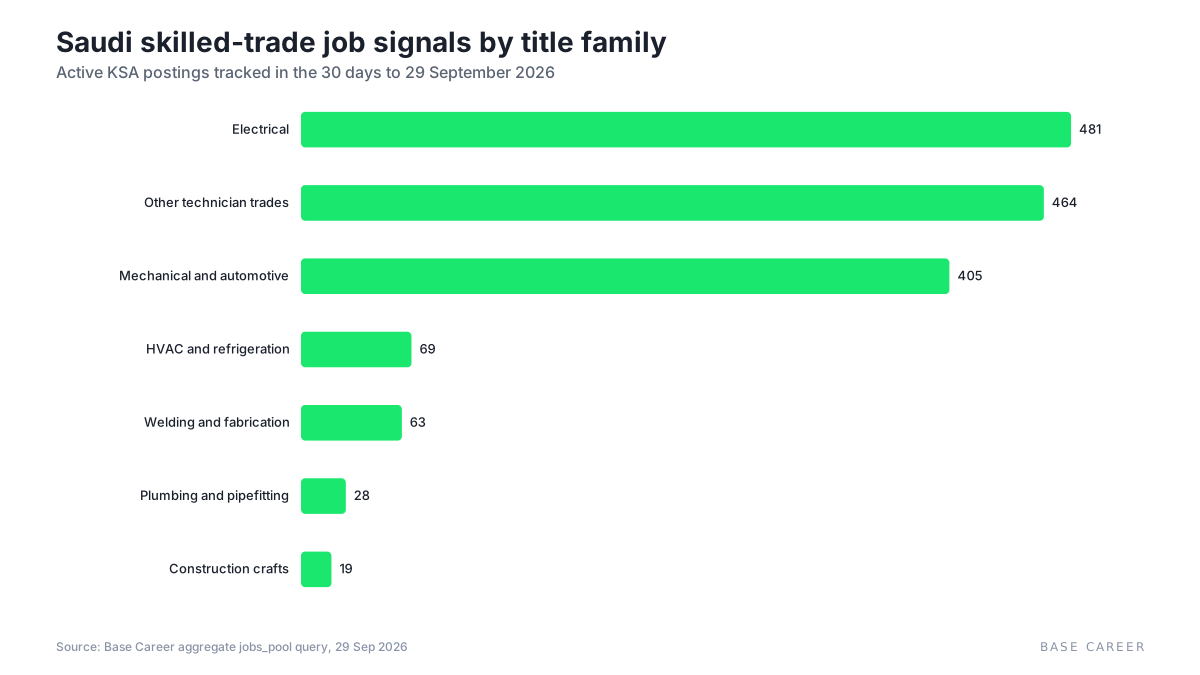
Electrical titles accounted for 481 tracked postings, other technician titles for 464, and mechanical or automotive titles for 405. Smaller matched groups included HVAC and refrigeration at 69, welding and fabrication at 63, plumbing and pipefitting at 28, and construction crafts at 19. The figures come from an aggregate query executed on 29 September 2026 and sum to the disclosed 1,529-posting set.
These signals explain why verification questions matter to many jobseekers, but the chart must not be used as a substitute for the Saudi occupation classification. HRSD publishes occupation families and codes, including a current craft and related trades classification (accessed 29 September 2026). Your employer should map the offer to the applicable official occupation rather than infer a requirement from an English-language job title.
How to identify your verification route
Start with the occupation attached to the offer
A vacancy title is marketing copy; the occupation used for the work permit and official process is the controlling reference. Ask for the exact title and code before booking travel, resigning from a current job or paying for training. If an intermediary refuses to provide the employer name, occupation or official request trail, pause the process.
Separate skills testing from qualification verification

“I kept getting rejections from London. Base Career rewrote my CV for Dubai, and I landed Emirates in 3 weeks.”
Sarah M. · Marketing Manager · UK 🇬🇧 → Dubai 🇦🇪
No credit card required
For an examination route, preparation should centre on task competence, tool selection, hazard control and the standard sequence of work for the assigned trade. For a qualification-verification route, the focus is authentic education records, the field and level of study, experience evidence and consistency across records. Some regulated professions may have additional licensing bodies, so do not assume that Professional Verification replaces every sector regulator.
Confirm the current channel with the employer
The employer controls key employment and occupation details. Ask it to show where the request appears in the official process and which party is expected to act next. Keep screenshots or receipts from the official channel for your own records, but do not publish personal identifiers or send passport scans through informal chat groups.
A safer preparation plan for a skills examination
There is no reliable basis for treating one online question pack as the official exam for every occupation. The assessed task can differ by occupation, country route, centre and current standard. Use alleged past questions only, if at all, as informal practice prompts. Never buy an answer key or a promised pass.
- Review the occupational task: be able to explain the safe sequence before touching tools or equipment.
- Practise tool identification: know the correct tool, its limits and the pre-use check.
- Rehearse hazard controls: isolation, guarding, ventilation, housekeeping and personal protective equipment should be part of the task, not an afterthought.
- Use the expected method: a finished result is not enough if it was produced through an unsafe shortcut.
- Practise clear communication: if an instruction is unclear, ask for clarification rather than guessing.
The current HRSD labour-education portal also publishes occupational safety guidance for industrial hazards, construction work, scaffolding and toolbox talks. Candidates should use official safety guidance and recognised trade training rather than memorising a broker’s answer sheet.
Document preparation without overclaiming requirements
Requirements can vary by route, so this guide does not present one universal document list. Prepare the records the official request asks for and make them internally consistent. Common problem areas include different name spellings, an occupation that does not match the qualification field, incomplete institution details, and experience letters that cannot be verified.
- Use the same name order and spelling as the current passport wherever the issuing authority permits.
- Provide complete, legible scans; do not edit grades, dates, seals or signatures.
- Keep the original file and the submitted copy so you can answer a clarification request accurately.
- Use a certified translation only when the official process requires one.
- Ask the employer before changing an occupation label or uploading a substitute document.
Do not invent an affidavit, employment history or trade certificate to close a mismatch. A discrepancy should be resolved with the issuing body, employer or official service. Fabricated evidence creates a larger employment and immigration risk than a delayed application.
How to evaluate an exam centre or intermediary
Use the centre or link assigned through the official route. A legitimate provider should be able to identify the applicant’s occupation, booking reference, location, date and payment record without offering a guaranteed result. A broker who sells a “confirmed pass”, requests money to alter a result or asks you to use another person’s identity is presenting a serious warning sign.
The International Labour Organization’s Saudi migrant-worker regulatory brief (accessed 29 September 2026) summarises rules on recruitment costs, passport retention, contracts and grievance channels. Use it as a rights reference, while following the current official Saudi and origin-country rules for your own case. Never hand over an original passport to an informal intermediary merely to secure a test booking.
What changed in the wider Saudi work-permit system
Professional Verification now sits within a wider skills-based labour-market framework. In 2025, HRSD announced that expatriate work permits would be classified into three skill categories: high-skill, skilled and basic. The ministry said the system was intended to improve verification and align workers’ skills and qualifications with their roles. Read the official skill-category announcement (accessed 29 September 2026).
For candidates, the practical lesson is not to self-classify from a job advertisement. The employer’s occupation mapping, the official request and any relevant professional regulator determine what evidence is needed. Treat a recruiter’s verbal summary as provisional until it matches the official case.
After verification: keep the job search moving
Verification is only one part of being hired. Continue checking live vacancies on the Base Career Saudi Arabia jobs page, tailor your CV to the occupation and evidence your practical responsibilities without copying a job description. For a broader view of current roles, cities and search strategy, read the Saudi Arabia jobs guide.
When comparing offers, verify the employer, written role, workplace, compensation structure and official contract path. Do not let the urgency of an exam or document review pressure you into accepting a different occupation from the one discussed during recruitment.
A practical decision checklist
- Exact occupation title and official code confirmed by the employer.
- Verification route identified: skills examination, qualification review or profession-specific licensing.
- Official request or booking path received and independently checked.
- Names, dates, qualification field and experience records checked for consistency.
- Trade practice reviewed with safety and method, not just the final output.
- No payment made for a guaranteed result, altered document or unofficial shortcut.
- Written offer and role details retained before major travel or resignation decisions.
Frequently asked questions
Frequently Asked Questions
Is the Saudi SVP exam mandatory for every foreign worker?+
Where can I find official SVP exam questions?+
Does Professional Verification only apply to manual trades?+
Can I book through any training centre?+
What if my qualification does not match the occupation?+
Does passing verification guarantee a Saudi job or visa?+
Sources and methodology
Official and research sources were accessed on 29 September 2026. They include HRSD’s programme launch and implementation notices, qualification-verification announcements and coverage update, the current Saudi occupation-classification page, the work-permit skill-category announcement, and the ILO regulatory brief linked throughout this guide.
The chart uses only aggregate Base Career job-pool counts from active KSA postings scraped during the preceding 30 days. It groups titles with a documented keyword rule and does not reproduce individual jobs, employers, descriptions, users, applications or personal data. The chart is evidence of search-market activity, not legal eligibility or programme coverage.
Official processes can change. Recheck the employer’s current official request and the linked Saudi government sources before acting. Base Career provides practical job-search information, not legal or immigration advice.
Ready to organise a targeted Saudi search? Browse current Saudi Arabia opportunities and keep your CV, applications and follow-ups in one clear workflow.
Land 4x more interviews in 27 days. Join Base Career Today.
Track applications, tailor resumes, and follow up faster in one UAE job search system.
Start freeNo credit card required

James T.
Canada 🇨🇦 → Riyadh 🇸🇦
“50 applications, zero replies with my Canadian CV. Base Career got me 4 Riyadh interviews and a Series B offer.”
Written by Base Career Research Team
Produced by the Base Career Research Team with AI, using Base Career job-market data, and published automatically. How our articles are made
Related Posts

Is it Easy to Get a Job in Dubai From Overseas? The Honest Truth
Dreaming of a tax-free salary in Dubai but living abroad? We analyze the challenges of international applications and share a strategic roadmap for success.

Building 'Wasta' from Scratch: Networking Strategies for Dubai Expats
Frustrated by 1,000+ applicants on LinkedIn? Learn how to build 'Wasta'—your professional network—from zero to access the UAE's hidden job market.