Saudi Arabia Jobs 2026: Demand and Saudization Guide

Saudi Arabia has a large active hiring market, but a useful search cannot stop at a national vacancy count. Base Career tracked 28,873 active Saudi postings scraped in the thirty-day window ending 19 September 2026. That scale creates options, yet the market is shaped by location, title language, occupational rules and each employer’s ability to hire for a specific role.
This refreshed guide combines that aggregate posting snapshot with current official labour-market guidance. It is designed for Saudi candidates and international professionals who want a practical way to narrow their search. It does not treat a posting count as a forecast, promise that a listed job is open to every applicant, or replace advice from the responsible Saudi authority.
Start with current jobs on Base Career, then verify the vacancy on the employer’s official site. Use the sections below to decide which title variants to monitor, where to focus and which eligibility question must be resolved before a long application.
The 2026 Administrative Support Change Matters
Saudi Arabia’s Ministry of Human Resources and Social Development states that an updated private-sector Saudization decision took effect on 5 April 2026. It added 69 professions to the scope of roles subject to 100% Saudization, using the titles and definitions in the Unified Saudi Occupational Classification. The official notice says the rule applies to establishments employing one worker or more in a covered profession. Read the MHRSD announcement.
The ministry identifies secretarial, clerical, translation, data-entry and administrative-support work among the affected fields. That wording is important. A broad English label on a job board is not enough to determine legal coverage; the employer’s classified occupation and the official procedural guide control. Candidates should not infer eligibility from a loosely written title, and employers should not use a cosmetic title change to avoid the applicable classification.
Treat the official occupation code as the eligibility question, and the advert title as the search question. They are related, but they are not interchangeable.
The Saudi Press Agency also reported the administrative-support update. If an advert is unclear, ask the employer which Saudi occupational classification applies and whether the vacancy is open to your status. That is more reliable than relying on a social post, recruiter shorthand or an older application checklist.
What the Current Posting Snapshot Shows
The Base Career query counted active records with country code KSA and a scrape timestamp after 20 August 2026. The chart groups title keywords rather than legal occupations. Reception-related labels appeared in 192 postings, document-control labels in 132, administrative-assistant labels in 108 and data-entry labels in 85.
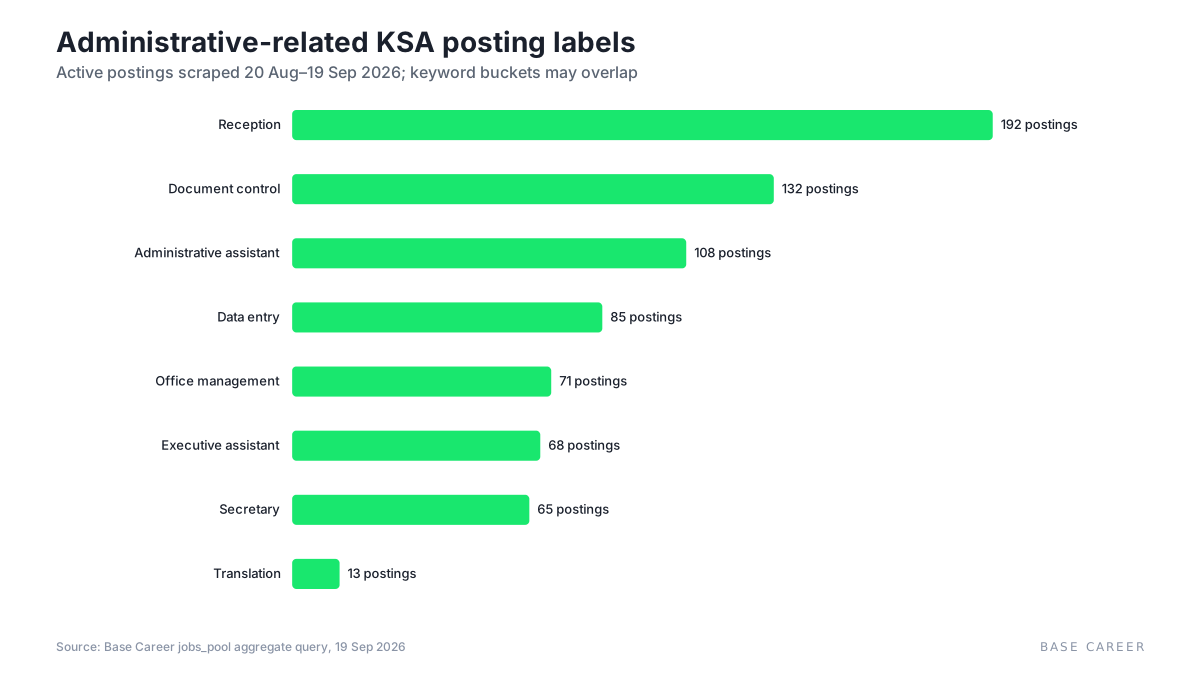
Office-management labels appeared in 71 postings, executive-assistant labels in 68, secretary labels in 65 and translation labels in 13. These are search observations, not an official list of reserved occupations. A posting can match more than one bucket, and an employer may use a broad title for work that maps to a more specific occupation.
- Use the chart to discover vocabulary, not to decide legal eligibility.
- Open the advert and identify the actual function, reporting line and required occupation.
- Confirm whether the employer is recruiting Saudi nationals only before tailoring a long application.
- Keep document control separate from general administration unless the employer combines them explicitly.
- Search both Arabic and English title variants where your language ability supports the role.
The practical message is that administrative demand has not disappeared from public listings, but the candidate pool and compliance route are role-specific. Saudi applicants can use the visible title mix to broaden discovery. Non-Saudi applicants should treat covered administrative-support occupations as a hard eligibility screen and redirect effort toward roles that the employer can lawfully fill.
For Saudi Applicants: Turn the Policy Into a Focused Search
The wider labour market is still expanding. The National Labor Observatory reported 13.570 million private-sector workers at the end of the first quarter of 2026, including more than 2.627 million Saudi employees and about 10.942 million non-Saudi employees. It also reported that Saudi private-sector employment was 6% higher than a year earlier. See the NLO Labour Force Snapshot.
For an administrative candidate, that context should lead to better positioning rather than a generic CV. Employers need evidence that you can manage information, coordination and service reliably. Show the systems you used, the volume or complexity you handled, the stakeholders you supported and the outcome. Do not claim tools, language levels or responsibilities that an interviewer cannot verify.
- Administrative support: calendars, records, correspondence, meeting logistics and workflow control.
- Reception: visitor handling, call routing, service recovery and accurate escalation.
- Data entry: validation rules, error reduction, turnaround time and confidentiality.
- Translation: language pair, subject domain, quality review and terminology management.
- Document control: versioning, approvals, distribution, retrieval and audit readiness.
- Executive support: prioritisation, discretion, briefing preparation and cross-team coordination.

“I kept getting rejections from London. Base Career rewrote my CV for Dubai, and I landed Emirates in 3 weeks.”
Sarah M. · Marketing Manager · UK 🇬🇧 → Dubai 🇦🇪
No credit card required
Official survey evidence also supports a multi-channel search. GASTAT reported that unemployed Saudi jobseekers used an average of three active search methods. Direct applications to employers were used by 74.6%, the Jadarat platform by 55.2%, and professional social platforms for CV activity by 48.5%. See GASTAT’s first-quarter labour-market release.
Use that as a process design, not a volume target. Combine employer career pages, the official national employment platform and a professional profile that makes your target function clear. For a city-specific example, read Base Career’s Riyadh job-search guide, then adapt its role-and-evidence method to administrative work.
For Non-Saudi Applicants: Check the Occupation Before Applying
MHRSD’s official summary of the rules for employing non-Saudis says a worker needs ministry approval and a work permit, must be legally authorised to work, and must be under contract with an employer. It also says an employer may not employ a worker in a profession different from the profession stated on the permit without the prescribed change procedure. Review the official employment-of-non-Saudis guidance.
That means an advert’s existence does not prove that a non-Saudi candidate can fill it. For an administrative or support vacancy, ask whether the classified occupation is covered by the current Saudization decision. If it is, do not try to solve the mismatch with title wording. Move to a role where your specialist evidence and the employer’s permitted hiring route align.
MHRSD’s work-permit classification guide describes high-skilled, skilled and basic categories and says classification considers factors such as occupation group, qualifications, experience, professional skills, remuneration and age where applicable. It also explains that classification appears through the employer’s Qiwa account. Read the official skill-category guide.
- Ask for the classified occupation, not only the marketing title.
- Confirm whether the employer can hire for your nationality and current status.
- Keep qualifications, experience dates and job titles consistent across the CV and application.
- Never pay an unofficial fee for a permit, interview or guaranteed offer.
- Stop if a recruiter asks you to work under a different profession without the official procedure.
Location Still Changes the Search
The same Base Career snapshot found 12,198 Riyadh postings and 3,887 Jeddah postings. Among other named searches, Dammam matched 955, Khobar 846, Makkah 650 and Tabuk 87. Riyadh therefore dominates the tracked pool, but a national query can hide smaller markets where sector fit is better.
These city counts use keyword matching across normalised and source city fields. They do not sum to the national total because some postings use other cities, regions, remote labels or incomplete location data. Treat the numbers as a discovery map rather than a population estimate or a promise of vacancy quality.
- Create a separate Riyadh alert so the capital’s volume does not overwhelm every other result.
- Run a distinct Jeddah search when western-region employers match your sector or mobility plans.
- Keep Dammam and Khobar separate when targeting Eastern Province operations, energy or services.
- Check the real worksite, schedule and relocation expectations before applying.
- Compare interview response by city instead of assuming the largest pool is automatically best.
Make an Administrative CV Easy to Verify
Use a clear target title, conventional section headings and a simple chronology. The top third of the CV should establish the function you perform, the environments you understand and the strongest evidence you can defend. A dense list of office tools is weaker than a concise example of how you kept a process accurate, confidential and on time.
- Name the workflow: records, travel, procurement support, correspondence, visitor service or document control.
- Show scale without exposing confidential data: teams supported, locations coordinated or turnaround improved.
- Place Arabic and English proficiency at an honest level and connect it to real work.
- Keep protected or regulated credentials separate from general training.
- Mirror vacancy terminology only where it accurately describes your experience.
- Use measurable outcomes only when you can explain how they were measured.
Applicant-tracking software can help an employer organise applications, but it does not make unsupported claims credible. Keep the document text-readable and use important keywords in context. If the advert asks for document control, show versioning and approvals. If it asks for reception, show service handling and escalation. If it asks for executive support, show prioritisation and discretion.
A Practical Saudi Job-Search Workflow
- Choose one primary role family and a small set of truthful title variants.
- Check the occupation’s eligibility and Saudization status before deep tailoring.
- Create separate location searches instead of one broad national alert.
- Shortlist employers with a verifiable domain and an official application route.
- Tailor the CV’s opening and evidence order to the actual function.
- Record the source, location, classified occupation question and next action.
- Review replies by role family and city, then change one variable at a time.
A measured workflow protects time. If relevant applications receive no screening calls, inspect title fit, eligibility and the clarity of your evidence. If calls happen but interviews do not, inspect how you explain scope and outcomes. If an employer cannot answer a basic eligibility question, pause rather than investing more effort.
Warning Signs to Treat Seriously
- A guaranteed offer without a documented interview process.
- A request to pay a recruiter or intermediary for a vacancy or permit.
- An employer identity that cannot be verified through its official domain.
- A role advertised as administrative support to international applicants despite an unclear occupation classification.
- Instructions to work under a permit title that does not match the actual job.
- Pressure to share sensitive identity documents before the employer and process are verified.
What the Data Does Not Prove
Base Career’s figures are counts of active posting records, not unique hires, employers or labour-force totals. One vacancy may be distributed through more than one source. Title-keyword buckets can overlap, and city fields can be incomplete. The snapshot also does not determine who is legally eligible for a role; that depends on the official occupation, current policy and the employer’s circumstances.
The official NLO and GASTAT figures describe different statistical systems from a job-board aggregate. NLO’s administrative snapshot measures registered employment, while GASTAT’s labour-force survey estimates population-level outcomes. They provide context, but they should not be combined with Base Career posting counts as if all three measured the same thing.
The Bottom Line
Saudi Arabia’s posting pool is large and heavily concentrated in Riyadh, while administrative title searches remain visible across the market. The decisive 2026 change is that many administrative-support occupations now sit inside a strict Saudization framework. Saudi candidates should use the policy and current title mix to sharpen their search. Non-Saudi candidates should resolve occupation eligibility before tailoring and redirect quickly when a role is reserved.
The strongest application is focused, accurate and easy to verify: one defensible role family, a realistic location plan, evidence matched to the work, and official confirmation of the hiring route. That approach will not remove competition, but it will prevent wasted applications and make genuine fit easier for an employer to assess.
Sources and Methodology
- Base Career jobs_pool aggregate count queries executed 19 September 2026 for active KSA postings scraped after 20 August 2026; no individual job, user or applicant records were retrieved.
- MHRSD, administrative-support Saudization update: official announcement (accessed 19 September 2026).
- MHRSD, employment of non-Saudis: official labour guidance (accessed 19 September 2026).
- MHRSD, classification of work permits by skill category: official guide (accessed 19 September 2026).
- National Labor Observatory: Labour Force Snapshot, first quarter of 2026 (accessed 19 September 2026).
- General Authority for Statistics: Labour Market Statistics, first quarter of 2026 (accessed 19 September 2026).
- Saudi Press Agency: administrative-support Saudization report (accessed 19 September 2026).
Frequently Asked Questions
Are all administrative jobs in Saudi Arabia limited to Saudi nationals?+
Can a non-Saudi applicant use a different title for a covered role?+
Which Saudi city has the largest posting pool in this snapshot?+
What should an administrative CV prove?+
Where should I confirm Saudi work and occupation rules?+
Land 4x more interviews in 27 days. Join Base Career Today.
Track applications, tailor resumes, and follow up faster in one UAE job search system.
Start freeNo credit card required

James T.
Canada 🇨🇦 → Riyadh 🇸🇦
“50 applications, zero replies with my Canadian CV. Base Career got me 4 Riyadh interviews and a Series B offer.”
Written by Base Career Research Team
Produced by the Base Career Research Team with AI, using Base Career job-market data, and published automatically. How our articles are made
Related Posts

Landing Your First Dubai Job: A Roadmap for Freshers and Graduates
Breaking into the UAE job market with zero experience is tough but not impossible. Here is your strategic roadmap to landing that first role in Dubai.

Is it Easy to Get a Job in Dubai From Overseas? The Honest Truth
Dreaming of a tax-free salary in Dubai but living abroad? We analyze the challenges of international applications and share a strategic roadmap for success.