Remote Jobs from Dubai: A Practical Search and Compliance Guide

Remote work from Dubai is not one job-search route. It can mean keeping an overseas employment relationship while living in the UAE, joining a UAE employer in a remote or hybrid role, or working independently for clients. Those arrangements can look similar on a profile, but they create different questions about residence, work authorisation, employer policy, tax, data security and contracts. A useful search starts by naming the arrangement before chasing vacancies.
This refreshed guide replaces broad promises about ‘Western salaries’ and tax-free geographic arbitrage with current evidence. It combines an aggregate snapshot of Base Career’s UAE job pool with official UAE immigration, tax and cybersecurity sources. It is practical career guidance, not legal, immigration or tax advice, and it does not promise that a remote label makes a role available from every country.
Treat remote as a workplace arrangement, not proof of location freedom, sponsorship or legal eligibility.
What current UAE posting data shows
Base Career tracked 76,411 active UAE posting records scraped in the latest 30-day window captured on 7 October 2026. Within that pool, the normalised workplace field labelled 2,219 records as remote and 1,957 as hybrid. Together, those 4,176 records represented 5.5% of the observed pool. These are directional records, not a census of unique vacancies or hires.
The label is only a discovery signal. Some sources may use ‘remote’ for work performed away from an office but still inside the UAE. A hybrid role may require regular attendance in a particular emirate. An employer can also restrict payroll location, working hours, equipment, travel or access to sensitive data. Always read the original vacancy and confirm the permitted work location with the employer.
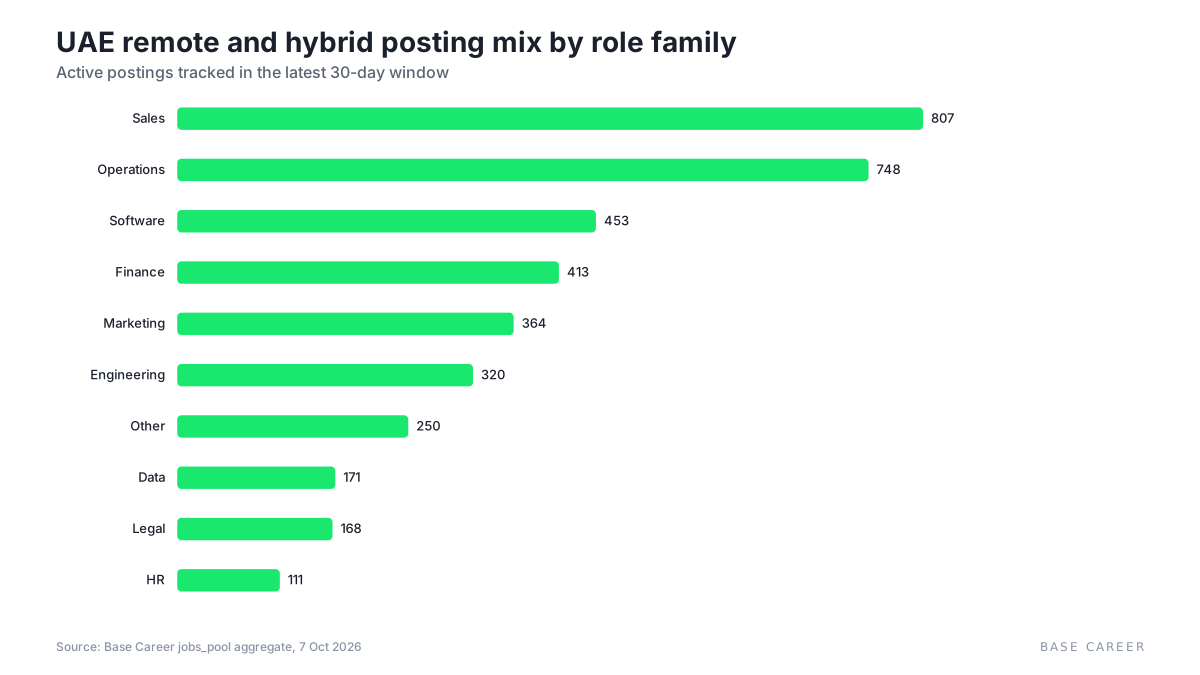
Sales led the normalised remote-and-hybrid subset with 807 records, followed by operations with 748. Software accounted for 453, finance 413, marketing 364 and engineering 320. The chart groups existing normalised role families; it does not imply that every job inside a family is fully remote or open to applicants outside the UAE.
Salary fields were too sparse for a responsible pay benchmark. Only 320 of the 4,176 remote-or-hybrid records carried a non-empty salary value, equal to 7.7%. Use the employer’s range, the contract currency, payroll location, benefits and working-time expectations instead of inferring a Dubai remote salary from a small scraped subset.
Choose the correct employment route first
Start with a simple classification. Route A is foreign employment: the organisation and employment relationship remain outside the UAE while you live and work remotely from the UAE. Route B is UAE employment: a UAE employer hires you for a local remote or hybrid role. Route C is independent work: you invoice clients or operate a business. Do not treat those routes as interchangeable.
For Route A, the UAE Government’s virtual work visa page says a foreigner may live in the UAE while working for a company outside the UAE. Its current requirements include health insurance, a medical fitness result, proof of work outside the UAE and a salary certificate showing at least US$3,500 a month or the foreign-currency equivalent.
The GDRFA Dubai service card describes the virtual work residence permit as a one-year, renewable residence without a UAE guarantor or host for someone working remotely for an organisation outside the country. The separate renewal service repeats the outside-organisation and income requirements. Check the live service card when applying because documents and charges can change.
For Route B, the UAE Government’s work-residence page distinguishes the standard work visa and states that the employer applies for it. A remote workplace label does not convert local employment into the foreign-employer virtual route. Ask the hiring organisation which employing entity, permit and payroll arrangement it will use.
Route C needs its own review. An independent contractor is not automatically an employee simply because one client pays regularly. Licensing, immigration, tax and contractual treatment can differ. If the arrangement is commercially significant or unclear, obtain qualified advice before relocating, invoicing or representing your status to a client.
Get written employer approval before relocating
A vacancy that says ‘remote’ may not authorise international remote work. Before moving or accepting an offer, ask HR, legal or the hiring manager to confirm the employing entity, permitted country of work, expected office attendance, payroll country, travel cadence, core working hours, equipment ownership, insurance, expense rules and any restriction on accessing company systems from the UAE.
This is also an employer-risk question. The Federal Tax Authority’s permanent-establishment overview explains that a fixed place or dependent-agent presence can matter for a non-resident business, while listing exclusions that depend on the facts. Do not tell an overseas employer that Dubai creates no corporate or payroll issue. Give it the location, duties and duration it needs to review the arrangement.
- Which legal entity will employ or contract with me?
- May I perform the role from the UAE, and is that approval recorded in writing?
- Which country’s payroll, benefits, holidays and insurance rules will apply?
- Could my duties include signing, negotiating or routinely concluding contracts?
- Are there client, export-control, confidentiality or data-residency restrictions?
- What overlap hours and travel are genuinely required?

“I kept getting rejections from London. Base Career rewrote my CV for Dubai, and I landed Emirates in 3 weeks.”
Sarah M. · Marketing Manager · UK 🇬🇧 → Dubai 🇦🇪
No credit card required
Handle tax claims carefully
Avoid reducing the decision to ‘Dubai means tax-free’. The Federal Tax Authority’s natural-person guidance says wages are not treated as a business or business activity for UAE corporate-tax purposes. It separately states that a natural person conducting business in the UAE enters the corporate-tax framework when the relevant annual turnover exceeds AED 1 million.
That official UAE position does not decide another country’s tax residence, filing, social-security or payroll rules. A residence permit is also not a personalised tax ruling. Your citizenship, former residence, days present, family and home ties, contract, business activity and applicable treaty can all matter. Keep immigration residence, UAE corporate-tax scope, employer exposure and home-country obligations as separate checks.
A safe offer review asks who employs you, where you work, what you do, how you are paid and which authorities can claim jurisdiction.
Build a remote-ready application
For the search itself, lead with evidence that travels. A remote employer needs confidence that you can produce outcomes without constant proximity. Replace generic claims such as ‘excellent communicator’ with concise examples of decisions documented, handovers completed, risks surfaced early, stakeholders coordinated across time zones and results delivered with limited supervision.
GitLab’s public asynchronous-work handbook treats documentation and intentional communication as core operating habits. You do not need to imitate one company’s tools. You do need examples showing that a colleague can understand context, ownership, decisions and the next action without waiting for a meeting.
- Write a short target line naming the role family, level and business outcome you support.
- Show two or three results that required independent judgement, not only task completion.
- Describe one cross-time-zone handover, written decision record or process improvement.
- State your location and work-authorisation position accurately; do not imply approval you do not hold.
- List collaboration tools only when you can explain how you used them to improve delivery.
- Keep a bounded portfolio sample that removes client, customer and employer-confidential information.
Search by arrangement, not by the word remote
Use Base Career’s current jobs directory to inspect live role language, then verify the original employer route. Search your primary title with location and workplace filters, but add adjacent terms that describe the operating model: distributed, regional, home-based, hybrid, asynchronous or time-zone coverage. The goal is to find the employer’s actual constraints, not to collect as many remote-labelled results as possible.
Create two lanes. In the UAE-employer lane, confirm the office location, attendance expectation and employment route. In the overseas-employer lane, confirm whether the company can employ someone resident in the UAE and whether it permits the work to be performed there. Keep contractor opportunities in a separate lane because the commercial and compliance questions differ.
For discovery-channel strategy, see Base Career’s refreshed guide to the best job sites in Dubai. Use job boards to find vocabulary and employers, then confirm the vacancy, entity and application route on the employer’s own site. A copied listing or recruiter message is not enough evidence for a relocation decision.
Treat data security as part of employability
Remote eligibility can fail even when a manager likes the idea. The UAE Cyber Security Council’s National Secure Remote Work Policy emphasises governance, secure remote access, device controls, data protection and compliance with legal, regulatory and contractual obligations. An employer may therefore restrict countries, devices, networks or data access for valid security reasons.
Ask which device you must use, how multi-factor authentication works, whether local storage is prohibited, which communication services are approved and what to do during an incident. Never route around an employer restriction or claim to be in another country. A credible candidate treats access controls and data-location rules as part of the job, not as obstacles to conceal.
Evaluate the offer beyond headline pay
Compare the contract in its actual currency and legal form. Clarify base compensation, variable pay, payment schedule, exchange-rate exposure, benefits, leave, notice, probation, equipment, travel, expense reimbursement and dispute terms. If equity is offered, ask what instrument it is, which entity issues it, what vesting and exercise rules apply and what happens when the relationship ends.
Then test the working day. A role can be location-flexible but time-zone rigid. Ask how many meetings require real-time attendance, when decisions are normally made, whether customers expect local hours and how urgent work is handled. A sustainable schedule is more valuable than an impressive salary attached to permanent late-night availability.
A focused application workflow
- Classify the opportunity as foreign employment, UAE employment or independent contracting.
- Verify the employer and original vacancy before sharing sensitive documents.
- Confirm permitted work location, employing entity, residence or work route and payroll arrangement.
- Tailor the CV around remote-operating evidence: outcomes, documentation, handovers and ownership.
- Ask about security, data, equipment, travel and overlap hours before accepting.
- Review tax and employer-risk questions with qualified advisers where the facts are material.
- Record the decision, documents requested, approvals received and next action.
Run the workflow on a small group of well-matched roles and review response quality. If employers reject the location arrangement, do not hide it; refine the target list toward companies that can support your route. If interviews stall on remote-readiness, strengthen evidence of ownership, written communication and distributed delivery rather than adding more generic tool names.
What this data cannot tell you
The Base Career snapshot does not measure unique employers, interview probability, hiring speed, international work permission, sponsorship, compensation quality or whether a role remains open when you visit it. Workplace labels can be incomplete or inconsistent across sources. The aggregate is useful for seeing where remote and hybrid language appears; the employer and responsible authorities remain the sources of truth for a specific arrangement.
The current evidence supports a disciplined conclusion: remote and hybrid language exists across several UAE role families, but the eligible arrangement must be verified role by role. Start with the employment route, secure written approval, build proof that you can operate asynchronously and review the contract as a cross-border system rather than a lifestyle slogan.
Frequently asked questions
Frequently Asked Questions
Can I live in Dubai and work for a company outside the UAE?+
Does a remote job label mean I can work from Dubai?+
Can the virtual work route be used for a UAE employer?+
Which UAE role families currently show remote or hybrid listings?+
What should a remote-ready CV prove?+
Sources and methodology
External sources were accessed on 7 October 2026: the UAE Government pages for working outside and inside the UAE; GDRFA Dubai’s virtual work residence issuance and renewal service cards; the Federal Tax Authority pages on natural persons and permanent establishments; the UAE Cyber Security Council’s National Secure Remote Work Policy; and GitLab’s public asynchronous-work handbook.
Base Career figures came from an aggregate query against the self-hosted production jobs_pool. It filtered active records to country UAE and a scrape date within the trailing 30 days, then grouped normalised workplace and role-family fields. No individual jobs, descriptions, users, CVs, applications or customer records were retrieved. Totals may include repeated campaigns, changing source coverage and incomplete fields.
Stay ahead of the market. Join Base Career Today.
Turn market shifts into a clearer application workflow with resume tailoring and tracking in one place.
Start freeNo credit card required

James T.
Canada 🇨🇦 → Riyadh 🇸🇦
“50 applications, zero replies with my Canadian CV. Base Career got me 4 Riyadh interviews and a Series B offer.”
Written by Base Career Research Team
Produced by the Base Career Research Team with AI, using Base Career job-market data, and published automatically. How our articles are made
Related Posts

Moving from the UK to Dubai: Why a Job Offer is Non-Negotiable
Planning a move from the UK to Dubai? Discover why arriving without a job is a financial risk and how to secure a role from home to avoid the 'low-pay trap.'

Building 'Wasta' from Scratch: Networking Strategies for Dubai Expats
Frustrated by 1,000+ applicants on LinkedIn? Learn how to build 'Wasta'—your professional network—from zero to access the UAE's hidden job market.