From 3,000 to 30,000 AED: Escaping the Low Salary Trap in Dubai

It is the most common debate in the UAE job market, often discussed in hushed tones among expats or debated fiercely on Dubai-centric Reddit threads. The scenario is almost always the same: A qualified professional from South Asia or a developing nation arrives in Dubai, struggles to land a role, and eventually receives an offer for 3,000 to 4,000 AED.
The advice they receive is polarized. One camp says, "Don't accept it; you destroy the market for everyone else." The other camp argues, "Take it as a foot in the door. Once you have 'UAE Experience,' you can jump to 15,000 or 25,000 AED."
At basecareer.co, we analyze thousands of career trajectories. The data suggests that while the "foot in the door" strategy sounds logical, it often leads to a phenomenon known as the Low Salary Trap. Escaping a 3,000 AED salary to reach 30,000 AED is not just difficult—without a calculated strategy, it is statistically improbable for many. Here is why the trap exists and, more importantly, how you can engineer an escape.
The Mathematics of Salary Anchoring
The biggest enemy of the low-salary employee in Dubai is Salary Anchoring. In the Middle East, unlike in some Western jurisdictions where asking for salary history is illegal, recruiters almost always ask: "What is your current monthly salary?"
This number becomes the anchor for your next negotiation. Most HR departments in the UAE operate within fixed bands for salary hikes—typically offering a 15% to 30% increase on your current pay for a job switch.
- Scenario A: You start at 15,000 AED. A 30% jump takes you to 19,500 AED.
- Scenario B: You start at 3,000 AED. A massive 50% jump (rare) takes you to 4,500 AED.

If you start at 3,000 AED, reaching 25,000 AED solely through standard increments or "reasonable" job hops requires you to multiply your income by more than 8x. In a standard corporate environment, that kind of multiplication takes decades, not years. The market perceives your value based on your price tag, and breaking that perception is the hardest hurdle to clear.
The 'Survival Job' Paradox
Many job seekers believe that accepting a survival job allows them to hunt for better roles while covering their bills. However, the reality of a 3,000 AED job in Dubai is often a 6-day work week, 10-hour shifts, and a commute that consumes two hours daily. This leaves zero bandwidth for upskilling, networking, or attending interviews.
A survival job keeps you alive, but often kills your career momentum. You become too exhausted to find the exit.
Furthermore, the type of company that pays 3,000 AED is rarely the type of company that impresses a recruiter at a multinational corporation (MNC). These roles are often in disorganized SMEs where you wear ten hats but master none. When you apply for a specialized role at a top-tier firm later, your resume may reflect "jack of all trades" chaos rather than the specialized expertise high-paying employers demand.

“I kept getting rejections from London. Base Career rewrote my CV for Dubai, and I landed Emirates in 3 weeks.”
Sarah M. · Marketing Manager · UK 🇬🇧 → Dubai 🇦🇪
No credit card required
Internal Promotions vs. Strategic Job Hopping
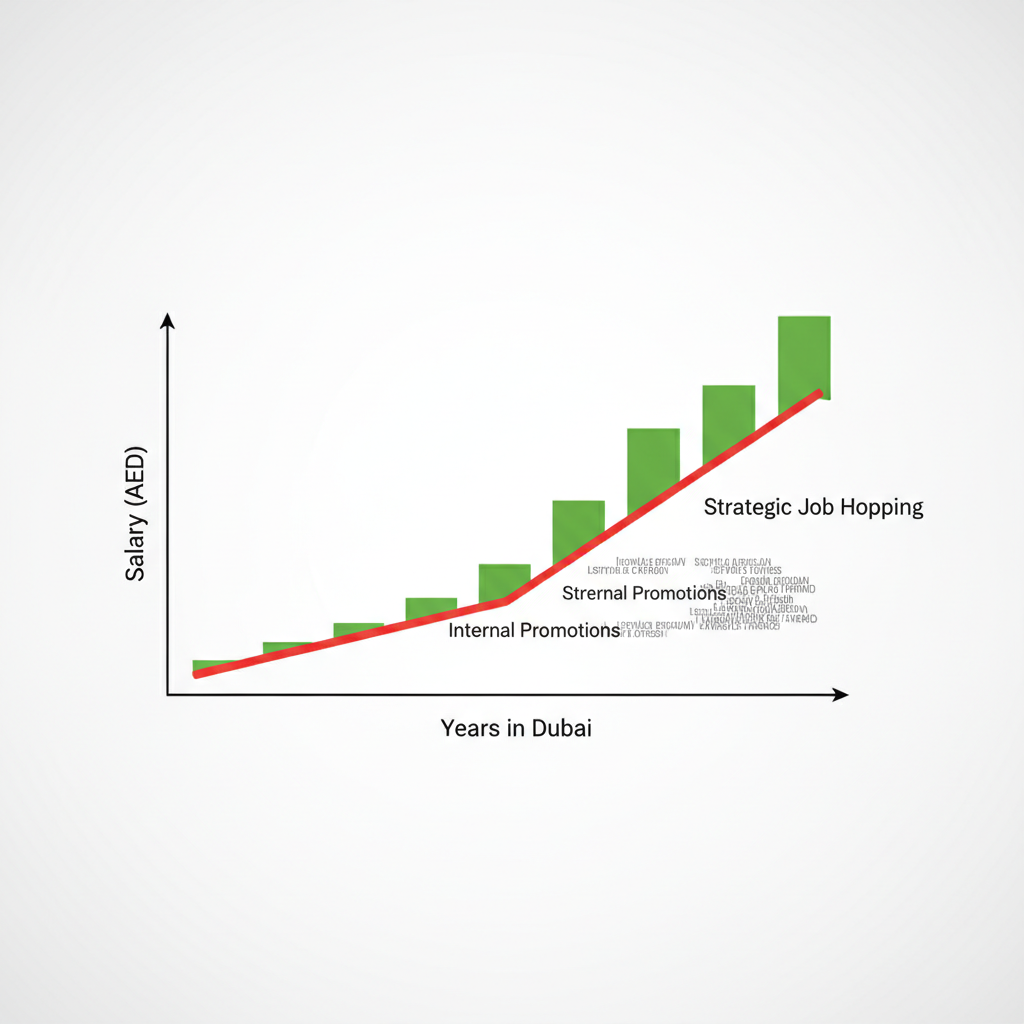
Can you stay in one company and climb from 3k to 30k? In 99% of cases, the answer is no. Internal promotions in the UAE are notoriously conservative regarding salary adjustments. Even if you are promoted from a Junior Executive to a Manager, if you were earning 4,000 AED, the company is unlikely to bump you to the market rate of 18,000 AED. They might offer you 7,000 AED and call it a "generous" 75% raise.
Strategic Job Hopping is the only viable escalator. To bridge the gap, you cannot take linear steps; you must take exponential leaps. This usually requires a specific three-step maneuver:
- Step 1: The Validation Role (1-2 Years): Accept the lower salary only if the title is strong and the company has some name recognition. Use this time to build a portfolio of tangible results.
- Step 2: The Correction Jump (Year 3): Move to a different company, refusing to disclose your previous salary slip until the offer stage, or negotiating based on market value rather than a percentage hike. This is where you aim to reset your anchor from 4k to 10-12k.
- Step 3: The Tier Upgrade (Year 5+): Move from a local SME to an MNC or a government-semi-government entity. This is where the leap to 25k-30k happens.
Breaking the Salary History Taboo
To execute the "Correction Jump," you must master the art of negotiation. When a recruiter asks for your current salary, and you know it is drastically below the market rate for the role you are applying for, you have two options:
1. The Honest Pivot:
"I am currently on a salary that reflects a different scope of work/entry-level position. However, for this role, based on the responsibilities and market standards, I am targeting the range of AED 15,000 - 18,000."
2. The Market Value Stance:
"I prefer to focus on the value I bring to this specific role. My research indicates this position typically pays between X and Y. Is that within your budget?"
If you simply hand over your pay slip showing 3,500 AED, you hand over all your leverage. Companies hire based on budget. If they have budgeted 20,000 AED for a role, they can pay it. But if they see they can get you for 8,000 AED, they will save the difference.
The Skill Arbitrage: How to Justify the Leap
You cannot demand 30,000 AED with 3,000 AED skills. The Dubai market pays a premium for three things:
- Specialized Tech/Data Skills: Proficiency in Python, SQL, Advanced CRM management, or digital transformation tools.
- Revenue Generation: Sales roles with proven track records of closing deals in the UAE market.
- Western/Global Communication Standards: High-level business English, presentation skills, and the ability to manage stakeholders.
If you are stuck in the low salary trap, your evenings and weekends must be dedicated to upskilling. A certification in Data Analytics or Project Management (PMP) can be the catalyst that allows you to apply for roles in entirely different salary brackets.

Conclusion: Patience vs. complacency
Is it possible to go from 3,000 to 30,000 AED? Yes. We see it happen on basecareer.co. But it is rarely a straight line. It requires realizing that your first job is just a visa sponsor, not your destiny. It requires the courage to negotiate, the discipline to upskill, and the resilience to apply for jobs that feel "out of your league."
Don't let a low start define your worth in the market forever. Automate your job search, target better companies, and build the career you deserve.
Ready to upgrade your search? Join Base Career today and let our AI agents find the opportunities you might be missing.
Get hired faster in 25 days. Join Base Career Today.
Run a more organized search so you can reach better-fit roles with more leverage.
Start freeNo credit card required

James T.
Canada 🇨🇦 → Riyadh 🇸🇦
“50 applications, zero replies with my Canadian CV. Base Career got me 4 Riyadh interviews and a Series B offer.”
Written by Base Career Research Team
Produced by the Base Career Research Team with AI, using Base Career job-market data, and published automatically. How our articles are made
Related Posts

Landing Your First Dubai Job: A Roadmap for Freshers and Graduates
Breaking into the UAE job market with zero experience is tough but not impossible. Here is your strategic roadmap to landing that first role in Dubai.

Building 'Wasta' from Scratch: Networking Strategies for Dubai Expats
Frustrated by 1,000+ applicants on LinkedIn? Learn how to build 'Wasta'—your professional network—from zero to access the UAE's hidden job market.