Australia Employer-Sponsored Jobs: A 482 Search Guide

Searching for Australia employer-sponsored jobs is not the same as searching for every vacancy in Australia. A role can match your skills and still be unavailable to an overseas applicant. A listing can mention relocation without committing to sponsorship, while another employer may consider sponsorship only after confirming the occupation, duties, pay, location and candidate. The useful question is not simply ‘who sponsors?’ but ‘which real role, under which current pathway, with which employer evidence?’
This guide narrows that problem into a practical search and verification workflow. It combines a fresh aggregate of Australian postings tracked by Base Career with current Australian Government sources on skilled occupations, labour shortages, workplace rights, business identity and migration assistance. It is general career information rather than migration or legal advice. Always use the live government pages for a personal visa decision.
Treat sponsorship as a verified hiring arrangement, not a keyword, badge or promise in a message.
What current Australian posting data shows
Base Career tracked 55,252 active Australian posting records scraped in the trailing 30 days at the time of this analysis on 9 October 2026. This is a directional view of the available pool, not a count of sponsorship offers, unique employers or completed hires. Source coverage, repeated campaigns and changing vacancy status can affect the total.
The most-posted exact title was Store Team Member with 426 records. It was followed by Registered Nurse with 219, Classroom Teacher with 165, Crew Member with 143 and Project Manager with 113. Administration Officer, Storeperson and Employment Consultant completed the charted group with 105, 101 and 100 records respectively.
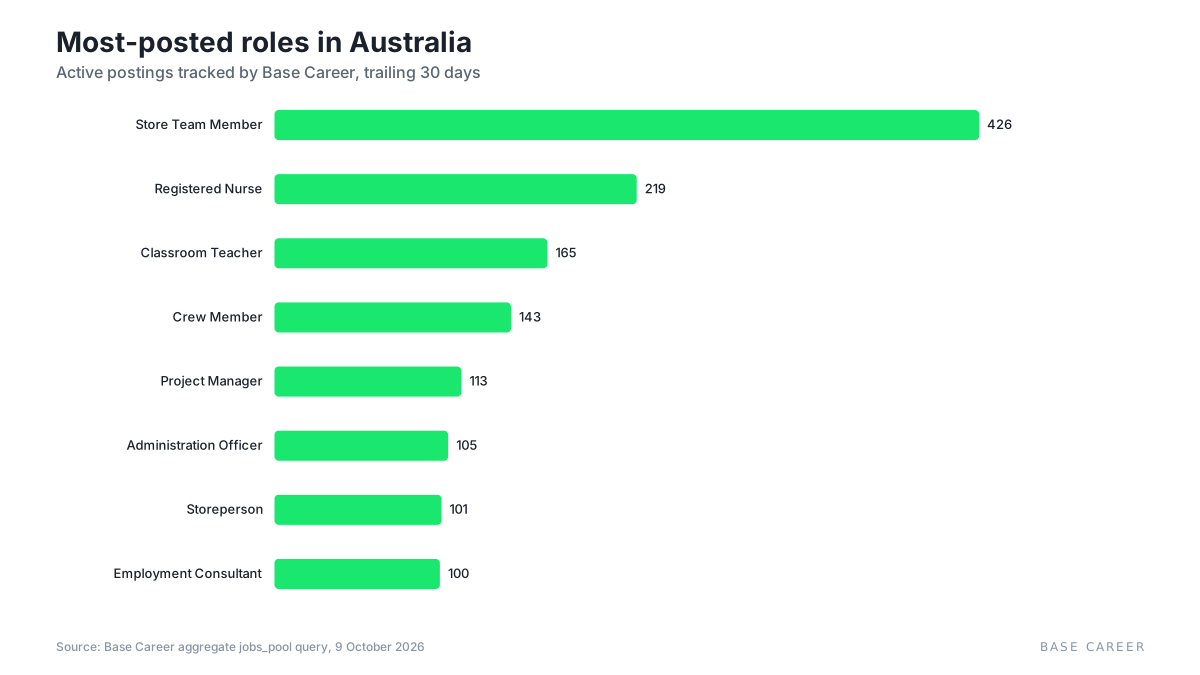
The mix matters because vacancy volume and sponsorship eligibility answer different questions. High-volume retail and crew titles may create many search results, but that does not establish an employer-sponsored route. Nursing and teaching appear prominently in the same aggregate, yet regulated occupations can require registration or assessment beyond a job offer. Use the chart to understand the wider market, then apply a separate occupation-and-employer check.
The data also shows why broad searches can waste time. A title search may return a large pool whose work-right wording is unsuitable for an overseas applicant. Conversely, a smaller specialist or regional pool may be more relevant when the occupation, employer need and immigration pathway align. Relevance beats raw result count.
Shortage does not automatically mean sponsorship
Jobs and Skills Australia reported that 29% of assessed occupations were in shortage in its 2025 Occupation Shortage List, down from 33% in 2024 and 36% in 2023. Its summary says shortages remained particularly visible in health, education, construction and trades. That official evidence is useful for targeting, but it is not a promise that every employer in those fields will sponsor an overseas candidate.
The Jobs and Skills Australia shortage resource defines shortage in terms of employers having difficulty filling vacancies at prevailing pay and conditions in reasonably accessible locations. It also distinguishes national, metropolitan and regional patterns. Your search should therefore be occupation-specific and location-aware rather than based on a claim that an entire industry is desperate for workers.
Shortage data can guide where to investigate. It cannot replace the employer’s vacancy, the Department of Home Affairs occupation rules, professional registration, a skills assessment where required, or a genuine nomination. Keep those checks separate so one encouraging signal does not become an unsupported conclusion.
Understand the employer-sponsored route you are discussing
The Department of Home Affairs publishes the Skills in Demand visa, subclass 482, as an employer-sponsored route. The current visa page and its stream pages are the authority for eligibility, evidence and application requirements. Do not rely on an old article that still describes the former programme as though nothing changed.
Home Affairs also maintains the skilled occupation list. The page connects eligible occupations to the relevant visa programmes, provides occupation codes and points to the applicable legislative instruments. Search by the duties you actually perform, not only the title printed on your CV. Similar titles can map to different occupational classifications.
An occupation appearing on a relevant list is an eligibility signal, not an offer. The employer still needs a genuine position and must complete its side of the process. The candidate still needs to satisfy the applicable visa criteria. Regulated work may require registration or licensing before employment can begin, and some roles may involve a designated skills-assessment authority.
A credible sequence is role first, occupation match second, employer confirmation third, and application evidence after that.
Why ‘sponsorship available’ is not enough
Job-board wording can be useful for discovery, but it is not the final source of truth. ‘Sponsorship available’, ‘may sponsor’, ‘transfer considered’ and ‘relocation support’ describe different levels of commitment. A copied listing may also be stale or stripped of its original conditions. Open the employer’s own careers page and confirm that the vacancy, location and contact route are genuine.
Ask the employer a bounded question: is sponsorship available for this specific role and candidate profile, which employing entity would make the nomination, and at what stage will the employer assess it? A recruiter who cannot answer immediately may still be legitimate, but you should not fill the gap with assumptions. Record the answer and any conditions in writing.
- Does the employer’s own careers site show the same vacancy, title and location?
- Does the role’s duty profile match the occupation being discussed, rather than only sharing a similar title?
- Is sponsorship confirmed for this vacancy, merely possible after assessment, or unavailable?
- Which Australian legal entity would employ and nominate the successful candidate?
- Are professional registration, licensing, English evidence or a skills assessment relevant before work can start?
- Who is paying each legitimate recruitment, nomination, advice and application cost?

“I kept getting rejections from London. Base Career rewrote my CV for Dubai, and I landed Emirates in 3 weeks.”
Sarah M. · Marketing Manager · UK 🇬🇧 → Dubai 🇦🇪
No credit card required
Verify the employer before sharing sensitive documents
Use the Australian Government’s ABN Lookup to check public business identity information. It can show whether an Australian Business Number is active or cancelled and display public entity details. An active record does not prove that a vacancy or sponsorship promise is genuine, but a mismatch between the recruiter’s claimed employer and the public business identity is a reason to stop and investigate.
Cross-check the company domain, careers page, recruiter email domain, business name, office details and interview process. Be careful when the only contact channel is a personal messaging account, when the sender creates artificial urgency, or when the ‘employer’ refuses a normal video or telephone interview. Never send passport scans, bank information or identity documents merely to reserve an interview.
If you pay for immigration assistance, verify the provider. The Office of the Migration Agents Registration Authority register lets you search for registered migration agents. Home Affairs warns that paid immigration assistance must come from an authorised provider, such as a registered migration agent or an Australian legal practitioner.
Know the red flags that official guidance identifies
The Fair Work Ombudsman’s guidance for visa holders and migrants states that migrant workers have the same workplace rights and protections as other employees. It also says that paying for visa sponsorship is illegal. An employer asking you for money in exchange for sponsorship, or demanding that you return part of your wages, is not a normal shortcut.
Home Affairs’ migrant-worker protection guidance identifies further warning signs: passport retention, threats about visa cancellation, underpayment, pressure to work outside visa conditions, repayment demands for sponsorship or recruitment costs, and duties that differ from the approved job. It also explains that employers do not personally cancel visas; the responsible government decision-makers handle visa decisions.
- Do not pay an employer, recruiter or intermediary for the promise of a sponsored position.
- Do not accept a contract with a different employer, occupation or location from the arrangement explained to you.
- Do not let urgency prevent you from verifying the company, adviser and original vacancy.
- Do not conceal facts or submit documents you know are false, even if an intermediary says it is standard practice.
- Keep copies of the vacancy, offer, contract, receipts and written sponsorship statements.
- Use official reporting and advice channels when a demand or threat appears improper.
Build a search around occupations and evidence
Start with one primary occupation family and a small number of credible adjacent titles. Map your actual duties, qualifications, registration status and recent experience before applying. If you target unrelated roles simply because they mention sponsorship, your CV becomes less credible and your occupation evidence becomes harder to explain.
Use Base Career’s current jobs directory to inspect active role language and employer patterns. Combine the occupational title with terms such as employer sponsored, Skills in Demand, regional, relocation or the relevant professional registration. Those terms are discovery aids; every result still needs employer and occupation verification.
Keep three search lanes. The first contains vacancies that explicitly confirm sponsorship for the role. The second contains employers that say they may assess sponsorship for a suitable candidate. The third contains strong role matches with no sponsorship statement, where a concise question is appropriate before a long application. Do not mix the lanes when measuring response rates.
Target the current market without over-reading it
The Base Career aggregate suggests several practical research lanes. Registered nursing and classroom teaching combine visible posting volume with sectors that Jobs and Skills Australia says continue to experience shortages. Project management appears across industries but requires closer duty matching. Retail and crew roles have volume, yet volume alone is a weak basis for an overseas sponsorship strategy.
For nursing, teaching, allied health, licensed trades and other regulated work, investigate the responsible registration or assessment body before presenting yourself as immediately employable. A recruiter may value your experience while still being unable to progress you until formal evidence is available. State your current stage accurately: eligible to assess, assessment underway, registration held, or not yet checked.
For a broader market orientation, read Base Career’s guide to getting hired in Australia. That cornerstone covers the wider hiring process. This article has a narrower purpose: finding and verifying employer-sponsored opportunities without mistaking general demand for immigration eligibility.
Make the application easy to evaluate
A sponsorship-capable employer still hires for business value. Your opening summary should name the occupation, level, specialism and location flexibility. The first half of the CV should make relevant duties and outcomes easy to compare with the vacancy. Avoid leading with a long immigration request before showing why the employer should assess you.
Use evidence that can be checked: service volumes, project scale, safety results, quality improvements, delivery timelines, team scope, systems used and regulated responsibilities. Explain the context and your contribution without exposing customer, patient or employer-confidential data. Generic claims such as ‘hard-working’ or ‘willing to relocate’ are not substitutes for occupational fit.
- Match the role’s core duties with concise examples from recent work.
- Name required registrations, licences or assessments and state your exact current status.
- Show outcomes and scope, not a catalogue of every task you have performed.
- State your present location and work-right position honestly.
- Make availability for interviews and relocation planning clear without promising an impossible start date.
- Tailor the cover note to the employer’s need rather than sending a generic sponsorship appeal.
Questions to ask during the hiring process
Timing matters. Ask a short sponsorship question before investing in a lengthy process when the listing is ambiguous. Once the employer confirms interest, ask which entity employs the role, whether the position has been assessed for the relevant pathway, which evidence the employer expects from you, and whether any registration or skills assessment must be completed first.
At offer stage, compare the job title, duties, work location, hours, salary terms, probation, leave, relocation support, notice and any repayment clause. If an adviser is involved, confirm their identity and role. If the final contract differs materially from what was discussed for sponsorship, pause until the employer and a qualified adviser explain the difference.
A focused weekly workflow
- Choose one occupational target and verify its current Home Affairs treatment.
- Build a list of real employers from original careers pages and reputable job sources.
- Classify each vacancy by sponsorship certainty rather than counting every search result equally.
- Verify business identity and adviser registration before sending sensitive material or money.
- Submit tailored applications that prove occupational fit and make your evidence status explicit.
- Record employer answers, follow-up dates, interview outcomes and the reason each opportunity progressed or stopped.
- Review the pattern and refine the employer list, duties language or evidence gap for the next search cycle.
The purpose of the workflow is not to maximise application volume. It is to reduce false positives, identify employers with a real need, and present evidence in a format they can assess. A smaller verified pipeline is safer and usually more informative than hundreds of applications based on a sponsorship keyword.
What the data cannot tell you
The Base Career snapshot cannot tell you whether an employer is approved to sponsor, whether a role maps to an eligible occupation, whether a candidate satisfies visa criteria, whether registration will be granted, or whether an advertised position remains open. It does not measure interview or visa outcomes. No individual job descriptions, applicants, users, CVs or customer records were used for this analysis.
The responsible conclusion is practical: Australia has a large and varied vacancy pool, and official shortage evidence points to persistent needs in selected fields. But an employer-sponsored search succeeds only when the occupation, duties, employer, candidate evidence and current government pathway align. Verify each layer before treating an opportunity as real.
Frequently asked questions
Frequently Asked Questions
Does a job saying sponsorship available guarantee a subclass 482 visa?+
How do I check whether my occupation is relevant to employer sponsorship?+
Which Australian fields currently show persistent shortages?+
Can an employer charge me for the promise of sponsorship?+
How can I verify an Australian employer or migration adviser?+
What should I say about sponsorship in an application?+
Sources and methodology
External sources were accessed on 9 October 2026: Department of Home Affairs pages for the Skills in Demand subclass 482 visa, skilled occupation lists and migrant-worker protections; Jobs and Skills Australia’s Occupation Shortage List resources and summary; the Fair Work Ombudsman’s visa-holder guidance; Australian Government ABN Lookup; and the OMARA register of migration agents. SEEK results were reviewed as live public search evidence of user and employer vocabulary, but were not used for legal claims or article statistics.
Base Career figures came from an aggregate query against the self-hosted production jobs_pool. It filtered active records to country AUS and a scrape date within the trailing 30 days, then grouped exact titles. No individual rows, job descriptions, users, resumes, applications or private records were retrieved. The counts are posting records tracked by Base Career, not a census of the Australian labour market or a measure of sponsorship availability.
Land 4x more interviews in 27 days. Join Base Career Today.
Track applications, tailor resumes, and follow up faster in one UAE job search system.
Start freeNo credit card required

James T.
Canada 🇨🇦 → Riyadh 🇸🇦
“50 applications, zero replies with my Canadian CV. Base Career got me 4 Riyadh interviews and a Series B offer.”
Written by Base Career Research Team
Produced by the Base Career Research Team with AI, using Base Career job-market data, and published automatically. How our articles are made
Related Posts

Is it Easy to Get a Job in Dubai From Overseas? The Honest Truth
Dreaming of a tax-free salary in Dubai but living abroad? We analyze the challenges of international applications and share a strategic roadmap for success.

Landing Your First Dubai Job: A Roadmap for Freshers and Graduates
Breaking into the UAE job market with zero experience is tough but not impossible. Here is your strategic roadmap to landing that first role in Dubai.