How to Get Hired in Australia in 2026: A Practical Guide

Getting hired in Australia is not one generic process. Your strongest route depends on the work you can legally do, the role family where your evidence is credible, and the locations where employers are actually advertising. This refreshed guide combines a current Base Career posting snapshot with official Australian labour-market, pay and immigration sources. It is designed to help you narrow your search—not to promise an interview, sponsorship or visa outcome.
A better Australia job search separates market demand, role fit and work rights before the first application is sent.
What the current Australian job pool shows
Base Career tracked 111,746 active Australian postings scraped during the thirty days ending 21 September 2026. That is a much broader tracked pool than the one used in the August version of this guide. The change reflects expanded source coverage as well as live inventory, so it must not be read as proof that the whole Australian market grew by the same amount. The figures below are directional aggregates from jobs_pool, not a census of every vacancy.
The sample is large enough to reveal useful search lanes, but it does not measure applicant competition, interview rates, sponsorship availability or offer probability. Similar vacancies can also appear under different titles. Use the counts to build a shortlist, then verify the original vacancy on the employer’s own site before applying.
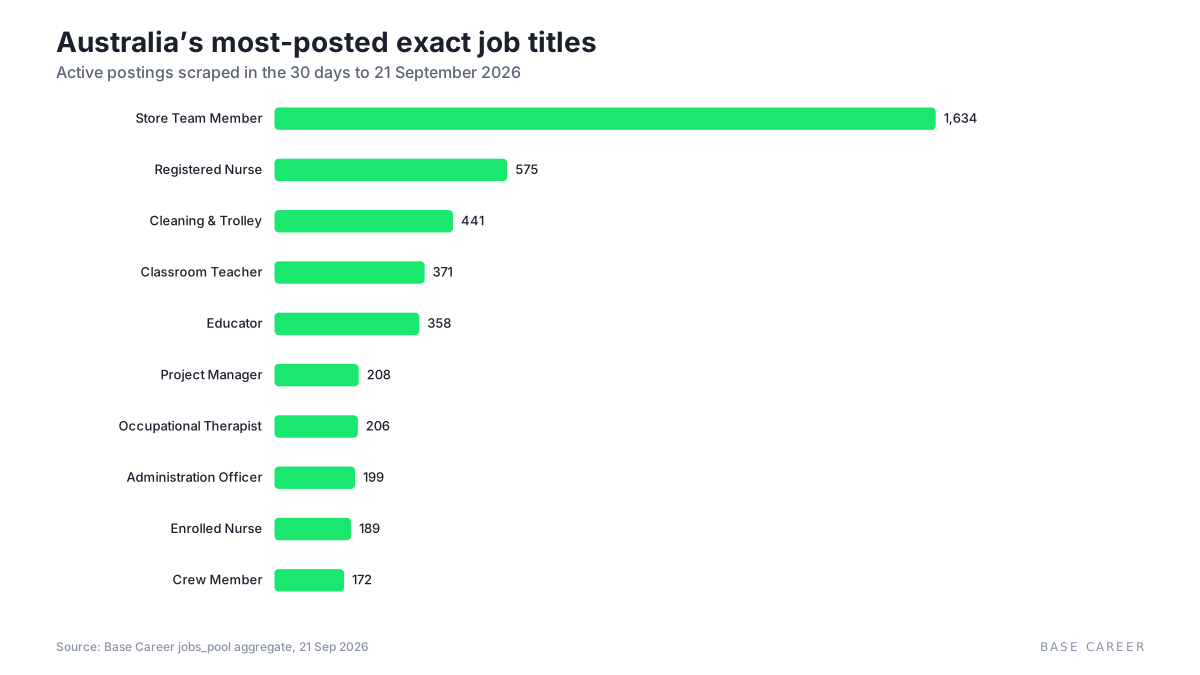
Exact titles point to several distinct hiring lanes
Store Team Member was the most repeated exact title with 1,634 postings. Registered Nurse followed with 575, while Cleaning and Trolley Collection had 441. Education was also visible: Classroom Teacher appeared 371 times and Educator 358 times. These are title counts, not occupational forecasts, and one employer campaign can create many similar records.
Professional and care roles appeared further down the exact-title list: Project Manager had 208 postings, Occupational Therapist 206, Administration Officer 199, Enrolled Nurse 189, and Crew Member 172. The mix supports a role-first strategy: retail, health, education, project delivery and administration require different evidence, credentials and work-right conversations.
- Choose one primary role family that matches your recent evidence.
- Add only genuinely adjacent titles; do not treat every high-volume title as a target.
- Collect recurring requirements from live advertisements without copying job-description text.
- Separate mandatory registration or licences from skills that can be learned after hiring.
- Record whether each vacancy is open to your current work-right position before tailoring an application.
Sydney leads the named-city counts, but city volume is not fit
The largest named-city totals were Sydney with 14,484 postings, Melbourne with 9,536, Brisbane with 6,942, Perth with 3,775, Adelaide with 2,507 and Canberra with 1,344. A further 15,548 records had no usable city value. Because the missing-location group is large, the named-city figures are search signals rather than complete market shares.
Do not choose a city on volume alone. Compare the concentration of your specific title family, on-site expectations, commute feasibility, professional registration, living costs and the employer’s actual workplace. Regional opportunities can be important for some occupations and visa pathways, but “regional” has an official migration meaning; check the current Department of Home Affairs definition rather than assuming every location outside Sydney or Melbourne qualifies.
Browse current Australia jobs on Base Career to test title and location combinations. Use the result to create a manageable search map, then confirm role details on the hiring organisation’s official careers page.
National indicators say demand exists, not that every candidate has an easy market
The Australian Bureau of Statistics reported a seasonally adjusted 4.5% unemployment rate for July 2026. It also reported 14,807,200 employed people and an employment-to-population ratio of 63.9%. The ABS warns that short-term movements should be interpreted carefully and that trend data are the better measure of underlying behaviour. See the ABS Labour Force release (accessed 21 September 2026).
Jobs and Skills Australia reported 212,200 seasonally adjusted online job advertisements in July 2026, up 2.7% over the month and around 25% above the 2019 monthly average. Its Internet Vacancy Index is a proxy for recruitment activity, not a count of hires. See the official IVI release (accessed 21 September 2026).
Its latest published Occupation Shortage List said 29% of occupations were in shortage in 2025, down from the previous two releases. Nearly half of trade roles and two in five professional occupations remained in shortage, particularly across health, education and construction. That context aligns with several strong title signals in Base Career’s pool, but an occupation shortage does not remove employer, registration or work-right requirements. See Jobs and Skills Australia’s shortage summary (accessed 21 September 2026).
Start with work rights, not a generic application blast

“I kept getting rejections from London. Base Career rewrote my CV for Dubai, and I landed Emirates in 3 weeks.”
Sarah M. · Marketing Manager · UK 🇬🇧 → Dubai 🇦🇪
No credit card required
If you need permission to work in Australia, use the Department of Home Affairs as the source of truth. Home Affairs explains that some people hold visas with work rights that do not require employer sponsorship, while other routes require an approved sponsor, a nomination and a separate visa application. Conditions differ by visa type, and some visas restrict hours or the length of work with a particular employer. Review Home Affairs’ employer and sponsorship options (accessed 21 September 2026).
For employer-sponsored routes, the role usually needs to be on the relevant skilled occupation list unless a valid labour-agreement route applies. The official list connects occupations to visa programs, occupation codes, caveats and assessing authorities. Check the current skilled occupation list (accessed 21 September 2026) and then read the page for the exact visa you are considering. A shortage label, recruiter message or job-board filter is not proof of eligibility.
State your current position accurately and briefly. Examples include unrestricted work rights, a current visa with stated conditions, or a need for employer sponsorship. Do not claim that a pending application is approval. If your circumstances are complex, use a registered migration professional; this article is a job-search guide, not migration advice.
Check pay against the right award or agreement
A usable salary value appeared in 22,418 of 111,746 postings, a field-coverage rate of 20.06%. That is not enough to treat the mixed pool as a national salary benchmark. Salary visibility can differ by occupation, state, seniority, hours and source, and a populated field is not proof that the value was normalised consistently.
The Fair Work Ombudsman states that, from 1 July 2026, the National Minimum Wage is AUD 26.44 per hour or AUD 1,004.90 per week for employees not covered by an award or registered agreement. Many employees are covered by an award or agreement with different applicable rates, penalties and allowances. Check the official Fair Work minimum-wage guidance and its Pay and Conditions Tool (accessed 21 September 2026).
Compare any offer on the correct basis: annual versus hourly pay, ordinary hours, casual loading, superannuation, penalties, allowances and contract type. Treat a pay figure in an advertisement as a prompt for verification, not the final interpretation of the package.
Use posting lifetime as a workflow clue, not a deadline guarantee
Among 1,978 tracked records with a plausible posted and expiry date in the latest ninety-day query, the median interval was 27.9 days. This subset excludes missing dates and implausibly long intervals, and an advertised closing date does not prove the employer will wait until that date to shortlist. The practical lesson is to keep your evidence ready and apply promptly when the fit is real, without sacrificing accuracy.
Build an Australian-ready résumé that is easy to verify
Use a clear, reverse-chronological structure with familiar headings such as Summary, Experience, Education, Skills and Certifications. Keep dates, employers and locations consistent. Avoid putting essential evidence inside decorative graphics, skill bars or multi-column layouts that can be read out of order by applicant tracking systems.
The opening section should name the work you actually do, show the strongest relevant evidence and make your location or work-right status clear where the employer asks for it. Match accurate terminology from the vacancy, but never add a tool, credential or responsibility that you cannot defend in an interview.
Achievement bullets work best when they explain context, action and outcome. Numbers can make evidence concrete, but only include figures you can verify. Protect confidential customer, patient, employer and commercial information. A strong résumé is specific without exposing private data.
Australian English is the safest default for spelling and tone. A photograph, date of birth, marital status and unrelated identity details are usually unnecessary. Follow the file-format instruction in the vacancy rather than assuming PDF is always preferred. For a broader comparison of evidence-led applications, see Base Career’s UK jobs and CV guide; adapt the method, not country-specific legal details.
If you are applying from overseas
Overseas applicants should answer three questions before spending time on a tailored application: can the employer legally hire for this role, does the vacancy indicate that sponsorship or offshore candidates are considered, and does your specialist evidence justify the extra complexity? If any answer is unclear, verify it rather than hiding your location or selecting an inaccurate work-authorisation response.
Where sponsorship is plausible, show why the role is difficult to fill with a generic candidate. That might be a regulated qualification, scarce technical experience, sector knowledge, language capability tied to the work, or a record of delivering a comparable outcome. Do not lead with migration needs while leaving role value unexplained.
Check professional registration separately from visa eligibility. Nurses, teachers, therapists, tradespeople and other regulated professionals may need approval from a profession- or state-specific authority. The presence of a title on a visa occupation list does not itself authorise professional practice.
Run a search that produces useful feedback
Workforce Australia offers a government job-search platform with job listings, profiles, alerts and application tools. Its guidance encourages genuine applications that match a candidate’s skills, experience and qualifications. See Workforce Australia for job seekers (accessed 21 September 2026). Major commercial boards can broaden discovery, but the employer’s official careers page should be the final verification point.
- Define one primary role family, one adjacent lane and a realistic location set.
- Create saved searches using accurate title variants rather than one broad keyword.
- Shortlist only roles where essential criteria, work rights and location are plausible.
- Tailor the summary and evidence order while keeping facts consistent.
- Record source, employer, role, city, work-right requirement, date and outcome.
- Review responses weekly and change one variable at a time.
If relevant applications produce no screening calls, inspect role targeting, evidence clarity and work-right fit before increasing volume. If recruiter conversations stall, improve positioning and examples. If interviews stall, strengthen role knowledge, outcome stories and questions. A measurable process makes rejection useful evidence rather than a cue to send more generic applications.
Protect yourself from recruitment fraud
Verify that the vacancy exists on the employer’s official domain, check the recruiter’s identity independently, and be cautious when a process moves immediately to private messaging or requests money. Legitimate employers may need identity and work-right evidence at the appropriate stage, but urgency is not a reason to send unnecessary sensitive documents.
- Do not pay an individual for a guaranteed interview, job or sponsorship.
- Do not send banking details, identity documents or tax identifiers before the employer and purpose are verified.
- Check the contract, legal employer name, location, pay basis and work-right conditions before accepting.
- Use official government pages for visa, pay and workplace-right claims.
A practical plan for your next week
Begin by writing a one-sentence work-right statement and identifying any registration that your target occupation requires. Next, select a role family and compare live vacancies across realistic cities. Build a vocabulary list from recurring requirements, then rewrite the top third of your résumé around truthful evidence. Submit a small set of strong applications, record outcomes and schedule a review. The goal is not to predict the entire Australian labour market; it is to create a search that is lawful, credible and easy to improve.
Australia jobs FAQ
Frequently Asked Questions
Can I apply for Australian jobs if I need sponsorship?+
Which Australian city has the most jobs?+
Which roles appeared most often in the tracked pool?+
Does an occupation shortage mean I will get hired or sponsored?+
Is the salary field a reliable Australian pay benchmark?+
Sources and methodology
External sources accessed 21 September 2026: Australian Bureau of Statistics, Labour Force, Australia, July 2026; Jobs and Skills Australia, Internet Vacancy Index and Occupation Shortage List summary; Department of Home Affairs, employer and sponsorship options and skilled occupation list; Fair Work Ombudsman, minimum wages; Workforce Australia, job-seeker services; and the current commercial job-board search structure was reviewed during live SERP research.
Base Career figures come from aggregate SQL executed against the self-hosted production jobs_pool on 21 September 2026. The data covered active Australian records scraped in the trailing thirty days, plus a bounded ninety-day posting-lifetime subset with valid dates. No individual job descriptions, users, applications, résumés or customer records were retrieved. Exact-title and city counts are directional and can reflect source coverage, repeated campaigns and incomplete fields.
Land 4x more interviews in 27 days. Join Base Career Today.
Tailor your resume for every role with a workflow built for faster applications.
Start freeNo credit card required

James T.
Canada 🇨🇦 → Riyadh 🇸🇦
“50 applications, zero replies with my Canadian CV. Base Career got me 4 Riyadh interviews and a Series B offer.”
Written by Base Career Research Team
Produced by the Base Career Research Team with AI, using Base Career job-market data, and published automatically. How our articles are made
Related Posts

Is it Easy to Get a Job in Dubai From Overseas? The Honest Truth
Dreaming of a tax-free salary in Dubai but living abroad? We analyze the challenges of international applications and share a strategic roadmap for success.

Landing Your First Dubai Job: A Roadmap for Freshers and Graduates
Breaking into the UAE job market with zero experience is tough but not impossible. Here is your strategic roadmap to landing that first role in Dubai.