Why Dubai Recruiters Ignore Your CV (And How to Fix It)

You have spent countless hours scrolling through job boards, carefully selecting roles that perfectly match your experience. You attach your documents, hit apply, and then... absolute silence. If you are sitting there wondering why you have no callbacks in Dubai, you are far from alone. The UAE job market is a global magnet for talent, making it one of the most intensely competitive environments in the world. When you face the harsh reality of having a dubai recruiter cv ignored time and time again, it is easy to start doubting your own skills and professional worth.
However, the truth is often much more mechanical than personal. Recruiters in the Middle East are not ignoring you because you are unqualified; they are ignoring your application because they simply never saw it, or because its presentation actively worked against you. In a market where a single corporate job posting can attract upwards of 2,000 applications within the first 48 hours, hiring managers do not have the luxury of reading every single page. Instead, they rely heavily on automated systems and rapid, six-second visual scans to immediately weed out the bottom 90% of candidates.
If you want to stop disappearing into the digital abyss and start securing high-quality interviews, you have to fundamentally change how you construct your professional narrative. You must build a document that pleases both the soulless algorithms of Applicant Tracking Systems (ATS) and the highly fatigued human eyes of HR professionals. In this comprehensive guide, we are going to break down the exact reasons why your resume is being thrown in the virtual trash bin, and provide actionable, step-by-step solutions to fix every single error.
The Dubai Job Market Reality: Why Volume Kills Visibility
Before we dive into the specific mistakes on your CV, it is absolutely vital to understand the environment in which you are competing. Dubai is unique. Unlike regional cities in Europe or North America, Dubai draws aggressive talent from the UK, India, Pakistan, South Africa, the Philippines, and beyond. Every time a recognizable multinational company posts an opening, it acts as a lightning rod for global applicants looking to secure a tax-free salary and a high standard of living. This massive influx creates a logistical nightmare for local HR departments.
Because of this sheer volume, recruiters are not reading resumes to find reasons to hire you; they are actively scanning for reasons to reject you. Their primary goal in the first phase of hiring is elimination. If there is a typo, a weird formatting glitch, or a missing piece of critical information, you are immediately discarded. This is why understanding why you are not getting interviews requires looking at your application through the ruthless lens of a recruiter who has 999 other profiles to review before lunch.

1. Your CV Fails the ATS (Applicant Tracking System) Test
The number one reason your CV is ignored is that a human never even had the chance to look at it. Over 80% of mid-to-large-sized companies in the UAE—including groups like Emirates, Al Futtaim, and Chalhoub—use Applicant Tracking Systems like Taleo, Workday, or Greenhouse. These software platforms act as digital bouncers. When you upload your PDF or Word document, the ATS strips away all the formatting and attempts to parse the raw text into a standardized digital profile for the recruiter to search.
If your resume contains complex tables, multi-column layouts, text boxes, or unusual headers, the ATS algorithm gets confused. It might read your job title as your phone number, or completely skip over your most recent and relevant work experience. When the recruiter searches the database for a "Senior Marketing Manager," your scrambled, poorly parsed profile will not appear in the search results. You have essentially been ghosted by a robot.
To survive the ATS filter, you must adopt a "boring is better" approach to your layout. Mastering the proper ATS format guide is non-negotiable. Stick to standard, single-column formats. Use clean, universally recognizable fonts like Arial, Calibri, or Garamond. Most importantly, use standard, predictable headings like "Professional Experience," "Education," and "Skills." If you try to be clever and use headings like "My Journey" or "What I Bring to the Table," the software will not recognize the section, and your data will be lost in translation.
2. You Suffer from the "Generic Resume" Syndrome
Another fatal flaw in the Dubai job hunt is the "spray and pray" method. This occurs when a candidate creates one single, generic CV and applies to 50 different jobs across varying industries with the exact same document. Recruiters can spot a generic, un-tailored resume from a mile away. If your professional summary starts with a vague, outdated objective statement like, "Seeking a challenging role in a dynamic organization where I can utilize my skills to foster mutual growth," the recruiter will instantly lose interest.
UAE employers hire specialists who can hit the ground running, not generalists who want to try a bit of everything. Your resume must clearly articulate exactly who you are and what specific problem you solve for the employer. If you are applying for an e-commerce role, your summary should highlight digital sales growth and platform management. If you are applying for a B2B sales role, it should highlight lead generation and enterprise contract negotiations.
A generic resume tells a recruiter that you want 'a' job, not 'their' job. In a market as competitive as Dubai, generic applications are the fastest route to the rejection pile.
Fixing this requires dedication. You must commit to tailoring your CV for every single role you apply to. This does not mean completely rewriting your entire history from scratch every time. It means adjusting your headline, tweaking your professional summary, and reordering the bullet points under your past roles to ensure the most relevant achievements are sitting right at the top where the recruiter's eye will naturally fall.

“I kept getting rejections from London. Base Career rewrote my CV for Dubai, and I landed Emirates in 3 weeks.”
Sarah M. · Marketing Manager · UK 🇬🇧 → Dubai 🇦🇪
No credit card required
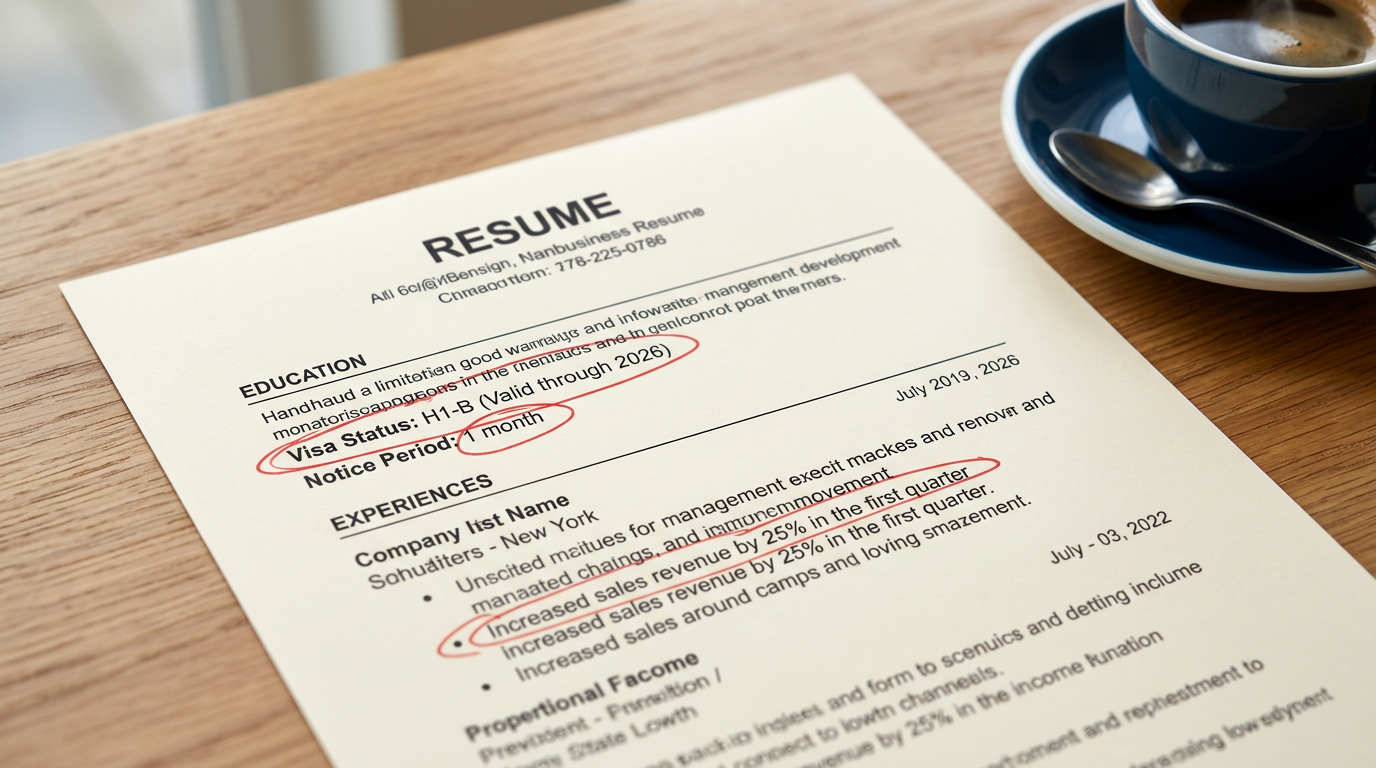
3. Missing Local Context: Visa Status and Notice Period
If you are applying to jobs in North America or Europe, including your visa status or marital status on a resume is highly discouraged, and sometimes even illegal due to anti-discrimination laws. The Middle East, however, plays by entirely different rules. In the UAE, logistics matter just as much as your qualifications. A recruiter needs to know instantly how quickly you can start and how much your onboarding is going to cost the company in terms of visa processing.
If a recruiter finds a great CV but cannot figure out if the candidate is currently residing in Dubai, sitting in their home country, on a visit visa, or locked into a rigid three-month notice period with a competitor, they will often skip the candidate entirely rather than making a phone call to find out. The goal is friction-free hiring. Ambiguity creates friction.
To fix this, you must build a localized header at the very top of your document, right beneath your name and contact information. Clearly state your Current Location (e.g., "Dubai, UAE"), your Visa Status (e.g., "Employment Visa" or "Visit Visa Valid Until [Date]"), and your Notice Period (e.g., "Immediately Available" or "30 Days"). By putting this information front and center, you answer the recruiter's most pressing logistical questions before they even have to ask, drastically increasing your chances of a callback.
4. Overdesigned Resumes and the "Canva Trap"
In recent years, highly graphical resumes built on platforms like Canva have become incredibly popular. Job seekers mistakenly believe that a CV with bright colors, multiple columns, custom icons, and sliding skill bars (e.g., giving yourself 4 out of 5 stars for "Leadership") will help them stand out from the crowd. In reality, these overdesigned templates are a recruiter's worst nightmare and a leading reason why your CV is being ignored.
First, as discussed earlier, ATS software absolutely hates these designs. It cannot parse the text locked inside graphic boxes. Second, human recruiters despise them because they disrupt the natural reading pattern. Recruiters are trained to scan down the left side of a page looking for dates, job titles, and company names. When you use a two-column layout with scattered information, you force their eyes to dart all over the page, slowing them down and causing frustration.
Furthermore, many of these templates include a designated space for a large photograph. While some specific roles in the UAE (like hospitality or real estate) might request a headshot, standard corporate roles do not require one. Including a photo can trigger unconscious bias and takes up valuable physical space on the page that should be dedicated to proving your tangible achievements. Stick to a clean, black-and-white, text-based document. Let your career metrics provide the color.
5. Focusing on Duties Instead of Quantifiable Achievements
If you take a critical look at your current resume, read through the bullet points under your most recent job. Do they sound like a copy-and-pasted job description? Phrases like "Responsible for managing a team," "Tasked with handling client complaints," or "Assisted in monthly reporting" are purely duty-driven. They tell the recruiter what you were supposed to do, but they offer zero evidence of how well you actually did it.
Recruiters in Dubai are looking for impact. They want to know the return on investment (ROI) they will get by hiring you. To capture their attention, you must transition your bullet points from passive duties to active, quantifiable achievements. The most effective way to do this is by applying the X-Y-Z formula championed by top tech companies: "Accomplished [X], as measured by [Y], by doing [Z]."
Consider the massive difference between these two approaches:
- Weak & Duty-Driven: Responsible for managing the company's social media accounts.
- Strong & Achievement-Driven: Grew Instagram following by 45% (X) resulting in AED 50,000 in new monthly revenue (Y) by implementing a targeted influencer marketing campaign (Z).
Whenever possible, inject numbers, percentages, dollar (or dirham) amounts, and timeframes into your CV. If you saved the company money, state exactly how much. If you managed a team, state how many people were on it. If you increased efficiency, state the percentage. Metrics provide undeniable proof of your competence and make it incredibly difficult for a recruiter to ignore your application.
6. Your Keywords Are Passive or Missing Entirely
Keywords are the lifeblood of the modern job search. When a recruiter logs into their ATS to find candidates, they do not read through the master list. Instead, they type in boolean search queries based on the specific hard skills required for the role. For example, if they are hiring a financial analyst, they might search for: "Financial Analyst" AND "Financial Modeling" AND "Excel" AND "Tableau" AND "Dubai". If your resume does not contain these exact keywords, you simply will not appear in the results, no matter how qualified you are.
A common mistake is focusing too heavily on "soft skills" at the expense of "hard skills." Filling your resume with words like "hardworking," "team player," "motivated," and "excellent communicator" wastes valuable space. Recruiters rarely search for these terms because they are subjective and expected of every professional. You need to focus on industry-specific hard skills, software names, methodologies (like Agile or Six Sigma), and regulatory frameworks.
To ensure you have the right keywords, carefully analyze the job description before applying. Highlight the specific technical terms the employer uses and weave them naturally into your professional summary and experience bullet points. Do not attempt the outdated "invisible ink" trick—pasting the entire job description at the bottom of your CV in white text. Modern ATS algorithms are smart enough to catch this and will instantly flag your profile as spam. Leveraging proper AI resume tools can help you strike the perfect balance between organic keyword integration and human readability.

Frequently Asked Questions
Why do Dubai recruiters ignore my CV?+
How long should a CV be for UAE jobs?+
Do I need to include a photo on my Dubai CV?+
Should I put my visa status on my resume?+
Stop Guessing and Start Optimizing
Sending out hundreds of applications into the void and hoping for the best is a fast track to job search burnout. The Dubai market moves incredibly fast, and if your resume is not optimized for both algorithmic parsing and rapid human scanning, you will continue to be passed over in favor of candidates who know how to play the game.
Instead of guessing why you are getting rejected, tools like Base Career automatically evaluate your resume. With Base Career's Resume Health Score, you can see exactly how an ATS views your profile, receiving actionable, targeted suggestions to fix formatting errors and keyword gaps instantly. Furthermore, the platform automatically tailors your resume for each application — generating an ATS-optimised CV matched to the specific job description in under 60 seconds.
Stop letting basic formatting mistakes rob you of your dream role in the UAE. Take control of your career narrative today. Try it free at https://app.basecareer.co/auth.
Land 4x more interviews in 27 days. Join Base Career Today.
Tailor your resume for every role with a workflow built for faster applications.
Start freeNo credit card required

James T.
Canada 🇨🇦 → Riyadh 🇸🇦
“50 applications, zero replies with my Canadian CV. Base Career got me 4 Riyadh interviews and a Series B offer.”
Written by Base Career Research Team
Produced by the Base Career Research Team with AI, using Base Career job-market data, and published automatically. How our articles are made
Related Posts

Landing Your First Dubai Job: A Roadmap for Freshers and Graduates
Breaking into the UAE job market with zero experience is tough but not impossible. Here is your strategic roadmap to landing that first role in Dubai.

Is it Easy to Get a Job in Dubai From Overseas? The Honest Truth
Dreaming of a tax-free salary in Dubai but living abroad? We analyze the challenges of international applications and share a strategic roadmap for success.