UK Skilled Worker Jobs: Check Sponsors and Roles

A UK job advert that mentions visa sponsorship is only a lead. It is not proof that the employer can sponsor your route, that the role is eligible, or that the salary meets the rules. A safer search tests the employer, occupation code, pay and Certificate of Sponsorship process as one connected chain before you invest in a long application or share sensitive documents.
This guide combines current official UK guidance with an aggregate of active UK posting records tracked by Base Career. It is practical job-search guidance, not immigration advice. Rules can change, and individual circumstances differ, so use the linked GOV.UK pages for the final check before applying or making a visa decision.
The sponsor–role–salary chain
For the Skilled Worker route, GOV.UK says the job must be eligible, the employer must be approved by the Home Office, and pay must meet the applicable minimum. The current Skilled Worker job requirements are the controlling source. Passing one check does not compensate for failing another.
- Sponsor: identify the employer’s legal name and confirm the relevant route on the live Home Office register.
- Role: match the real duties to the correct occupation code; do not rely on a creative job title.
- Salary: compare the offered pay with both the general threshold and the going rate that applies to the occupation and your circumstances.
- Process: expect a genuine offer and an electronic Certificate of Sponsorship issued through the employer’s official process.
“Sponsorship available” is a prompt to verify. It is not a guarantee of eligibility, a visa or a job.
What current UK posting geography shows
Base Career tracked 120,200 active UK posting records scraped in the 30 days to 19 October 2026. The city field was missing or unusable in 33,386 records. Among the largest named locations, London appeared in 25,423 records, followed by Manchester 3,584, Birmingham 2,760, Glasgow 2,050, Edinburgh 1,924 and Bristol 1,855. These are posting records in Base Career’s pool, not unique vacancies, sponsored roles, hires or a measure of the whole UK labour market.
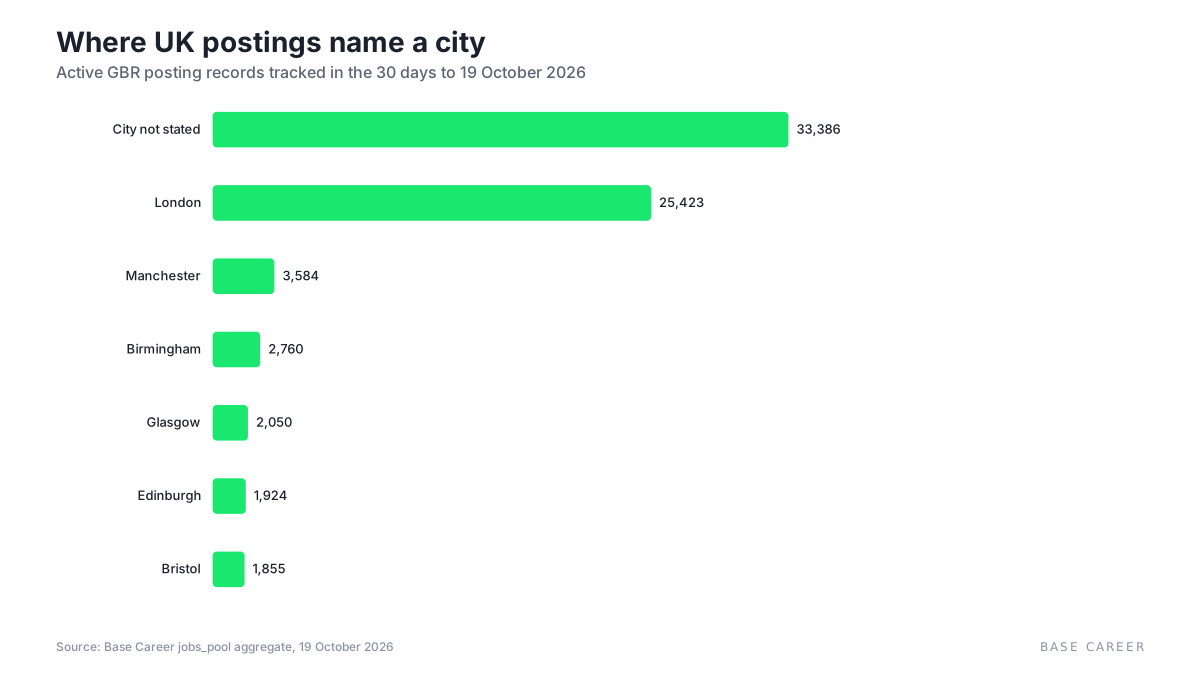
The geography is useful for organising searches, but it says nothing about visa sponsorship. A London filter will find a large pool; it will not tell you whether a particular employer is licensed, whether that licence covers Skilled Worker sponsorship, or whether the vacancy meets the relevant occupation and salary rules. Apply location filters after you define the eligible role family, not instead of doing the eligibility checks.
Check the employer on the live sponsor register
The Home Office register of licensed sponsors is the starting point. The version fetched for this guide was updated on 16 October 2026. Because the register changes frequently, download or search the current version when you are assessing an advert rather than relying on a screenshot, an old spreadsheet or an agency’s claim.
- Use the legal entity: the trading brand in an advert may differ from the registered company name. Find the employing entity in the offer, privacy notice, company website or recruiter confirmation.
- Match the route: look for a Worker licence that includes the Skilled Worker route. A temporary route or another category is not automatically interchangeable.
- Match the location carefully: a group may contain several legal entities. Confirm which entity would employ and sponsor you.
- Recheck at offer stage: registration can change between application and offer. Repeat the check before you resign, relocate or pay any government fee.
GOV.UK explains that a Worker sponsor licence can cover different skilled routes and that Skilled Worker roles must meet the job-suitability requirements. That is why finding a company name somewhere on the register is necessary but not sufficient. You still need the right employing entity, route, vacancy and terms.
If the name is not an exact match, do not “repair” it yourself by assuming that a parent company, franchise, hospital group or recruitment agency is the sponsor. Ask the recruiter for the sponsor’s legal name and the entity that will appear on the employment contract. A legitimate hiring team should be able to explain the relationship without asking you to bypass official checks.
Match the real job to an occupation code
The route uses an occupation code based on the work you will actually do. GOV.UK tells applicants to obtain the code from the employer when an offer exists and to use the occupation-coding tool when researching. The official eligible occupations table also notes that occupation codes changed on 4 April 2024, so an old code copied from a forum or historic vacancy may be wrong.
- Write down the main duties, level of responsibility, required qualifications and reporting line from the advert.
- Search for the occupation family that best describes those duties, not the title that sounds most senior or most likely to qualify.
- Check the code in the current eligibility table and note whether it is higher skilled, medium skilled or ineligible.
- For a medium-skilled code, verify whether the specific route conditions currently allow it rather than treating “medium skilled” as automatic eligibility.
- Ask the employer to confirm the code intended for the Certificate of Sponsorship and resolve any mismatch before accepting.
Title-only matching can fail. The official job-requirements page gives a clear construction example: bricklayers, roofers and carpenters may be eligible while construction labourers are not. The difference is in the occupation classification and duties, not in adding the word “skilled” to the advert.
Check salary against the applicable rule
For most applicants, GOV.UK currently states a usual standard of at least £41,700 a year or the occupation’s going rate, whichever is higher. It also explains that some applicants may qualify under lower salary rules, with a floor of at least £33,400 a year, and that some healthcare and education roles use different arrangements. Read the current salary requirements for the Skilled Worker route rather than treating either figure as universal.

“I kept getting rejections from London. Base Career rewrote my CV for Dubai, and I landed Emirates in 3 weeks.”
Sarah M. · Marketing Manager · UK 🇬🇧 → Dubai 🇦🇪
No credit card required
The practical implication is simple: a salary that exceeds the general headline can still fail if the going rate is higher, while a lower salary is not automatically eligible merely because the employer is licensed. The route, occupation code, working pattern, applicant circumstances and any permitted salary discount all matter. Ask the employer which rule they are using and compare it with GOV.UK yourself.
- Annual salary: confirm the guaranteed gross pay, not a best-case package built from discretionary bonus or overtime.
- Hours: confirm contracted weekly hours because the going-rate comparison depends on the job and working pattern.
- Going rate: check the current table for the exact occupation code supplied by the employer.
- Exceptions: if the employer relies on a lower threshold, ask which published provision applies to you and retain the official link.
- Consistency: the advert, offer, contract and sponsorship record should describe the same role and pay.
Understand the Certificate of Sponsorship
A Certificate of Sponsorship is an electronic record, not a paper certificate that an agent can sell you. The official Certificate of Sponsorship guidance says the employer assigns it and the worker uses its reference for the visa application. It also says the visa application must be made within three months of assignment and not more than three months before the job start date shown on the record.
For a Skilled Worker applicant applying from outside the UK, the employer normally uses a defined certificate; the same official guidance distinguishes that from certificates used for applicants inside the UK. You do not need to master the sponsor management system, but you should expect the employer’s HR or immigration team to understand which process applies.
- Do not pay a private person for a “CoS document” or a place in a sponsor allocation.
- Confirm the sponsor’s legal name, job title, occupation code, salary, hours, work address and start date before using the reference.
- Question any request to route employer sponsorship costs through your personal account.
- Apply through the official visa service linked from GOV.UK, not through a payment link sent in a chat message.
- Keep the offer, contract, sponsor details and correspondence together so discrepancies are easier to spot.
Read sponsorship wording in job adverts carefully
Useful adverts are specific. They may state the visa route, whether sponsorship is available for that vacancy, who is eligible, and whether applicants who already have work permission are preferred. Weak adverts use vague language such as “visa help”, “sponsorship possible” or “international candidates welcome” without naming the employing entity or role conditions. Treat vague wording as an unanswered question, not a promise.
- Strong signal: the employer names the route, provides a traceable careers page and explains when sponsorship will be assessed.
- Needs confirmation: the company appears on the register but the vacancy says nothing about sponsorship.
- High friction: the advert is from an agency and neither the end employer nor the sponsor is identified.
- Red flag: a recruiter guarantees a visa before assessing your experience, duties, occupation code or salary.
- Red flag: payment is required to reserve the job, obtain the CoS or move the application to interview.
A licensed employer is not required to sponsor every vacancy. Some employers sponsor only defined job families, grades or locations. Others may have a licence but choose candidates who already have unrestricted work permission for a particular opening. Ask a precise question: “Is Skilled Worker sponsorship available for this vacancy, and which occupation code and salary rule would apply?”
Build a safer UK sponsorship search
Start with the role, not the phrase “visa sponsorship”. Choose occupation families that match your evidence, then search across verified employer career sites and reputable job services. You can browse current UK jobs on Base Career, but always follow through to the original employer or trusted application route and complete the sponsor, occupation and salary checks yourself.
The government’s Find a job service covers roles in England, Scotland and Wales, with a separate service for Northern Ireland. Its help and advice page says searches can be refined by title, company, skill, location, remote option, posting date, salary, category, contract and hours. Use those filters to narrow a role family, then verify sponsorship separately; a listing on a government service is not a personal visa assessment.
For broader market context, read Base Career’s UK jobs guide covering demand, cities, CVs and work rights. This article has a narrower intent: it gives you a repeatable way to assess sponsor claims and role eligibility before applying.
- Role lane: save searches for a small set of occupation families that genuinely match your experience.
- Sponsor lane: maintain a working list of verified legal entities, then recheck the live register before relying on it.
- Employer lane: use the organisation’s own careers site to understand locations, grades and sponsorship wording.
- Evidence lane: tailor your CV to the vacancy’s real duties and essential criteria without changing your history.
- Tracking lane: record the source URL, employer entity, occupation code, sponsorship answer and follow-up date.
Protect yourself from sponsorship scams
The Home Office fraud, tricks and scams guidance warns about fake UK jobs, guaranteed visas, unofficial payment requests and forged offer letters. It states that a legitimate employer would not ask for payment to secure a visa and that official UK government sites end in gov.uk. Pressure, secrecy and payment to an unknown or personal account are reasons to stop and verify.
- Check the sender’s domain character by character and reach the employer using contact details published independently on its official website.
- Search the sponsor register yourself; do not rely on a cropped screenshot supplied by the recruiter.
- Do not put bank details, identity numbers or unrelated personal data in a CV or initial application.
- Do not pay by cash, voucher, cryptocurrency or transfer to a personal account for a job, interview or CoS.
- If a message claims to be from the Home Office, navigate to GOV.UK independently rather than using its link.
- Report suspected UK fraud through the official channels linked from GOV.UK; if you are overseas, also use the appropriate authority where you live.
Health and social care candidates need an additional check. Current government guidance for overseas health and care applicants says UK-based agencies cannot charge a fee for finding work and identifies employer-side sponsorship costs that should not be shifted to the worker. It also points candidates towards official jobs boards and ethical-recruiter checks. Professional registration may still be required for regulated work, so verify the relevant regulator separately from visa sponsorship.
Make your application easy to assess
Once the vacancy passes the initial checks, write for the actual person specification. A sponsorship-focused search still succeeds on role fit: qualifications, scope, outcomes, systems, sector context and evidence that you can perform the duties. Put your current location and work-authorisation position clearly, but do not let immigration language replace the professional case.
- Use the vacancy’s truthful role language in your profile and recent experience bullets.
- Show outcomes and scope rather than listing generic responsibilities.
- Address essential criteria directly and avoid claiming a licence or registration you do not hold.
- State accurately whether you require employer sponsorship; do not describe a pending or hoped-for status as approved.
- Keep sensitive identity documents out of early-stage applications unless a verified process genuinely requires them.
- Ask sponsorship questions after confirming role fit, or earlier when the advert explicitly restricts eligibility.
A short, direct question works better than a long immigration explanation: “I match the essential requirements and would require Skilled Worker sponsorship. Is sponsorship available for this vacancy, and can you confirm the intended occupation code?” The answer will not replace official checks, but it can prevent wasted applications.
Use city data without mistaking it for sponsorship data
The posting aggregate shows a wide UK pool and a strong London concentration among named cities, but sponsorship is decided vacancy by vacancy. Search across cities where your occupation has real demand and where you can meet the job’s location requirements. Do not infer that an unstated city is remote, that a large employer sponsors every branch, or that a smaller city is automatically easier.
If relocation matters, confirm the worksite, hybrid expectations, start date and any professional-registration step before accepting. Compare the full offer with realistic housing and travel costs, but keep that decision separate from the visa eligibility check. A role can be sponsorable yet still be a poor practical fit.
Final verification checklist
- The employing legal entity is identifiable and appears on the current sponsor register for the relevant route.
- The real duties match the occupation code the employer plans to use.
- The code is eligible under the current table and any conditions for its skill level are met.
- The guaranteed salary and hours satisfy the applicable threshold and going rate.
- The advert, offer, contract and planned Certificate of Sponsorship are consistent.
- The application route and recruiter identity are independently verifiable.
- No one is charging you to buy the job, CoS or a guaranteed visa outcome.
- You have rechecked GOV.UK at offer stage before resigning, relocating or paying an official application fee.
The safest sponsorship search is not the one with the most “visa” keywords. It is the one where the employer, occupation code, salary and formal process agree.
Frequently Asked Questions
Does being on the sponsor register mean an employer will sponsor every job?+
Can I trust a job advert that says “visa sponsorship available”?+
What if the employer name does not match the sponsor register exactly?+
Is a Certificate of Sponsorship a paper document I can buy from an agent?+
Where should I start searching for UK roles?+
Sources checked for this guide
- Home Office: Register of licensed sponsors — workers (accessed 19 October 2026; register updated 16 October 2026).
- GOV.UK: Skilled Worker visa — your job (accessed 19 October 2026).
- GOV.UK: Skilled Worker visa eligible occupations and codes (accessed 19 October 2026).
- GOV.UK: Certificates of Sponsorship (accessed 19 October 2026).
- GOV.UK: Types of sponsor licence (accessed 19 October 2026).
- Home Office: Fraud, tricks and scams guidance (accessed 19 October 2026).
- GOV.UK: Find a job and Find a job help and advice (accessed 19 October 2026).
- UK government: Applying for health and social care jobs from abroad (accessed 19 October 2026).
Land 4x more interviews in 27 days. Join Base Career Today.
Track applications, tailor resumes, and follow up faster in one UAE job search system.
Start freeNo credit card required

James T.
Canada 🇨🇦 → Riyadh 🇸🇦
“50 applications, zero replies with my Canadian CV. Base Career got me 4 Riyadh interviews and a Series B offer.”
Written by Base Career Research Team
Produced by the Base Career Research Team with AI, using Base Career job-market data, and published automatically. How our articles are made
Related Posts

Is it Easy to Get a Job in Dubai From Overseas? The Honest Truth
Dreaming of a tax-free salary in Dubai but living abroad? We analyze the challenges of international applications and share a strategic roadmap for success.

Landing Your First Dubai Job: A Roadmap for Freshers and Graduates
Breaking into the UAE job market with zero experience is tough but not impossible. Here is your strategic roadmap to landing that first role in Dubai.