Forklift Operator Jobs in the UAE: Skills and Safety

Forklift operator jobs in the UAE sit at the practical end of logistics, manufacturing, construction and warehouse operations. The machine skill matters, but employers also need evidence that an operator can protect pedestrians, check equipment, read a site, handle loads and stop work when conditions are unsafe.
That makes a generic ‘driver’ CV a weak fit. A useful application should identify the equipment you have actually operated, the environment in which you used it, the loads you handled, the checks you completed and the safety rules you followed. It should also separate a training certificate from the driving permit or licence required for a particular emirate, site and equipment category.
This guide combines current UAE and Dubai safety sources with aggregate posting data tracked by Base Career. It does not reproduce individual vacancy records or job descriptions, and it does not treat every forklift advert as identical. Use it to structure your search, then verify the original vacancy and the relevant authority before applying or paying for training.
The strongest forklift application proves controlled, repeatable operation—not speed.
What the current UAE posting snapshot shows
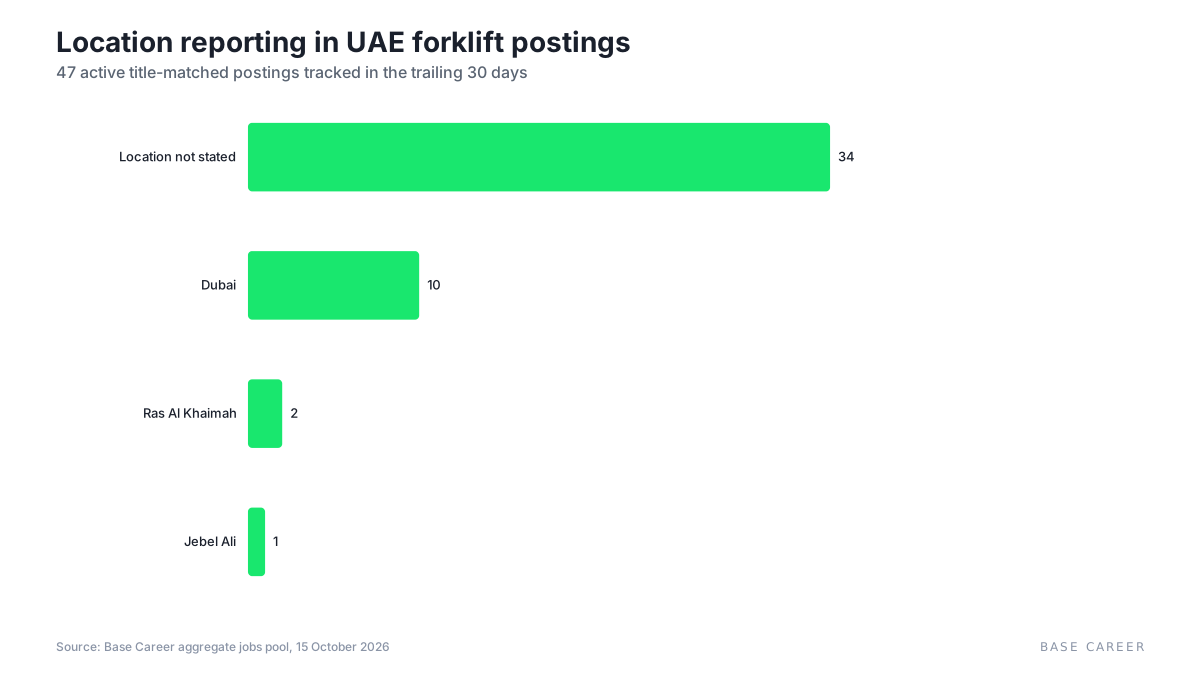
Base Career tracked 77,481 active UAE posting records scraped in the trailing 30 days when this analysis ran on 15 October 2026. Within that wider pool, 47 active records had titles containing ‘forklift’ or ‘fork lift’. This is a title-matched directional sample, not a census of unique vacancies or hires.
Location quality is the first warning in the data. 34 of the title-matched records did not expose a usable city. Of the named locations, 10 were in Dubai, 2 in Ras Al Khaimah and 1 in Jebel Ali. The correct conclusion is not that other emirates have no demand. It is that broad job feeds often leave location incomplete, so candidates must verify the original advert before planning travel or comparing roles.
The sample also included several title variants, including forklift operator, forklift driver, heavy forklift operator and combined warehouse or reach-truck roles. Search behaviour should reflect that variation. A candidate who searches only one exact phrase may miss relevant work, while a candidate who applies to every ‘operator’ role may waste effort on unrelated equipment.
The broader logistics setting is active, but real-estate demand is not the same as job demand. A current Cushman & Wakefield Core market update reports tight Grade A logistics occupancy and new industrial supply across Dubai, Abu Dhabi and the Northern Emirates. Treat that as sector context, not as proof that a specific employer is hiring forklift operators.
Start by matching the equipment, not just the job title
Forklift is an umbrella term. Counterbalance trucks, reach trucks, articulated aisle equipment, heavy forklifts and specialised site machines differ in controls, capacity, turning behaviour and operating environment. An employer may need a warehouse operator for narrow aisles, a yard operator working around trucks, or a heavy-equipment operator on an industrial site.
- Write down the exact equipment types you have operated and whether the work was indoors, outdoors or mixed.
- Record the load types you handled, such as palletised goods, production materials or long and awkward items, without disclosing confidential customer information.
- Distinguish loading, unloading, stacking, de-stacking, replenishment and production-line support.
- Note whether you worked around pedestrians, loading docks, ramps, cold rooms, battery-charging areas or external yards.
- State the permit, licence and competency evidence you currently hold, including the issuing authority and validity only when you can verify it.
Do not claim competence on a truck category because it looks similar to one you used elsewhere. The safer approach is to show transferable fundamentals and ask what equipment, capacity, attachment and site authorisation the employer requires.
Understand the Dubai permit distinction
Licensing language in adverts can be vague, so do not rely on a recruiter’s shorthand. The current Dubai Roads and Transport Authority special-driving-permit service makes an important distinction: for a forklift used within a construction site, an activities-of-special-nature permit may be sufficient; for driving a forklift outside the construction site, the RTA says a light-equipment driving licence is required. The same page says drivers in other emirates must check with the relevant licensing authority.
That is why ‘valid UAE licence’ should trigger questions rather than assumptions. Confirm the emirate, whether the equipment leaves the company site, the equipment category, who owns the vehicle and whether the employer has an internal authorisation or competency process. A training certificate, a company permit and a public-road or equipment licence are not automatically interchangeable.
Current Dubai training-provider pages from Al Ahli Driving Center and Galadari Motor Driving Centre describe RTA-linked forklift training and testing routes. They are useful for understanding the process, but they are provider information rather than a nationwide legal rule. Verify the current category, documents, eligibility and charges with the RTA or the relevant emirate authority before enrolling.
Never alter a certificate, change a validity date or describe internal company familiarisation as a government licence. If your evidence does not match the vacancy, say what you hold and ask whether employer-sponsored conversion or additional testing is available.
Safety evidence employers can assess
The UAE Government workplace safety page states that employers must provide a safe and appropriate work environment, protection, training and evaluation, while workers must follow safety instructions and use protective equipment correctly. For a forklift candidate, that means safety is part of the job rather than a sentence added at the bottom of a CV.
The Ministry of Human Resources and Emiratisation guidance also places equipment-related dangers within the occupational health and safety system. An interview answer should therefore explain how you recognise a hazard, what control you apply and when you escalate or stop the task.
Dubai Municipality’s current Safe Forklift Operations guideline provides a more specific competence map. It covers risk assessment, traffic management, pedestrian separation, pre-operation checks, load handling, charging or refuelling controls and the removal of defective equipment from service.

“I kept getting rejections from London. Base Career rewrote my CV for Dubai, and I landed Emirates in 3 weeks.”
Sarah M. · Marketing Manager · UK 🇬🇧 → Dubai 🇦🇪
No credit card required
- Pre-use inspection: explain how you check forks, tyres, mast, hydraulics, brakes, steering, warning devices and visible damage.
- Capacity discipline: show that you read the equipment plate, assess the load and avoid guessing about weight or centre of gravity.
- Pedestrian control: describe blind-corner behaviour, designated routes, barriers, horns, spotters and clear communication.
- Dock and trailer safety: explain how you confirm a stable loading area and that the vehicle cannot move unexpectedly.
- Defect response: show that you tag, isolate and report unsafe equipment rather than trying to finish the shift with it.
- Charging or fuel awareness: identify the relevant ventilation, ignition, spill and protective-equipment controls for the truck type.
These are not phrases to copy without evidence. Prepare a short example for each skill you claim. The example should explain the setting, the hazard, the action you took and the outcome you observed without naming private customers or revealing site-sensitive information.
Build a forklift CV that can survive verification
Use a clear role title that matches your real experience. If your employment title was warehouse assistant but you were authorised to operate a reach truck, say so in the bullet and keep the official title intact. That is more credible than changing the position to senior forklift operator.
Profile section
Lead with equipment, environment and safety scope. A practical profile might say that you are a warehouse operator with counterbalance and reach-truck experience, accustomed to pre-shift checks, racking work, loading bays and pedestrian-controlled facilities. Add a permit or licence only if it is current and relevant to the vacancy.
Experience bullets
Replace a duty such as ‘operated forklift’ with an evidence pattern: equipment and environment, task or constraint, safety action, and result. You do not need an invented percentage. Accurate detail about the process is stronger than a metric you cannot prove.
- Operated the named truck type in the named environment and completed documented checks before handover.
- Moved the named load category while following marked traffic routes and pedestrian controls.
- Supported receiving, put-away, replenishment or dispatch and reconciled movements in the employer’s authorised system.
- Reported a fault, unstable load or damaged pallet and kept the equipment or area out of service until cleared.
- Worked with spotters, warehouse supervisors, drivers or production teams during constrained movements.
Documents and keywords
Keep a separate, accurate section for licences, permits, operator cards, training and medical or site clearances. Use the exact issuing body and title shown on the document. In the skills section, include equipment and tasks that match your experience, such as reach truck, counterbalance, pallet movement, racking, loading bay, pre-use inspection, inventory movement and warehouse safety.
Avoid keyword stuffing. An ATS may recognise terms, but an employer can still ask for the original document, a practical test or a description of the controls. Every important keyword should be defensible.
Search beyond one phrase
Use combinations that reflect equipment, environment and geography. Examples include forklift operator, forklift driver, reach-truck operator, warehouse operator with forklift, heavy forklift operator, material-handling operator and loading-bay operator. Add the city, industrial zone or employer only when it helps narrow the result.
Start with Base Career’s UAE jobs search, then open the employer’s original careers page before applying. The existing Dubai logistics and shipping career guide is useful for understanding the wider sector; this article focuses on operator-level equipment, safety and verification.
- Save the original vacancy URL and note the employer, work site, equipment and shift pattern.
- Check whether the role is direct employment, a staffing assignment or a contractor position.
- Match the requested permit or licence to the relevant emirate and operating environment.
- Tailor the CV only where your experience genuinely matches the advert.
- Prepare for a practical assessment and ask what equipment will be used.
- Track the application outcome so you can refine equipment terms and evidence.
Questions to ask before accepting an interview
- Which forklift type, capacity and attachments does the role use?
- Is the work inside a warehouse, on a construction site, in an external yard or across several environments?
- Which authority-issued licence or company permit is required for this exact site?
- Will the employer arrange site familiarisation, competency assessment or category conversion?
- How are pedestrians and vehicles separated, and what happens when a route is blocked?
- Who owns inspection, maintenance, battery charging or fuel controls?
- Is the vacancy linked to a named employer site, and will the written offer identify the employing entity?
A legitimate employer should be able to explain the equipment and workplace. Vague answers do not prove fraud, but they are a reason to pause before travelling, paying or handing over sensitive documents.
Applying from outside the UAE
Overseas experience can be useful, but it may not satisfy a local permit requirement. Present the issuing country, equipment and validity honestly, then ask whether the employer accepts it as experience evidence and what local steps remain. Do not describe a foreign operator card as a UAE licence.
Be cautious when a recruiter promises a job or licence in return for an informal payment. Verify the company domain, vacancy, interview contact and written offer. Pay an approved authority or provider only through a verifiable channel after confirming that the route applies to your situation.
If the employer needs an operator immediately, lack of the exact local evidence may be a real barrier. That is better discovered before travel than after arrival. Focus applications on roles whose equipment and authorisation path you can realistically meet.
A practical interview framework
When asked how you would move a load, do not begin with the controls. Begin with the task and surroundings: confirm the equipment, inspect the truck, understand the load, check the route, identify pedestrians and obstructions, and verify the destination. Then explain controlled pickup, travel, placement and shutdown.
When asked about productivity, connect it to preparation and consistency. Safe route planning, correct pallet condition, clear communication and early defect reporting reduce avoidable interruptions. Do not imply that production pressure justifies bypassing a check or carrying an unstable load.
When asked about an incident, distinguish a near miss, equipment defect and injury. Explain what you did immediately, who you informed, how the area or truck was controlled and what changed afterwards. Do not invent a perfect record if you cannot evidence it.
The useful conclusion
Forklift operator jobs in the UAE reward specific, verifiable evidence. Search by equipment and environment, not only by title. Treat location fields in broad feeds as incomplete until the original advert confirms the site. Match your licence or permit to the emirate and operating context, and build the CV around safe decisions you can explain.
A credible candidate does not claim every machine. They show where they are competent, how they control risk and what they need to learn before operating somewhere new.
Frequently asked questions
Frequently Asked Questions
Do all UAE forklift jobs require the same licence?+
Can I apply with a forklift certificate from another country?+
What should I put on a forklift operator CV?+
Why are many UAE forklift postings missing a city?+
What safety topics should I prepare for an interview?+
Should I pay a recruiter for a guaranteed forklift job?+
Sources and methodology
External sources were accessed on 15 October 2026: the UAE Government workplace-safety page; Ministry of Human Resources and Emiratisation occupational-safety guidance; Dubai RTA special-driving-permit service; Dubai Municipality Safe Forklift Operations guideline; current Al Ahli and Galadari training pages; Cushman & Wakefield Core’s UAE logistics update; and the live UAE forklift results page on Indeed used for SERP and vocabulary context.
Base Career figures came from aggregate queries against the self-hosted production jobs_pool. The query filtered active records to country UAE and a scrape date in the trailing 30 days, then title-matched ‘forklift’ or ‘fork lift’ and grouped the result by normalised city. No individual job, user, CV, application, private document or customer record was retrieved or quoted.
Posting records can contain duplicates, stale states and missing fields. The figures are directional evidence for search planning, not a guarantee of available work. Verify each role, employer, location, equipment category and permit requirement at the original source.
Land 4x more interviews in 27 days. Join Base Career Today.
Track applications, tailor resumes, and follow up faster in one UAE job search system.
Start freeNo credit card required

James T.
Canada 🇨🇦 → Riyadh 🇸🇦
“50 applications, zero replies with my Canadian CV. Base Career got me 4 Riyadh interviews and a Series B offer.”
Written by Base Career Research Team
Produced by the Base Career Research Team with AI, using Base Career job-market data, and published automatically. How our articles are made
Related Posts

Is it Easy to Get a Job in Dubai From Overseas? The Honest Truth
Dreaming of a tax-free salary in Dubai but living abroad? We analyze the challenges of international applications and share a strategic roadmap for success.

Landing Your First Dubai Job: A Roadmap for Freshers and Graduates
Breaking into the UAE job market with zero experience is tough but not impossible. Here is your strategic roadmap to landing that first role in Dubai.