Saudi Cybersecurity Careers: What SOC Job Data Shows

A search for SOC analyst jobs in Saudi Arabia can look narrower than the work actually is. Employers may use SOC, security operations, cybersecurity, information security, threat management, defensive security, incident response or governance language for adjacent—but not interchangeable—roles. The practical task is to identify the work behind the label and prove that you can perform it.
This guide combines a fresh Base Career aggregate posting snapshot with the Saudi National Cybersecurity Authority’s current workforce material. It is designed for candidates who want to build a focused Saudi cybersecurity search without turning job-board counts into hiring promises or treating a certificate list as a substitute for evidence.
Do not optimise your application for the word “cybersecurity”. Optimise it for a defined role, the tasks behind that role and evidence a hiring team can test.
What the current Saudi posting pool shows
Base Career matched 168 active Saudi Arabia postings scraped in the trailing 30-day window captured on 1 October 2026. The aggregate filter looked for SOC, security-operations, cybersecurity, cyber-security and information-security wording in titles. It retrieved counts only—not descriptions, applicants, customer records or individual job rows. The result is a directional view of Base Career’s pool, not a census of every Saudi vacancy.
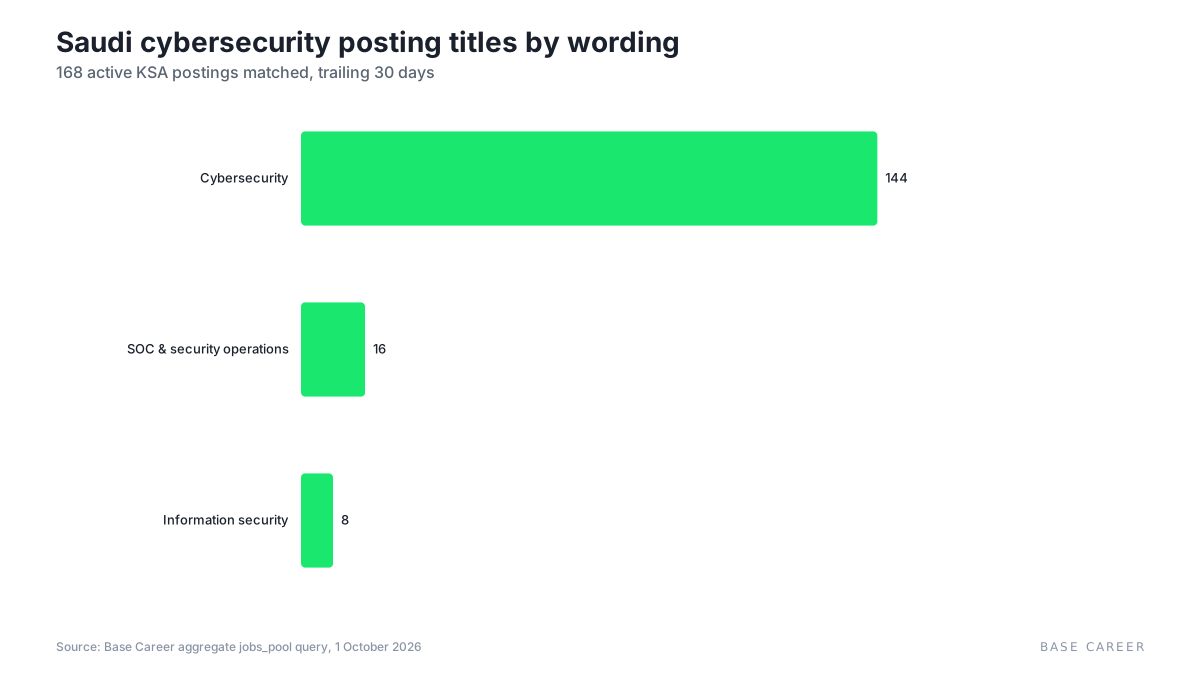
The deterministic title grouping placed 144 postings in the cybersecurity bucket, 16 in SOC and security operations, and 8 in information security. The groups are mutually exclusive and add back to the 168-posting sample. They describe title wording, not an official occupational classification.
The imbalance is useful for search design. A candidate who searches only “SOC analyst” can miss defensive-security roles expressed as cybersecurity engineer, threat-management specialist, information-security engineer or another employer-specific title. The opposite mistake is to apply to every cybersecurity result even when the responsibilities sit in governance, architecture, industrial systems or leadership rather than monitoring and response.
Use the Saudi workforce framework as a role map
The National Cybersecurity Authority’s Saudi Cybersecurity Workforce Framework page, updated in 2026, links the current framework and career-progression appendix. The official framework organises Saudi cybersecurity work into five categories, twelve specialty areas and forty job roles. It describes tasks, knowledge, skills and competency areas rather than presenting cybersecurity as one undifferentiated profession.
The current SCyWF 1.5 framework separates architecture, research and development; leadership and workforce development; governance, risk, compliance and laws; protection and defence; and industrial-control or operational-technology work. That structure is a better starting point than choosing a fashionable certification before you know which problems you want to solve.
- Protection and defence: monitoring, investigation, incident response, threat analysis, vulnerability work and related defensive tasks.
- Governance, risk and compliance: policy, controls, audit, risk treatment and compliance evidence.
- Architecture and development: secure design, research, software assurance and specialist technical development.
- Industrial systems: cybersecurity work for operational technology and industrial-control environments.
- Leadership and workforce development: management, advisory, training and capability-building responsibilities.
These lanes can overlap inside an employer, but your application should not blur them. If your strongest evidence is alert triage and incident investigation, lead with defensive outcomes. If it is control testing and risk treatment, a governance or assurance lane may be more credible than a SOC headline.
Translate “SOC analyst” into testable work
A credible SOC application is built around decisions, not tool names. Hiring teams need to understand what you monitored, how you distinguished routine noise from a credible signal, how you documented escalation and what you changed after an incident. A long list of products is weak evidence if it never shows judgement, scope or outcome.
- Monitoring: the data sources and alert classes you reviewed, described without exposing confidential infrastructure.
- Triage: how you prioritised events, tested hypotheses and recorded why an alert was closed or escalated.
- Investigation: the evidence you correlated and the boundaries you respected while collecting it.
- Response: your role in containment, communication, handover and recovery rather than claiming the whole incident.
- Improvement: a detection, playbook, workflow or documentation change that reduced repeated confusion.
- Communication: how you wrote for technical responders, managers or affected teams without overstating certainty.
Remove client names, internal addresses, credentials, screenshots, live indicators and sensitive incident details. A safe portfolio explains method with sanitised or synthetic material. It should demonstrate how you think without creating a new security problem.
Do not force every role into a SOC lane
The aggregate pool was dominated by broad cybersecurity wording. That reflects employer language, but it does not prove that most openings are entry-level analyst jobs. The top exact labels included engineering, management, risk and compliance, governance, architecture, threat management, industrial cybersecurity and production-support variants. Those titles point to different work and seniority expectations.
Read each source vacancy for verbs. “Monitor”, “triage”, “investigate” and “escalate” suggest a defensive operations lane. “Design”, “review” and “approve” may signal architecture. “Assess”, “audit”, “govern” and “report” often point toward risk and compliance. “Harden”, “integrate” or “operate” in an industrial setting can indicate operational-technology work. Use the title for discovery, but use the responsibilities to decide fit.

“I kept getting rejections from London. Base Career rewrote my CV for Dubai, and I landed Emirates in 3 weeks.”
Sarah M. · Marketing Manager · UK 🇬🇧 → Dubai 🇦🇪
No credit card required
Riyadh is the largest observed location, not the only option
Riyadh accounted for 84 of the 168 matched postings. A further 42 had no usable city in the aggregate field. Jeddah contributed 9, Khobar 8 and Dhahran 6; smaller counts appeared in other locations. Because incomplete location data is substantial, the snapshot cannot support a complete city ranking.
Run a Riyadh search because the observed pool is large, then create separate searches for Jeddah and Eastern Province locations that match your sector evidence. Do not combine every city in one alert and assume the first page represents the whole market. For broader city and role-family context, read Base Career’s Riyadh job-search guide.
You can browse current Saudi Arabia jobs on Base Career and test several accurate title variants. Always open the employer’s source vacancy before sharing documents because aggregator availability, location and wording can change.
Use the official career-progression material carefully
The NCA’s SCyWF Career Progression appendix maps role development, qualifications and proficiency expectations across the framework. Use it to compare your current evidence with the target role—not to award yourself a level or assume an employer will use the same title.
An early-career candidate can build credibility through supervised analysis, lab work, documented exercises and a clear account of fundamentals. An experienced candidate should show increased judgement, ownership and scope. In both cases, the evidence should explain what you personally did, which assumptions you tested and when you asked for escalation or review.
- Choose one target role from the official taxonomy or the closest employer equivalent.
- List the tasks and competency areas that appear repeatedly in credible vacancies.
- Mark each requirement as demonstrated, developing or currently unsupported.
- Build one safe evidence item for the most important unsupported task.
- Remove certifications or tools that do not strengthen the target lane.
- Review the map again after interviews reveal where employers interpret the role differently.
Treat MSOC qualification rules as a specific check
The NCA’s regulatory framework for licensed Managed Security Operations Centre services includes a section on obtaining an NCA qualification certificate to work at an MSOC. That is a specific regulatory context. Do not convert it into a claim that every Saudi cybersecurity vacancy has the same requirement.
If an employer or vacancy says the role sits inside a licensed MSOC, ask which current qualification or evidence applies to the position and verify it through the NCA source. If the role is outside that scope, do not add a regulatory claim simply because the title contains SOC. Requirements can change, and the responsible source is the current authority and employer process.
Do not invent a salary benchmark
None of the 168 matched postings exposed a usable value in the salary field queried for this analysis. The article therefore publishes no average or range. A blank field does not mean a role is unpaid or poorly paid; it only means the selected aggregate field cannot support a benchmark.
Compare complete written offers for similar work, seniority, location and employer context. Clarify fixed pay, allowances, variable components, working pattern, on-call expectations, benefits and any probation terms. Do not treat a number from a different role family as a SOC benchmark merely because both jobs sit under cybersecurity.
Build a role-specific CV rather than a cyber keyword list
The opening section of your CV should name the lane you can defend. A candidate with operations evidence might lead with security monitoring, triage and incident support. A governance candidate might lead with control assessment, risk treatment and audit evidence. An industrial candidate should make the relevant environment and safety boundaries clear.
- Scope: systems, environments or control areas you were authorised to work on.
- Action: the analysis, design, review or response work you personally performed.
- Method: how you tested evidence, recorded decisions and handled uncertainty.
- Collaboration: which teams you supported and where responsibility transferred.
- Outcome: a defensible improvement without confidential customer or employer detail.
- Boundary: what you did not own and when you escalated.
Tailor terminology only when it remains true. If a vacancy calls the function security operations and your employer called it defensive monitoring, explain the equivalence through duties. Do not rename unrelated experience to force a match.
Create safe evidence for interviews
A strong evidence pack can be simple. Use a synthetic alert set, a public lab or a redacted process diagram. Show the question, the evidence considered, the decision, the handover and the improvement. The goal is to demonstrate repeatable reasoning, not to recreate a former employer’s environment.
- A sanitised alert-triage write-up with explicit assumptions and escalation criteria.
- A detection or logging improvement tested against synthetic events.
- An incident timeline built from public or lab data, with uncertainty labelled.
- A control assessment that links a requirement to evidence and a remediation owner.
- A short threat-informed briefing written for a non-specialist stakeholder.
- A learning note that explains a mistake, the correction and the new check added.
Keep the pack bounded. One clear artefact for the target lane is more useful than a large repository of copied templates. Never include credentials, customer content, private indicators, internal screenshots or exploit material that you are not authorised to disclose.
Run a focused Saudi cybersecurity search
- Select one primary lane and one adjacent lane from the SCyWF role map.
- Create saved searches using accurate employer variants: SOC, security operations, defensive security, incident response, cybersecurity, information security, governance, risk or industrial cybersecurity as appropriate.
- Split searches by Riyadh, Jeddah and relevant Eastern Province locations instead of relying on one national feed.
- Read the employer’s source vacancy and record the actual responsibilities, seniority and location.
- Check any MSOC, professional or employment requirement against the current official source.
- Tailor the CV around two or three tested examples that fit the role’s verbs.
- Track applications and screening outcomes by lane so you can adjust evidence rather than merely increase volume.
The Saudi Ministry of Human Resources and Social Development’s worker-rights guidance is a safer reference for employment conditions than an informal recruiter summary. Verify the employer, written terms and official route before relying on a promise or sending sensitive documents.
Frequently asked questions
Frequently Asked Questions
Are SOC analyst and cybersecurity analyst the same role in Saudi Arabia?+
Is Riyadh the only place to search for Saudi cybersecurity work?+
Do all SOC jobs require an NCA qualification certificate?+
Which certification should I take for a Saudi SOC role?+
What salary do Saudi SOC analysts earn?+
Method and limitations
The first-party analysis used the self-hosted Base Career jobs_pool and aggregated active KSA records scraped in the trailing 30-day window at 1 October 2026. A deterministic title hierarchy grouped records using SOC, security-operations, cybersecurity, cyber-security and information-security wording. Counts can include title variants or reposts, and missing location fields limit geographic conclusions. The analysis measures postings in the observed pool, not unique vacancies, hires, applicant competition or the entire Saudi labour market.
Sources accessed for this guide
- Saudi National Cybersecurity Authority — Saudi Cybersecurity Workforce Framework page
- Saudi National Cybersecurity Authority — SCyWF 1.5 framework
- Saudi National Cybersecurity Authority — SCyWF Career Progression appendix
- Saudi National Cybersecurity Authority — Interactive SCyWF service
- Saudi National Cybersecurity Authority — 2026 SCyWF update
- Saudi National Cybersecurity Authority — MSOC licensing framework
- US National Institute of Standards and Technology — NICE Framework Resource Center
- Saudi Ministry of Human Resources and Social Development — Rights of workers in enterprises
All external sources were fetched on 1 October 2026. Frameworks, role descriptions and regulatory requirements can change. Re-check the linked authority and the employer’s current process before making an application, qualification or employment decision.
Land 4x more interviews in 27 days. Join Base Career Today.
Track applications, tailor resumes, and follow up faster in one UAE job search system.
Start freeNo credit card required

James T.
Canada 🇨🇦 → Riyadh 🇸🇦
“50 applications, zero replies with my Canadian CV. Base Career got me 4 Riyadh interviews and a Series B offer.”
Written by Base Career Research Team
Produced by the Base Career Research Team with AI, using Base Career job-market data, and published automatically. How our articles are made
Related Posts

Is it Easy to Get a Job in Dubai From Overseas? The Honest Truth
Dreaming of a tax-free salary in Dubai but living abroad? We analyze the challenges of international applications and share a strategic roadmap for success.

Building 'Wasta' from Scratch: Networking Strategies for Dubai Expats
Frustrated by 1,000+ applicants on LinkedIn? Learn how to build 'Wasta'—your professional network—from zero to access the UAE's hidden job market.