Negotiating the Car Allowance: A Guide to the Dubai Auto Market for Expats

Landing a lucrative job offer in the UAE is an exciting milestone, but the details of the compensation package can often leave new arrivals scratching their heads. One of the most common points of confusion for Western professionals relocating to the Middle East is the transportation benefit. When negotiating the car allowance as an expat in Dubai, you will typically face a critical choice: accept a company-provided vehicle or take a monthly cash allowance to source your own transport.
For professionals coming from the UK, US, or Europe, the concept of a company car or a leasing allowance is familiar, but the mechanics of the Dubai auto market are entirely different. The structures you are used to back home—such as tax-advantaged salary sacrifice schemes or all-inclusive corporate leases—do not translate directly to the UAE. Instead, you are entering a market governed by the Roads and Transport Authority (RTA), unique insurance premiums for new residents, and the absolute necessity of "GCC specs."
Making the wrong choice during your contract negotiations can leave you out of pocket, stranded in the summer heat, or locked into a vehicle that doesn't suit your family's needs. This comprehensive guide will walk you through the complexities of the Dubai auto market, helping you decide whether to take the keys to a company car or negotiate a cash allowance that truly covers your costs.
The Great Expat Dilemma: Company Car vs. Cash Allowance
When you receive your UAE employment contract, transportation is usually addressed in one of two ways. The employer will either provide a company-owned or leased vehicle for your personal and professional use, or they will offer a fixed monthly cash allowance added to your basic salary. Understanding the split between your base pay and benefits is crucial. For a deeper dive into this, read our guide on Basic vs. Allowances: Why Your Dubai Salary Structure Matters.
The Company Car Option: Opting for a company car is the path of least resistance. It is entirely hassle-free. The company handles the initial purchase or lease, the annual RTA registration, the insurance premiums, and all routine maintenance. If the car breaks down, you are usually provided with a replacement. For a new arrival overwhelmed by the logistics of moving to a new country, this "turnkey" solution is highly attractive. However, the downside is a complete lack of choice. You will drive what the company gives you—often a standard mid-range sedan—which may not be ideal if you have a large family, pets, or a desire to explore the UAE's rugged terrain on weekends.
The Cash Allowance Option: Taking the cash allowance offers ultimate flexibility. You can choose to rent, lease, or buy a vehicle that perfectly matches your lifestyle, whether that is a compact city car for easy parking in DIFC or a large 4x4 SUV for desert camping. Furthermore, if you manage your budget well, you might even have some of the allowance left over to supplement your income. The catch? You are entirely responsible for navigating the local auto market, dealing with insurance companies, handling annual registrations, and covering unexpected maintenance costs.
Decoding the Dubai Auto Market: Leasing, Renting, or Buying?
If you decide to negotiate the car allowance, your next step is figuring out how to acquire a vehicle. The Dubai market offers three main avenues for expats, each with its own financial implications.
Long-Term Rentals
For many expats, especially those on probation or unsure of their long-term plans, a long-term rental (often referred to locally as a monthly rental) is the safest starting point. You pay a fixed monthly fee that covers the car, comprehensive insurance, maintenance, and a replacement vehicle in case of accidents. All you pay for is fuel and Salik (road tolls). While this is the most flexible option—allowing you to return the car with minimal notice—it is also the most expensive over a multi-year period.
Corporate Leasing
Leasing in Dubai is somewhat different from the Personal Contract Purchase (PCP) or Contract Hire agreements popular in the UK and US. In the UAE, leasing usually involves a 12 to 36-month contract with a specialized leasing company. Like renting, it includes insurance and maintenance, but the monthly rate is significantly lower because you are locked into a longer term. Breaking a lease early in Dubai can incur hefty penalties, so this is only recommended once you are secure in your job and have passed your probationary period. Before you sign any long-term financial commitments, you need to evaluate your entire package. Learn How to Audit an Executive Job Offer in Dubai for 2026 to ensure your transportation needs are fully covered.
Buying Outright (New or Used)
Buying a car is the most cost-effective long-term strategy, provided you plan to stay in the UAE for more than three years. The used car market in Dubai is massive, with platforms like Dubizzle and specialized dealerships offering everything from nearly-new luxury SUVs to budget sedans. Bank financing is readily available for expats with a valid residence visa and salary certificate, typically requiring a 20% down payment. If you buy, your monthly car allowance can be used to pay off the auto loan, meaning you eventually own an asset that you can sell when you leave the country.

The Golden Rule of UAE Cars: Always Insist on GCC Specs

“I kept getting rejections from London. Base Career rewrote my CV for Dubai, and I landed Emirates in 3 weeks.”
Sarah M. · Marketing Manager · UK 🇬🇧 → Dubai 🇦🇪
No credit card required
If you choose to buy a used car with your allowance, you will quickly encounter the terms "GCC specs" and "North American/Import specs." This is perhaps the most critical piece of knowledge for any expat navigating the Dubai auto market.
Vehicles built with GCC (Gulf Cooperation Council) specifications are specifically engineered to withstand the extreme climate and environmental conditions of the Middle East. During the summer, temperatures in Dubai can easily exceed 45°C (113°F), with high humidity and frequent dust storms. GCC spec cars feature upgraded air conditioning compressors, larger radiators, enhanced rust protection to combat coastal humidity, and specialized dust filters to protect the engine.
You will often see imported cars (usually from the US or Japan) listed at significantly lower prices. Avoid them. These cars are frequently salvage vehicles that have been written off in their home countries due to accidents or floods, imported cheaply, and repaired in local garages. Furthermore, their cooling systems are not designed for the UAE summer, leading to chronic overheating issues. Insurance companies are also highly reluctant to offer comprehensive coverage on non-GCC spec vehicles. When using your hard-earned car allowance, only ever purchase a vehicle with verified GCC specs.
The Hidden Costs: Navigating Car Insurance for New Arrivals
One of the biggest shocks for Western expats taking the cash allowance is the cost of car insurance during their first year. In the UAE, insurance premiums are heavily influenced by your local driving history. As a new arrival, you have zero driving history in the eyes of the RTA and local insurance providers.
Consequently, you will not benefit from a "No Claims Bonus" (NCB) initially, and your premiums for comprehensive insurance will be calculated at the highest baseline rate. For a mid-range SUV, this can easily cost several thousand dirhams a year.
- Request a No Claims Certificate: Before leaving your home country, request an official letter from your current auto insurer detailing your accident-free years. While not all UAE insurers accept foreign NCB certificates, premium brokers often will, which can secure you a discount of up to 20%.
- Comprehensive vs. Third Party: If you are financing a car through a bank, comprehensive insurance is mandatory. If you are buying a cheaper used car with cash, you might be tempted by third-party liability insurance. However, given the fast-paced nature of Dubai's highways, comprehensive coverage is highly recommended.
- Agency Repair vs. Garage Repair: When selecting a policy, pay attention to where the car will be fixed in the event of an accident. "Agency repair" means the car goes back to the official dealership (e.g., Al Futtaim for Toyota), ensuring genuine parts. "Garage repair" means it goes to a third-party workshop approved by the insurer. Agency repair is more expensive but crucial for protecting the resale value of newer cars.
RTA Registration, Salik, and Licensing Explained
If you take the company car, the HR or fleet department handles the bureaucracy. If you take the allowance, you must navigate the Roads and Transport Authority (RTA) yourself. Fortunately, Dubai has heavily digitized these processes, making them relatively painless compared to other global cities.
Converting Your License: Expats from approved countries (including the UK, US, Canada, Australia, and most of the EU) can simply convert their home country driving license to a UAE license without taking a driving test. You just need your Emirates ID, an eye test (done at any approved optician), and a small fee at an RTA center.
Vehicle Registration (Mulkiya): In Dubai, vehicle registration must be renewed annually. For cars older than three years, this requires passing a physical inspection at an RTA testing center (like Tasjeel or Shamil). The test checks emissions, brakes, tires, and structural integrity. Once passed, you pay the registration fee, clear any outstanding traffic fines, and receive your new "Mulkiya" (registration card).
Salik (Toll Gates): Dubai operates a barrier-free toll system called Salik. You must purchase a Salik tag for your windshield and maintain a prepaid balance. Every time you drive under a toll gate (such as those on Sheikh Zayed Road), AED 4 is deducted. If you commute daily across the city, Salik costs can add up to several hundred dirhams a month, which must be factored into your allowance calculations. This is especially true if you are considering living in a different emirate to save on rent. If you are weighing up a long drive, read The 200km Executive Commute in the UAE: Is It Worth the Drive? to understand the toll it takes on your wallet and well-being.
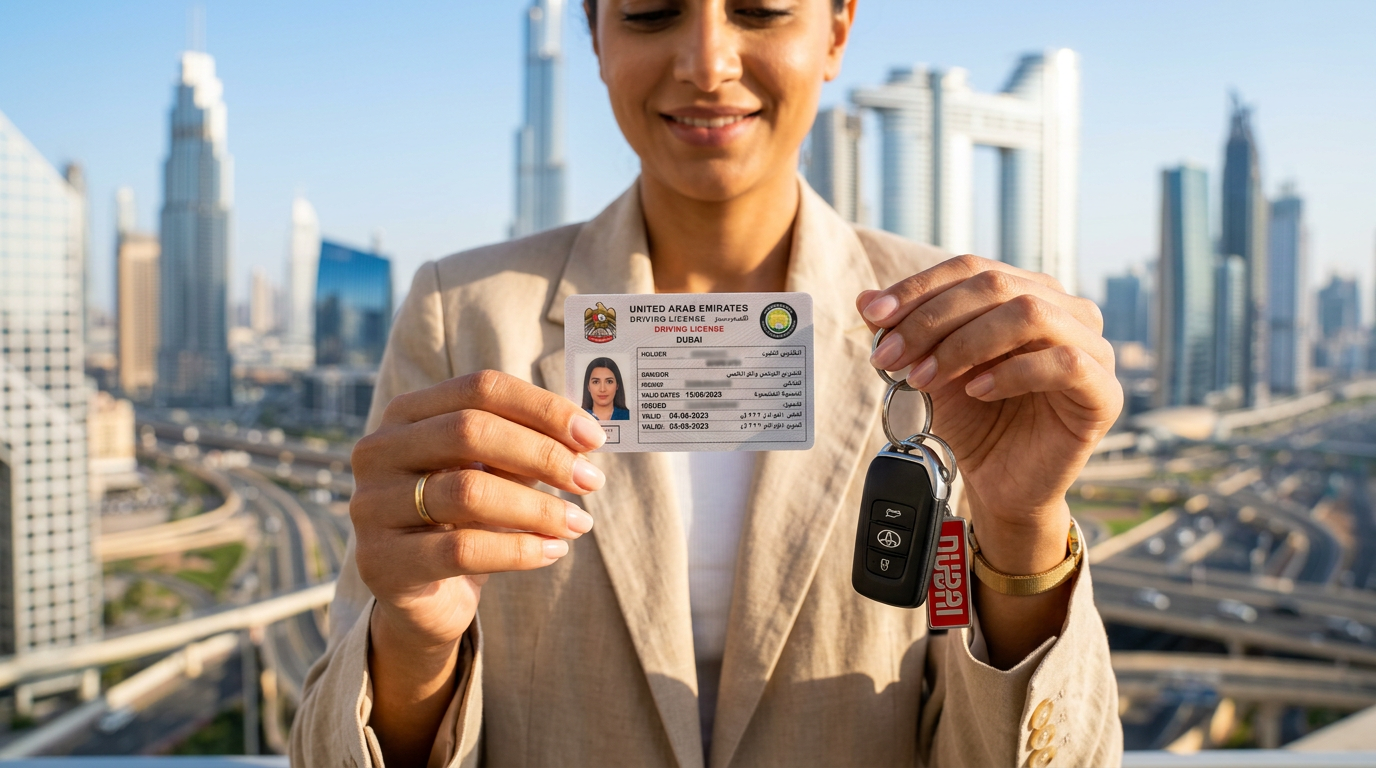
How to Calculate and Negotiate Your Car Allowance
When HR presents your job offer, how do you know if the car allowance is fair? A standard car allowance in Dubai ranges from AED 1,500 per month for junior roles up to AED 5,000+ for executive positions. To negotiate effectively, you must benchmark the offer against the actual cost of keeping a vehicle on the road.
Do not just look at the monthly lease or loan payment. A true cost-of-ownership calculation for Dubai must include:
- The monthly finance or lease payment.
- Comprehensive insurance (divided by 12 months).
- Annual RTA registration and testing fees.
- Estimated monthly fuel costs (while cheaper than Europe, distances in Dubai are vast).
- Estimated monthly Salik (tolls) and parking fees (mParking).
- A buffer for routine maintenance and servicing (especially AC servicing before summer).
If the initial allowance offered seems too low to cover a reliable vehicle that meets your professional and personal needs, you must push back professionally. Review our Dubai Salary Negotiation: How to Counter Any Job Offer guide for proven scripts and strategies to increase your total compensation package.
Family Considerations: The School Run and the SUV Culture
For single professionals, a compact sedan or a sporty coupe might suffice. However, if you are relocating with a family, your vehicle requirements change drastically. Dubai is undeniably an SUV-centric city. The combination of multi-lane highways, aggressive driving styles, and the sheer size of other vehicles on the road makes many expat parents feel safer in a larger 4x4.
Furthermore, the daily school run in Dubai can be an intense experience, often involving navigating congested drop-off zones in areas like Al Barsha or Arabian Ranches. An SUV offers better visibility, more space for school bags and sports equipment, and the capability to handle weekend trips to the desert or the mountains of Ras Al Khaimah. If you have dependents, the vehicle choice often revolves around these family logistics. Check out our insights on Dubai Expat Family Relocation: How to Analyze Job Offers to ensure your entire package supports your family's lifestyle.
When negotiating your allowance, factor in the premium cost of renting or buying a family-sized SUV compared to a standard sedan. If the company insists on providing a car rather than an allowance, explicitly request that the vehicle class matches your family size, rather than accepting a default compact car.
Frequently Asked Questions
What is a standard car allowance in Dubai?+
Can I convert my UK or US driving license in Dubai?+
What does "GCC specs" mean when buying a car in the UAE?+
Is it better to lease or buy a car in Dubai?+
Conclusion: Driving Your UAE Career Forward
Deciding between a company car and a cash allowance is one of the first major financial decisions you will make as an expat in Dubai. While the company car offers peace of mind and zero administrative hassle, the cash allowance provides the freedom to choose a vehicle that truly fits your lifestyle, whether that means navigating the city in a sleek sedan or exploring the dunes in a robust SUV. By understanding the nuances of GCC specs, RTA registrations, and local insurance premiums, you can confidently negotiate an allowance that covers your true costs.
Of course, you can only negotiate a strong car allowance when you have a competitive job offer in hand. Platforms like Base Career scan UAE job boards daily and match openings to your profile, so you stop missing relevant roles and can secure the interviews that lead to high-paying offers. By automating your job search, you can focus your energy on preparing for the move and negotiating the best possible package.
Ready to accelerate your Dubai job search? Try it free at https://app.basecareer.co/auth.
Get hired faster in 25 days. Join Base Career Today.
Run a more organized search so you can reach better-fit roles with more leverage.
Start freeNo credit card required

James T.
Canada 🇨🇦 → Riyadh 🇸🇦
“50 applications, zero replies with my Canadian CV. Base Career got me 4 Riyadh interviews and a Series B offer.”
Written by Base Career Research Team
Produced by the Base Career Research Team with AI, using Base Career job-market data, and published automatically. How our articles are made
Related Posts

Entry-Level Engineering in Dubai: How to Escape the 4,500 AED Trap
Stuck with lowball offers? We analyze how STEM grads can avoid the "technician trap," choose high-paying construction niches, and scale their careers in the UAE.

Salary Negotiation Etiquette: When to Talk Money in UAE Interviews
Navigating salary discussions in Dubai requires cultural tact. Learn the precise timing for discussing compensation, from HR screenings to the final offer.