India GCC Careers: How to Target Global Capability Centres

Global Capability Centre roles in India can look deceptively ordinary in a search result. The title may simply say software engineer, finance analyst, product manager or procurement specialist. What changes is the operating context: the India team is part of a multinational company and may own work for products, platforms, controls or operations used across several markets.
That distinction matters because a broad ‘GCC jobs’ search can return consultancy pages, setup firms and generic technology vacancies. A better search begins with a role family, then tests whether the employer’s India operation really carries a global mandate. This guide shows how to make that test and how to present evidence that fits the work.
The article combines current industry and government sources with an aggregate of active India posting records tracked by Base Career. The posting pool covers the wider India market, not a verified census of GCC vacancies. It is useful for understanding city concentration and adjacent role demand, but it must not be read as a count of jobs inside capability centres.
Search for the capability you can deliver, not merely for the letters ‘GCC’.
What an India GCC actually is
A Global Capability Centre is an organisation’s owned operation in another market, built to deliver capabilities for the parent enterprise. The current Nasscom GCC overview describes Indian centres working across technology, engineering and research, analytics, business operations and deep technology. It also describes a shift from execution-only work towards ownership of products, platforms and end-to-end outcomes.
That is different from assuming every multinational office, outsourced project or shared-service vacancy is a GCC role. The boundary can be blurred in practice. Some employers use ‘global services’, ‘technology centre’, ‘business services’, ‘centre of excellence’ or a local legal-entity name rather than the GCC label. Read the employer’s own description of the India unit and the role’s reporting line before classifying it.
Scale is one reason the category deserves a deliberate search strategy. Nasscom’s current market page says India hosts more than 1,760 centres employing more than 1.9 million professionals and generating more than US$60 billion in value. These are ecosystem figures, not the number of open vacancies or a promise of continued hiring at any particular employer.
A separate Nasscom and Zinnov landscape summary reports that almost 90% of centres are multi-functional. That helps explain why useful GCC searches extend beyond software: product engineering, finance transformation, risk, procurement, supply chain, data, security and operations may sit within the same India organisation.
What the current Base Career snapshot can and cannot show
Base Career tracked 173,279 active India posting records scraped in the trailing 30 days when this analysis ran on 13 October 2026. The total is directional: source duplication, repeat campaigns, missing locations and status changes can affect it. It is not a count of unique jobs, companies, interviews or hires.
Location was blank on 39,010 records, so the chart excludes that group rather than assigning it to a city. Among named locations, Bengaluru led with 36,582 records, followed by Hyderabad with 14,051, Mumbai with 13,883 and Pune with 13,670. Chennai, Gurugram, Noida and Ahmedabad also formed visible clusters.
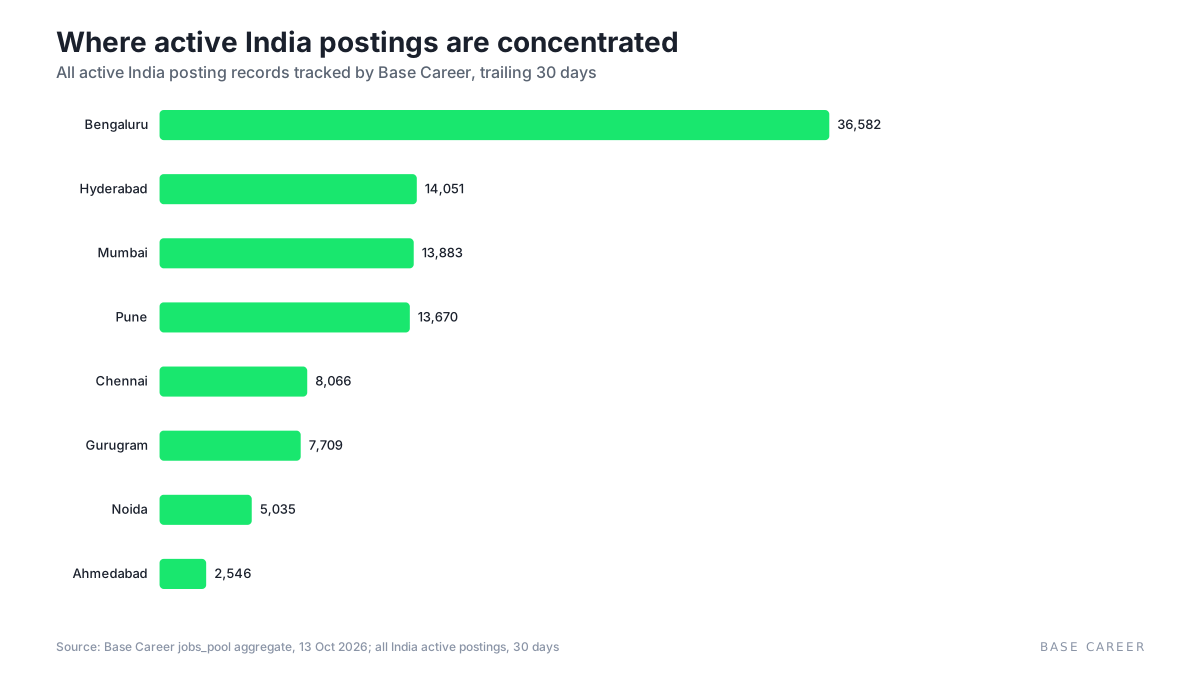
The city pattern is consistent with the established hubs named by India’s Ministry of Labour and Employment. Its official GCC release identifies Bengaluru, Hyderabad, Pune, Chennai, Mumbai and the National Capital Region. The overlap supports a practical search sequence, but it does not prove that every posting in those cities belongs to a capability centre.
Use the chart as a map of the broader hiring environment. A role in cloud security or financial planning may compete for talent across GCCs, domestic employers, service providers and startups in the same city. That surrounding market affects which keywords recruiters use and what evidence they expect, even when the employer structure differs.
Choose a capability lane before choosing employers
The strongest applications are specific about the kind of work they can own. Start with one primary lane and one adjacent lane. This keeps your CV, search terms and interview stories coherent while still allowing you to explore several industries.
Product, software and platform engineering
Look beyond language names. GCC engineering teams increasingly need evidence of operating a product or platform over time: design decisions, reliability, security, observability, incident learning and collaboration with users or teams in other regions. A project list becomes stronger when it shows the constraint, the decision you made and the measured operational result.
Data, AI, cloud and cybersecurity
Nasscom highlights AI, data, cloud and cybersecurity as priority capabilities, while the official government release also points to AI, cybersecurity, cloud computing and semiconductors. Treat those labels as domains, not automatic qualifications. A credible application names the systems, data boundaries, deployment environment and control responsibilities you actually handled.
Finance, risk and business operations
GCC work is not confined to technology. ACCA’s India GCC report describes finance work moving from transaction processing towards business partnering, procurement, reporting, planning, analysis and process transformation. Finance candidates should therefore pair technical accounting or controls knowledge with examples of decisions, automation, stakeholder influence and improved processes.

“I kept getting rejections from London. Base Career rewrote my CV for Dubai, and I landed Emirates in 3 weeks.”
Sarah M. · Marketing Manager · UK 🇬🇧 → Dubai 🇦🇪
No credit card required
Engineering, research and domain operations
Manufacturing, healthcare, automotive, retail and other sectors may place engineering, research, supply-chain or specialist operations inside their India centres. Domain context can be the differentiator. Show that you understand the underlying product, regulation, customer journey or operational risk rather than presenting a generic transformation story.
How to identify a genuine GCC opportunity
Begin on the parent company’s own careers site. Search the employer name with India, global services, technology centre, capability centre, business services, research and development, centre of excellence, engineering centre or the known local entity. Then compare the vacancy with the company’s official description of its India operation.
- Confirm the employing entity and office location on the original careers page.
- Look for an explicit global product, platform, control, customer or operating mandate.
- Check whether the manager, collaborators or users are distributed across markets.
- Separate direct company roles from staffing, consulting or managed-service assignments.
- Read the responsibilities for ownership signals: design, roadmap, control, service level, product outcome or transformation mandate.
- Treat a famous parent brand as context, not proof that the specific job has strategic scope.
An Economic Times report on mid-market GCCs says hiring spans software, banking, finance and accounting, insurance and retail, with demand for both technical and non-technical capabilities. That is a useful prompt to research less familiar employers, but forecasts in a news report should not be treated as guaranteed openings.
Build a CV around ownership and interfaces
A GCC recruiter may need to understand how you work across functions, time zones and organisational boundaries. Replace duty-only bullets with evidence of scope and interface. Explain what you owned, who depended on it, which constraint mattered and what changed because of your work.
- Engineering: service or product boundary, reliability target, architecture decision and operational effect.
- Data: data source, quality constraint, analytical or model decision and business use.
- Cybersecurity: environment, threat or control, action taken and verified risk reduction.
- Finance: process, reporting or control scope, stakeholders and decision enabled.
- Operations: volume or complexity, hand-offs, failure point and measurable improvement.
- Leadership: teams influenced, competing priorities resolved and operating mechanism created.
Do not add ‘global stakeholder management’ as an unsupported keyword. Name the work: for example, coordinating a release across engineering and operations, reconciling a control with an overseas business owner, or adapting a process for several markets. The evidence should make the global interface visible without exaggerating seniority.
Keep the document ATS-readable: standard headings, text rather than graphics for core experience, consistent dates and role-specific terminology. Use the language of the vacancy only where it accurately matches your experience. Base Career’s India job-search guide covers the broader CV and offer-comparison process; this guide adds the GCC operating-context layer.
Ask interview questions that reveal the mandate
The label matters less than the work design. Interviews are your opportunity to test whether the role owns outcomes or mainly receives tasks. Ask questions that are neutral and specific rather than implying that execution work is inferior.
- Which product, process or control does the India team own end to end?
- Which decisions are made in India, and which remain with the global headquarters or business unit?
- Who are the main users and partner teams for this role?
- How is success measured after the initial delivery or transition?
- What operational, regulatory or customer context must the team learn?
- Is this a new capability, a transfer of existing work or an expansion of an established team?
- What would meaningful ownership look like after the first review cycle?
The answers help you distinguish a role with product or process ownership from a vacancy whose scope is still being defined. Neither is automatically good or bad. The decision depends on whether the mandate, manager, learning path and expectations match what you want to build next.
A practical search workflow
- Define one capability lane and write down the evidence you can defend.
- Build a target list from official company and India-centre pages, not from GCC directories alone.
- Create searches that combine the role with employer, city, global services, technology centre or centre of excellence terms.
- Open the original vacancy and classify the mandate, location, seniority and employing entity.
- Tailor the top third of the CV to the role’s actual ownership and interfaces.
- Prepare two stories: one about delivering the work and one about aligning people or functions around it.
- Track applications by employer, role family and outcome so the evidence can improve the next search.
You can use Base Career’s India jobs search to explore current roles, then verify each promising vacancy on the employer’s own careers site. Search broadly enough to discover titles, but apply narrowly enough that your evidence remains credible.
What early-career and experienced candidates should do differently
Early-career candidates should not imitate senior transformation language. Lead with strong fundamentals, internships, projects, production exposure where available, and proof that you can learn a domain. A well-explained project with testing, trade-offs and user feedback is more useful than a long list of fashionable tools.
Experienced candidates should make the operating model visible. Show where you moved from task delivery to ownership, how you handled controls and dependencies, and how your decisions affected customers or business units outside your immediate team. If you have worked only in domestic or service-provider settings, translate the transferable interfaces honestly rather than relabelling the employer as a GCC.
Candidates moving from service providers can be attractive because they understand delivery discipline and complex stakeholders. The gap to close is often continuity of ownership. Prepare examples showing how you improved the product or process after launch, challenged unclear requirements, reduced recurring failure or helped a client team make a better long-term decision.
Avoid the GCC hype traps
A GCC role is not automatically more strategic, better paid or more stable than every alternative. Scope varies by employer, function, maturity and manager. Industry forecasts describe an ecosystem; they do not validate a specific vacancy or offer. Compare the actual work, total reward, work model, learning path, manager and business resilience.
Do not assume that an unfamiliar company is suspicious simply because its consumer brand is weak in India. Mid-market centres may belong to established firms whose products are sold elsewhere. Verify the parent company, local entity, official careers domain, interview contacts and written offer. Never pay for an interview or a guaranteed role.
Likewise, do not confuse a consultancy advertising GCC setup services with a direct employer opening. A legitimate staffing or consulting assignment can still be worthwhile, but the employment relationship and client mandate should be explicit before you compare it with a direct role.
The useful conclusion
India’s GCC ecosystem is broad enough that searching only for ‘GCC jobs’ hides much of the market. Start with the capability you can deliver, identify employers whose India centres own relevant global work, and build evidence around outcomes, interfaces and domain understanding. Use city and industry data to orient the search, not to replace vacancy-level verification.
The strongest application does not merely say you want global exposure. It shows what you can own, how you work across boundaries and why that evidence fits the mandate described by the employer.
Frequently asked questions
Frequently Asked Questions
What does GCC mean in India jobs?+
Are all GCC jobs technology roles?+
Which Indian cities should I search?+
How do I tell a GCC role from an outsourcing role?+
What should I emphasise on a GCC CV?+
Are GCC jobs always better paid or more stable?+
Sources and methodology
External sources were accessed on 13 October 2026: Nasscom’s current GCC market page; the Nasscom–Zinnov landscape summary; the Ministry of Labour and Employment release hosted by the Press Information Bureau; ACCA’s report on GCC finance talent; and the Economic Times report on mid-market GCC hiring. Industry and forecast figures are attributed to the source that published them.
Base Career figures came from aggregate queries against the self-hosted production jobs_pool. The query filtered active records to country IND and a scrape date in the trailing 30 days, then grouped records by normalised city. No individual job, user, CV, application, private document or customer record was retrieved, stored or quoted.
The Base Career aggregate covers the wider India posting pool and does not identify every employer as a GCC. It is used only for broad city context. Company ownership, role scope and vacancy status should be checked on the employer’s original careers page before applying.
Land 4x more interviews in 27 days. Join Base Career Today.
Track applications, tailor resumes, and follow up faster in one UAE job search system.
Start freeNo credit card required

James T.
Canada 🇨🇦 → Riyadh 🇸🇦
“50 applications, zero replies with my Canadian CV. Base Career got me 4 Riyadh interviews and a Series B offer.”
Written by Base Career Research Team
Produced by the Base Career Research Team with AI, using Base Career job-market data, and published automatically. How our articles are made
Related Posts

Is it Easy to Get a Job in Dubai From Overseas? The Honest Truth
Dreaming of a tax-free salary in Dubai but living abroad? We analyze the challenges of international applications and share a strategic roadmap for success.

Landing Your First Dubai Job: A Roadmap for Freshers and Graduates
Breaking into the UAE job market with zero experience is tough but not impossible. Here is your strategic roadmap to landing that first role in Dubai.