Cybersecurity Jobs in the USA: A Role-First Guide

Cybersecurity job searches often fail before the application starts. A candidate types “cybersecurity” into a job board, sees hundreds of titles, and treats security engineering, incident response, risk, architecture and leadership as one interchangeable market. They are not. A stronger search begins with the work you can prove, then expands into titles employers actually use.
This guide combines a fresh Base Career posting snapshot with current guidance from the U.S. Bureau of Labor Statistics, the National Institute of Standards and Technology, the Cybersecurity and Infrastructure Security Agency, and O*NET. The goal is practical: choose a realistic role lane, build evidence for its tasks, and stop wasting applications on jobs that only share a broad label.
Do not build one resume for “cybersecurity.” Build a defensible application for a defined kind of security work.
What current USA cybersecurity postings show
A read-only aggregate query on 23 October 2026 matched 3,843 active USA postings scraped in the trailing 30 days. The filter used cyber-specific title patterns such as cybersecurity, information security, SOC analyst, security engineer, security architect, incident response, threat intelligence, cloud security and application security. It excluded individual job descriptions and retrieved no applicant, user or customer records.
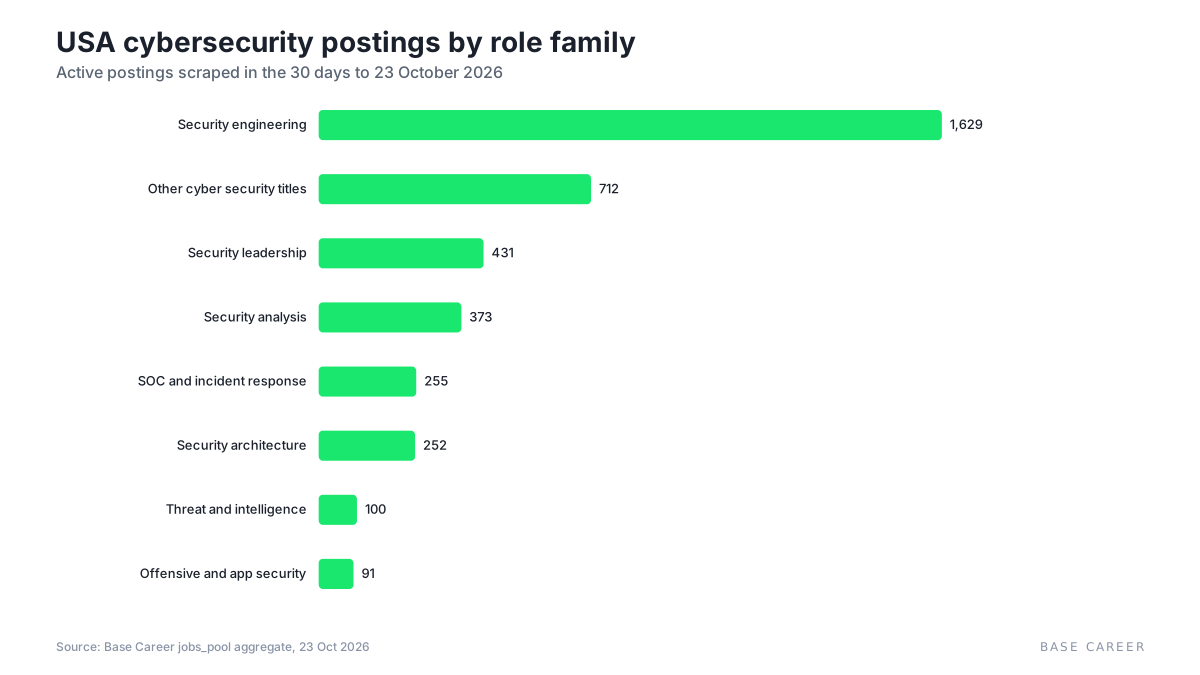
Security engineering was the largest classified family with 1,629 postings. The remaining groups were other cyber security titles with 712, security leadership with 431, security analysis with 373, SOC and incident response with 255, security architecture with 252, threat and intelligence with 100, and offensive and application security with 91. These groups are mutually exclusive within this run and add back to the matched sample.
This is a directional view of postings tracked by Base Career, not a census of every vacancy in the United States. Reposts, title variants and changing availability can affect the pool. The useful signal is the shape of employer language: “cybersecurity analyst” is only one door into the market, while engineering, operations, architecture, risk and leadership titles describe different expectations.
Why job titles are a poor career map
The NIST NICE explanation of occupations, jobs and work roles distinguishes an employer’s job from the work roles inside it. NICE currently describes 52 work roles, and a single job can contain all or part of more than one role. That is why two “security analyst” vacancies may ask for very different evidence. Source accessed 23 October 2026.
Use the title to discover a vacancy, but use the verbs to decide fit. “Monitor, triage, investigate and escalate” points toward defensive operations. “Design, build, automate and harden” points toward engineering. “Assess, document, audit and advise” may indicate governance or controls. “Model, approve and set direction” often signals architecture or senior responsibility.
- Discovery terms: the accurate titles you will search, including adjacent employer variants.
- Work pattern: the recurring tasks behind those titles.
- Proof: a project, work example, lab, report or outcome that demonstrates those tasks.
- Boundaries: seniority, location, schedule and authorization conditions you can honestly meet.
Choose one role lane before you rewrite your resume
Security engineering
Engineering roles dominated the current title sample, but the word “engineer” is not a shortcut to fit. These jobs may involve identity controls, cloud security, platform hardening, secure configuration, detection infrastructure, application security or automation. Your evidence should show what you built or changed, how you tested it, and what risk the change reduced. A list of tools without design decisions is weak evidence.
If your background is in software, cloud, systems or networking, translate existing work into security outcomes. Examples include reducing excessive permissions, automating a repeatable control, improving logging coverage, hardening a deployment path or documenting a recovery decision. Keep sensitive architecture, customer names, credentials and live indicators out of a public portfolio.
Security analysis and defensive operations
Analyst and SOC-oriented roles usually reward disciplined investigation. The O*NET profile for information security analysts emphasizes risk assessment, vulnerability checks, monitoring, documentation, communication and response. It also highlights reading comprehension, critical thinking, active listening, writing and active learning. Source accessed 23 October 2026.
A useful portfolio artifact might be a sanitized incident timeline, a lab-based alert triage note, a detection rule with test cases, or a short risk memo for a nontechnical audience. Explain what evidence you observed, what you ruled out, when you escalated and what uncertainty remained. That demonstrates judgment rather than pretending a home lab was a production incident.
Architecture, governance and leadership
Architecture and leadership titles appeared often enough in the sample to matter, but they are rarely entry-level labels. These roles ask candidates to connect security decisions to business constraints, system dependencies and risk ownership. Strong evidence may include threat models, control rationales, design reviews, program metrics or decisions communicated across teams.

“I kept getting rejections from London. Base Career rewrote my CV for Dubai, and I landed Emirates in 3 weeks.”
Sarah M. · Marketing Manager · UK 🇬🇧 → Dubai 🇦🇪
No credit card required
Do not apply to a leadership title because you once coordinated a small task. Show the scope you actually owned: the systems affected, stakeholders involved, trade-offs considered and outcome delivered. Honest scope is more credible than inflated authority.
Threat, intelligence, offensive and application security
These specialist lanes formed smaller title families in the current snapshot. Smaller does not mean unimportant; it means a broad “cybersecurity jobs” search can bury them. Use precise searches such as threat analyst, vulnerability analyst, application security engineer, penetration tester, secure software assessor or incident responder when your evidence matches the work.
CISA’s cybersecurity and IT work-role overview illustrates the breadth: defensive analysis, forensics, incident response, secure software assessment, architecture, control assessment, systems security and vulnerability assessment sit alongside program, policy and technical support roles. Source accessed 23 October 2026.
Build a skills plan from tasks, not certification slogans
Certifications can help organize learning or satisfy a stated requirement, but they are not a substitute for evidence. The BLS information security analyst profile says employers may prefer certification and that many analysts enter after related IT work. It also notes that some people enter with relevant industry training and certifications rather than the typical degree route. Source accessed 23 October 2026.
Start with a target role and collect recurring tasks from credible frameworks and current vacancies. Then mark each task as proven, practiced or unfamiliar. “Proven” means you can explain a real outcome without breaching confidentiality. “Practiced” means you have a lab or project. “Unfamiliar” becomes a learning item, not a keyword to add to your resume.
- Foundations: operating systems, networking, identity, logs, access control and basic scripting.
- Role practice: monitoring for defensive work, secure configuration for engineering, or control evidence for governance.
- Documentation: concise notes, decision records, diagrams and handoffs that another person can use.
- Communication: explain risk, uncertainty and recommended action to both technical and nontechnical readers.
- Safe learning: use authorized labs and synthetic data; never test systems without permission.
NIST’s workplace-skills guidance is a useful corrective to tool-heavy applications. It connects cybersecurity work with accountability, agility, collaboration, communication, critical thinking, integrity, lifelong learning, problem solving and resilience. Source accessed 23 October 2026. These skills become credible only when your examples show them in action.
A role-first portfolio that hiring teams can assess
Choose two or three artifacts that resemble the target work. A defensive candidate could present an incident note and detection test. An engineering candidate could show a hardened reference environment and an automated check. A governance candidate could build a control-evidence matrix and an executive risk summary. Keep each artifact small enough that a reviewer can understand the decision.
- State the scenario and the limits of the environment.
- Explain the task you performed and the evidence you used.
- Show the decision, configuration or analysis you produced.
- Record how you tested the result and what remained unresolved.
- Remove secrets, personal data, employer-confidential material and live attack details.
CISA’s Cyber Career Pathways Tool overview recommends exploring work roles through their knowledge, skills and abilities rather than treating the field as one ladder. Source accessed 23 October 2026. Use that approach to select portfolio work; do not collect unrelated badges because they look impressive together.
A portfolio should make your reasoning inspectable without exposing anyone else’s systems, data or trust.
Write a resume for the work you chose
Your headline should name the lane you can defend, such as security analyst, cloud security engineer or governance and risk analyst. The summary should connect your background to that lane. Each achievement should show an action, a security-relevant decision and an outcome. If the result cannot be quantified safely, describe the operational change precisely rather than inventing a percentage.
Use exact tools only when they are relevant and truthful. Group them by purpose—monitoring, identity, cloud, vulnerability management, scripting or documentation—rather than presenting an undifferentiated wall of product names. Keep credentials current and state their official names. Do not imply clearance, authorization or a certification you do not hold.
For broader U.S. application guidance, including work authorization, ATS basics and pay research, read Base Career’s USA hiring reality guide. This article is deliberately narrower: it helps you choose and prove a cybersecurity role without duplicating that market-wide process.
Run a search that learns from results
Start with the current USA jobs directory and use a compact set of title variants for one lane. Open the employer’s source vacancy before applying because aggregator wording and availability can change. Save the responsibilities, not just the title, and track which requirements recur across qualified roles.
- Security analysis: information security analyst, cyber defense analyst, vulnerability analyst.
- Defensive operations: SOC analyst, incident responder, detection engineer.
- Engineering: security engineer, cloud security engineer, application security engineer.
- Governance: GRC analyst, security control assessor, IT risk analyst.
- Architecture and leadership: security architect, information security manager, security program lead.
After a review batch, classify each result: strong fit, adjacent fit, seniority mismatch, domain mismatch or logistics mismatch. If most results are mismatches, change the query before rewriting your resume again. This creates a feedback loop between market language and your evidence instead of turning every rejection into a request for more keywords.
Read salary and outlook numbers carefully
BLS reports a $129,180 median annual wage in May 2025 for information security analysts. It projects 21 percent employment growth from 2025 to 2035 and about 14,100 openings per year on average during that period. These are national occupation benchmarks, not a promise for every cyber title, location or candidate. Source: the BLS profile fetched 23 October 2026.
Compare an offer with the actual role scope, location, seniority, schedule and compensation structure. Engineering, leadership, government contracting and entry-level analyst roles can sit in different pay markets. Do not convert one national median into a personal entitlement, and do not assume a posting labeled remote is available in every state.
Common mistakes that weaken a cybersecurity application
- Using one resume for engineering, operations, governance and leadership roles.
- Listing security products without a decision, task or result.
- Calling a training exercise a production incident or overstating personal ownership.
- Publishing confidential diagrams, logs, identifiers or employer data in a portfolio.
- Treating a certification as proof of experience the credential does not claim.
- Applying to senior architecture or management roles without evidence of comparable scope.
- Ignoring writing, listening and stakeholder communication because the role sounds technical.
A practical application checklist
- Name one target role lane and three to five accurate title variants.
- Map recurring vacancy verbs to the relevant NICE or O*NET tasks.
- Select two or three safe artifacts that prove those tasks.
- Rewrite the headline, summary and achievements for that lane.
- Check seniority, location, schedule and authorization conditions before applying.
- Open and verify the employer’s current source vacancy.
- Track mismatch reasons and refine the query after each review batch.
Frequently asked questions
Frequently Asked Questions
What is the best entry point into cybersecurity?+
Do I need a degree for a cybersecurity job in the USA?+
Will a certification get me hired?+
How many USA cybersecurity postings did Base Career match?+
Should I apply to every cybersecurity title?+
Method and sources
Base Career’s analysis used aggregate-only queries against the self-hosted production jobs pool on 23 October 2026. The filter covered active USA postings scraped in the trailing 30 days and grouped title patterns into mutually exclusive role families. No job descriptions, individual job records, resumes, applications, users or customer data were retrieved. Counts may include reposts or title variants and should be treated as directional.
External sources fetched on 23 October 2026: U.S. Bureau of Labor Statistics — Information Security Analysts; NIST NICE — Occupations, Jobs and Work Roles; NIST NICE — Workplace Skills; CISA — Cybersecurity and IT Jobs; NICCS — Cyber Career Pathways Tool; and O*NET — Information Security Analysts. Recheck a live source and employer vacancy before making a career or compensation decision.
Land 4x more interviews in 27 days. Join Base Career Today.
Track applications, tailor resumes, and follow up faster in one UAE job search system.
Start freeNo credit card required

James T.
Canada 🇨🇦 → Riyadh 🇸🇦
“50 applications, zero replies with my Canadian CV. Base Career got me 4 Riyadh interviews and a Series B offer.”
Written by Base Career Research Team
Produced by the Base Career Research Team with AI, using Base Career job-market data, and published automatically. How our articles are made
Related Posts

Is it Easy to Get a Job in Dubai From Overseas? The Honest Truth
Dreaming of a tax-free salary in Dubai but living abroad? We analyze the challenges of international applications and share a strategic roadmap for success.

Landing Your First Dubai Job: A Roadmap for Freshers and Graduates
Breaking into the UAE job market with zero experience is tough but not impossible. Here is your strategic roadmap to landing that first role in Dubai.