Canada LMIA Jobs: How to Verify Offers Before You Apply

Searching for “Canada LMIA jobs” can put useful vacancies and risky promises in the same results page. The safe approach is not to treat LMIA as a magic keyword. It is to separate the vacancy, the employer, the Labour Market Impact Assessment status and your own work-permit path, then verify each layer through an independent source.
This guide explains that process using current Government of Canada resources and an aggregate snapshot of Base Career’s Canada job pool. It is a job-search and verification framework, not immigration advice, and no listing or employer name can guarantee a permit decision.
An LMIA label is a claim to verify, not a promise that a job, work permit or permanent residence is guaranteed.
What an LMIA actually tells you
Immigration, Refugees and Citizenship Canada describes an LMIA as a document an employer in Canada may need before hiring a foreign worker. A positive decision indicates a need for a foreign worker and that no Canadian citizen or permanent resident is available for the job. The employer applies for the LMIA; after a positive decision, the worker can apply for a work permit. The official help page lists a job-offer letter, contract, LMIA copy and LMIA number among the documents for that application. Read IRCC’s LMIA explanation.
That sequence matters. A vacancy is not an LMIA. An LMIA is not a work permit. A positive LMIA does not remove the need for the worker to meet the requirements that apply to their case. Canada also has LMIA-exempt work routes, so a legitimate employer-specific opportunity may follow a different process. Start with the exact route the employer says it is using, then check the matching official guidance.
- Vacancy: a role the employer is recruiting for.
- LMIA status: requested, positive or not required under the route being used.
- Work permit: a separate decision made on the worker’s application.
- Job offer: terms that should match the employer, occupation, wage and work location across the evidence you receive.
The wider Canada job pool is not a sponsorship list
Base Career tracked 164,270 active Canadian postings scraped in the 30 days to 5 October 2026. The chart shows the most frequent exact titles in that aggregate pool. Sales Associate appeared 1,241 times; Licensed Practical Nurse 802; Registered Nurse 730; Print & Services Sales 722; Wireless Sales Consultant 719; Continuing Care Assistant 537; Health Care Aide 509; Customer Service Representative 489; General Duty Registered Nurse 456; and Cook 409.
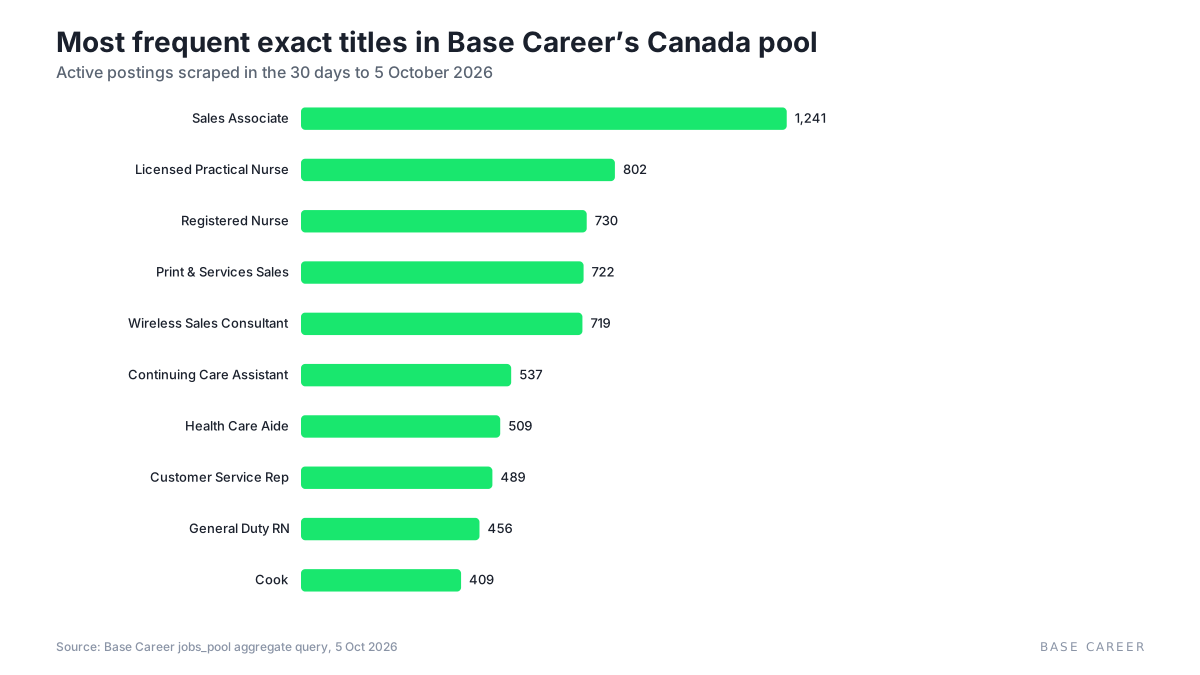
The distinction is essential: high posting volume does not show which employers will support an LMIA, which candidates are eligible, or which jobs remain open to applicants outside Canada. Use aggregate demand to choose a role lane, then use official immigration and Job Bank checks for sponsorship questions. For broader role and city planning, see Base Career’s Canada job-search guide.
Start with the official Job Bank filters
Canada’s Job Bank has a dedicated temporary-foreign-worker search. Its guidance says participating employers have already obtained or applied for an LMIA, and postings may distinguish between an LMIA that has been requested and one that has been approved. Those labels are not interchangeable. “Requested” means the application is under review; it is not proof of a positive decision. Open the Temporary Foreign Workers search.
If you are outside Canada, use the separate foreign-candidates guidance. Job Bank says applicants should focus on roles clearly identified as open to international candidates, check whether their qualifications require recognition and confirm whether they are eligible for the relevant work route before applying.
You can also review opportunities in the Base Career jobs directory, but do not infer LMIA support from a role’s presence there. Follow the employer’s direct application path and verify any sponsorship statement independently.
A practical verification sequence
1. Confirm that the job exists on an independent channel
Find the vacancy on the employer’s own careers site or an official Job Bank result. Compare the title, location, duties, employment type and application method. If the recruiter gives you a link, navigate to the employer independently rather than trusting the supplied domain. A copied logo and polished PDF do not prove that the company sent the offer.
2. Match the employer’s legal identity

“I kept getting rejections from London. Base Career rewrote my CV for Dubai, and I landed Emirates in 3 weeks.”
Sarah M. · Marketing Manager · UK 🇬🇧 → Dubai 🇦🇪
No credit card required
Check the operating name against the legal name shown in the offer and any public record. Use contact details from the employer’s established website—not the phone number inside a message—to ask whether the vacancy and recruiter are authorised. A genuine company can still be impersonated, so verifying that the business exists is necessary but not sufficient.
3. Read the Job Bank LMIA status literally
Do not rewrite “LMIA requested” in your notes as “LMIA approved.” Save the posting URL and the status shown when you applied. If the status changes, update your record. If a third party claims approval, ask the employer for the evidence needed for the work-permit process and compare every field rather than relying on a screenshot.
4. Check the positive-LMIA employer data carefully
Employment and Social Development Canada publishes a positive-LMIA employers dataset. It can help you compare an employer, occupation, programme stream and business location with historical positive decisions. But the dataset explicitly says it is not complete, excludes some personal-name employers and tracks positions on LMIAs rather than work permits issued or workers who entered Canada. It may also include positions later cancelled by an employer. Treat a match as supporting context, not final proof of your offer.
5. Check the non-compliant-employer list
IRCC maintains an official list of employers found non-compliant. It shows whether an employer received a penalty or a temporary ban and explains the status. Absence from this list does not certify an employer as trustworthy; presence provides a concrete reason to inspect the current status and terms more closely.
6. Make every document agree
The employer name, job title, work location, duties, wage, hours and route should align across the posting, interview discussion, offer, contract and LMIA material. Pause when a recruiter changes the company, occupation or location after you have paid attention to a different job. The safest evidence chain is consistent, independently reachable and specific.
Red flags that should stop the process
IRCC’s current scam guidance says nobody can guarantee a job or visa to Canada. It warns against guaranteed approvals, private payment requests, unusually high salaries, fake websites and messages that seek personal information through unverified channels. It also notes that realistic-looking content can be produced with generative AI. Review IRCC’s online and telephone scam guidance.
- Payment requested for the job itself, the LMIA, a guaranteed placement or faster approval.
- An offer without a credible interview or role-specific assessment.
- Pressure to send a passport, bank details or payment through a chat app before independent verification.
- A sender using a free email account while claiming to represent a recognised employer or government body.
- A salary or benefit package that is far outside the occupation and location without a credible explanation.
- An employer name, occupation, location or wage that changes between the advert and the paperwork.
- A promise that the job automatically guarantees a visa, work permit or permanent residence.
Job Bank’s temporary-worker guidance says the employer is not allowed to make the worker pay for the LMIA. The non-compliant-employer guidance also identifies charging or allowing recruitment fees as a compliance issue. If someone is selling access to an LMIA-labelled job, stop and verify through official channels before sharing money or sensitive documents.
Build a focused application, not an “LMIA” keyword dump
Start with one role family in which your experience is credible. Use the chart as a reminder that demand is specific: healthcare, sales, customer service and food-service titles appear differently and require different evidence. Do not send the same résumé to unrelated jobs simply because each advert mentions foreign workers.
- Choose a target title and province that fit your experience and any recognition requirements.
- Search Job Bank for international-candidate or temporary-worker postings and read the status label.
- Open the employer’s own careers site and confirm the same vacancy or recruitment channel.
- Tailor your résumé to the genuine duties and terminology without adding skills, licences or work rights you do not have.
- Record the URL, employer, contact domain, location, LMIA status and date checked.
- Apply through the verified path and keep the confirmation.
- If an offer arrives, repeat the employer, status, document and fee checks before taking the next step.
For an employer-specific permit, Canada’s current work-permit overview identifies a job offer as required, while an open work permit follows different eligibility rules. Use the official work-in-Canada hub to find the route that applies to you. Avoid taking route advice from a job advert or recruiter marketing page alone.
Protect your identity while you verify
A legitimate hiring process can require identity and immigration documents at the appropriate stage. The risk comes from sending them before you know who is receiving them and why. Confirm the employer’s domain, use a secure application portal, remove unrelated personal information and ask how documents will be used. Do not send banking credentials, one-time passcodes or payment-card details to prove that you are serious about a job.
Keep a simple evidence log: the page you used, the date you checked it, the person or team you contacted through an independent channel and the response. That record helps you spot contradictions and gives you a clearer basis for reporting a suspicious offer.
What to do when an offer fails a check
Pause the application. Do not accuse the contact based on one ambiguous signal; instead, verify through the employer and official channels. A missing historical match may have a benign explanation because the positive-LMIA dataset is incomplete. A requested LMIA may still be under review. But payment pressure, identity mismatch, unverifiable contact details or altered terms are reasons not to proceed until the inconsistency is resolved.
If you suspect an immigration scam, use the reporting links on IRCC’s fraud pages rather than confronting the sender or clicking more links in the message. Preserve the original email, domain, payment request and offer files without publishing personal details.
The bottom line
Canada LMIA jobs are best approached as a verification task. Start from a vacancy open to your candidate status, confirm the employer through an independent channel, read “requested” and “approved” accurately, understand the limits of historical employer data, and keep the job offer separate from the work-permit decision. A slower, evidence-led check is more useful than a large application count built on unverified promises.
Sources and methodology
External sources were accessed on 5 October 2026: IRCC’s LMIA help page; Job Bank’s Temporary Foreign Workers and Foreign Candidates pages; ESDC’s positive-LMIA employers dataset; IRCC’s non-compliant-employers list; IRCC’s online and telephone scam guidance; and IRCC’s Work in Canada hub. Base Career data came from one aggregate production query against self-hosted jobs_pool: active records with country CAN and date_scraped in the trailing 30 days, grouped by exact title. No individual job, user, résumé or application record was retrieved.
Frequently Asked Questions
Does “LMIA requested” mean the job is approved for a foreign worker?+
Does a positive LMIA guarantee my Canadian work permit?+
Can I use the positive-LMIA employer list to prove my offer is genuine?+
Should I pay a recruiter for an LMIA job?+
Where should candidates outside Canada search?+
Land 4x more interviews in 27 days. Join Base Career Today.
Track applications, tailor resumes, and follow up faster in one UAE job search system.
Start freeNo credit card required

James T.
Canada 🇨🇦 → Riyadh 🇸🇦
“50 applications, zero replies with my Canadian CV. Base Career got me 4 Riyadh interviews and a Series B offer.”
Written by Base Career Research Team
Produced by the Base Career Research Team with AI, using Base Career job-market data, and published automatically. How our articles are made
Related Posts

Is it Easy to Get a Job in Dubai From Overseas? The Honest Truth
Dreaming of a tax-free salary in Dubai but living abroad? We analyze the challenges of international applications and share a strategic roadmap for success.

Landing Your First Dubai Job: A Roadmap for Freshers and Graduates
Breaking into the UAE job market with zero experience is tough but not impossible. Here is your strategic roadmap to landing that first role in Dubai.